TL;DR
Claude Managed Agents is Anthropic's new hosted runtime for production agents. It gives you sandboxed execution, long-running sessions, scoped permissions, tracing, and optional multi-agent coordination without forcing your team to build that infrastructure from scratch. If your agent needs to call internal tools, third-party APIs, or long workflows, Apidog helps you validate those tool contracts before you let an agent touch real systems.
Introduction
Claude Managed Agents targets one of the biggest reasons agent projects stall: the runtime is harder to ship than the prompt. Anthropic now offers a hosted way to run long-lived agents with sandboxing, permissions, tracing, and session persistence built in, so teams can spend less time building plumbing and more time shipping useful workflows.
If you plan to expose internal APIs or tool endpoints to an agent, you should test that surface before launch. Apidog gives you a direct way to mock tool endpoints, validate JSON schema, chain multi-step test scenarios, and run regression checks in CI with Apidog CLI. That is a safer starting point than giving a new hosted agent live access and discovering contract bugs in production.
Why production agents are still hard to ship
A weekend demo agent is easy. A production agent is not.
Once you move past a single request and response, the hard parts show up fast:
- You need secure code execution for actions that generate files, transform data, or call custom scripts.
- You need state that survives network drops and browser refreshes.
- You need clear permission boundaries so an agent can read one system without silently editing another.
- You need traces for debugging because "the model did something weird" is not enough during an incident review.
- You need a way to retry failed steps without replaying the entire workflow from zero.
- You need predictable contracts for the APIs and tools the agent will call.
This is why many teams get stuck between prototype and launch. The model part keeps improving. The operational part still eats the schedule.
That pattern is familiar across agent products. Teams building coding assistants, research agents, meeting prep tools, and workflow automation all hit the same bottleneck: the runtime becomes a product of its own. Anthropic is trying to collapse that layer into a managed service.
What Claude Managed Agents includes
According to Anthropic's launch post, Claude Managed Agents combines a Claude-tuned orchestration harness with hosted production infrastructure. In practice, the launch introduces five capabilities that matter to API teams.
1. Hosted agent runtime
You define the job, tool access, and guardrails. Anthropic runs the loop on its own infrastructure. That removes a large amount of custom backend work for teams that would otherwise build a queue, sandbox worker, session layer, and execution controller.
This is the biggest value in the launch. Most teams can already call a model. What they do not have is a clean runtime for real work.
2. Long-running sessions
Anthropic says sessions can run for hours and persist outputs and progress even if the client disconnects. That matters for research tasks, large file generation, multi-step planning, or background operational work that does not fit inside a short interactive request.
If your agent writes reports, audits codebases, processes documents, or assembles deliverables from several systems, long-running sessions remove a major constraint. You stop designing around short chat windows and start designing around completed work.
3. Sandboxed execution and governance
The launch emphasizes secure sandboxing, authentication, identity, and scoped permissions. That is not a side detail. It is the difference between an interesting demo and an enterprise-ready system.
An agent that can open a pull request, generate a spreadsheet, or interact with finance data should never have broad access by default. Hosted governance lets you constrain what the runtime can do and gives security teams a clearer review surface.
4. Built-in tracing and troubleshooting
Anthropic says tool calls, decisions, analytics, and failure modes are visible in Claude Console. Good tracing shortens the gap between "something failed" and "here is the exact request, tool output, and branch that caused it."
That is especially useful when you are debugging tools instead of prompts. In many agent systems, the weakest link is the API contract around the tool, not the model itself.
5. Multi-agent coordination, in research preview
Anthropic also announced multi-agent coordination, where agents can direct other agents to parallelize work. This is still in research preview, so it is not the part of the launch I would center the article on. Still, it signals where the platform is going: from single workers to orchestrated teams of agents.
How this changes the architecture of an agent product
Before Managed Agents, a typical team had two choices.
Option A: Build the runtime yourself
This gives you maximum control. It also means you own:
- container or VM isolation
- tool execution lifecycle
- session persistence
- checkpointing
- secrets and credentials
- permissioning
- logs and traces
- retries and recovery
- ops maintenance after launch
This path still makes sense when you need unusual infrastructure, strict in-house hosting requirements, or deeply custom orchestration logic.
Option B: Use a managed runtime
This trades some control for speed. The runtime is already there, and your team can spend time on task design, UX, and tool quality instead of building plumbing.
That is why Anthropic frames Managed Agents as a way to get to production 10x faster. The launch post also says internal testing on structured file generation showed task success gains of up to 10 points over a standard prompting loop, with the biggest gains on harder problems.
The important shift is this: hosted agent infrastructure is becoming a product category, not a side project inside your stack.
Claude Managed Agents vs DIY agent infrastructure
| Decision area | Claude Managed Agents | DIY runtime |
|---|---|---|
| Time to first production launch | Fast, because the runtime is already hosted | Slower, because you build the runtime first |
| Sandboxing and governance | Built in | You own the full design |
| Long-running sessions | Built in | You build and maintain session state |
| Tracing | Available in Claude Console | You build your own observability layer |
| Flexibility | Good for the supported model and runtime pattern | Highest flexibility |
| Ongoing ops load | Lower | Higher |
| Best fit | Teams that want to ship agent products quickly | Teams with unusual infrastructure or strict custom runtime needs |
Here is the practical rule.
Choose Managed Agents if your team wants to ship an agent product this quarter and your core differentiator is the workflow, the UI, or the proprietary tools behind it.
Choose DIY if the runtime itself is part of your moat, you need full control over hosting and orchestration, or your security model requires deeper custom handling than a managed service can give you.
Pricing and tradeoffs you should understand
Managed Agents uses standard Claude Platform token pricing plus $0.08 per active session-hour. That makes sense for agents that are doing real work over time, but it changes the way you should think about cost.
With a normal chat API workflow, cost mostly comes from tokens. With a managed runtime, cost comes from tokens plus elapsed active runtime. That means you should design agents to finish work cleanly, fail fast on bad inputs, and avoid pointless loops.
Three questions matter before you adopt it:
- How often will a session run for minutes versus hours?
- How much value does one completed run create for the user?
- Which tasks should stay synchronous, and which should move into background execution?
If the answer is "our agent mostly does short deterministic calls," a normal API integration may still be enough.
If the answer is "our agent researches, writes, patches, coordinates tools, and returns a deliverable later," the managed runtime starts to look much more attractive.
How to test agent tool APIs with Apidog before launch
This is where the article needs to be specific.
The weak point in many agent launches is not the model. It is the tool layer. If your agent can call search_customers, create_invoice, open_pr, or send_slack_message, every one of those tools is an API contract. You need to know what happens when the payload is malformed, the schema drifts, a required field disappears, or the auth token has the wrong scope.
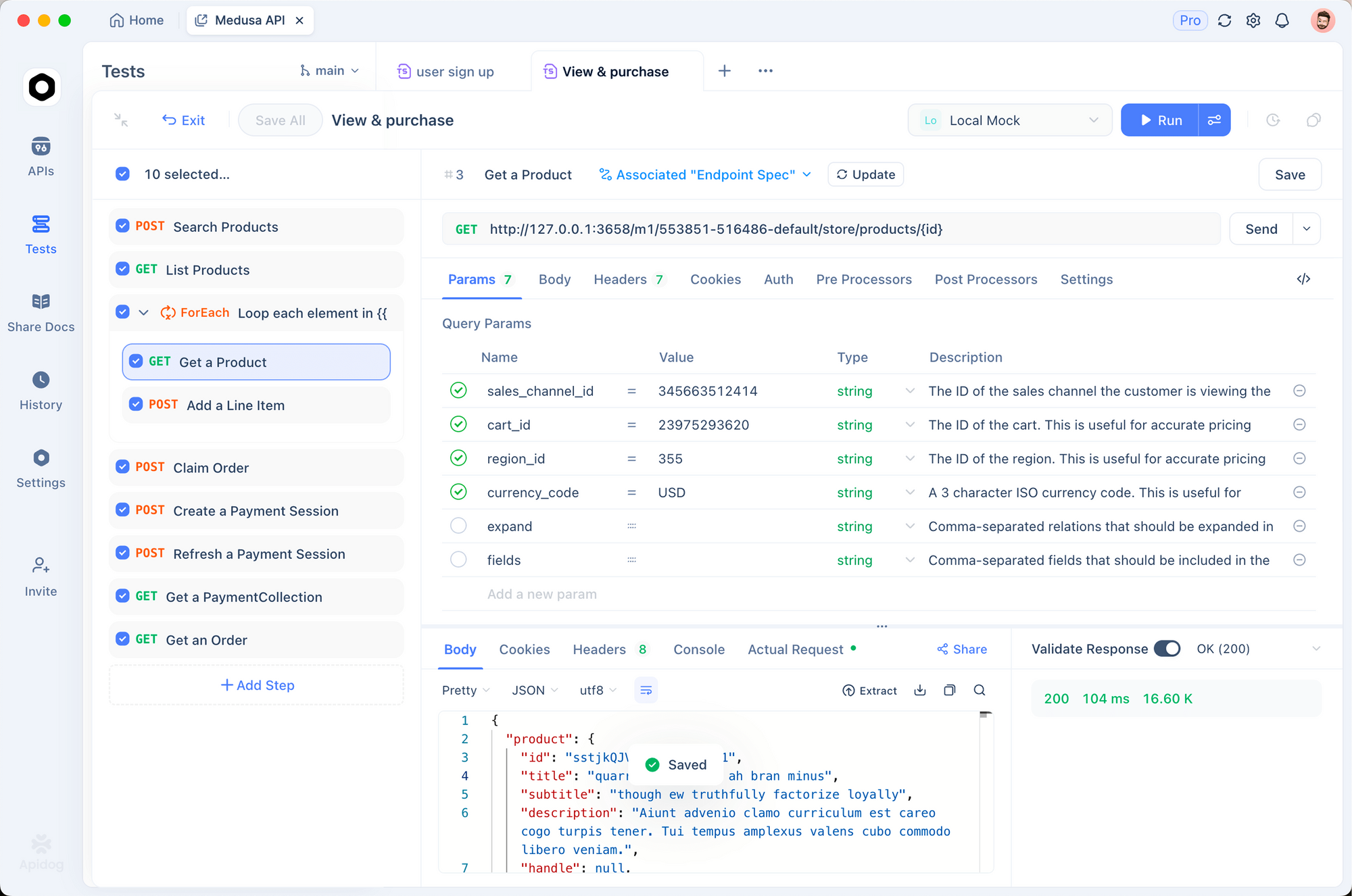
Apidog fits this workflow well because you can model the tool contracts before the agent hits production.
Use Smart Mock to stand up tool endpoints early
Smart Mock generates realistic responses directly from your API spec and respects JSON Schema constraints. That gives your team a fast way to stand up fake tool endpoints while the real backend is still changing.
For agent work, that matters because you can test planning and tool selection before every downstream service is ready. If your managed agent expects a ticket_priority, account_id, or status enum, Smart Mock can return data that matches the schema instead of hand-written placeholders that hide bugs.
See also API Testing Without Postman in 2026 if you are standardizing this workflow across the team.
Build multi-step Test Scenarios for agent workflows
Apidog Test Scenarios are useful when one tool call feeds the next. The docs describe support for sequential execution, data passing between requests, flow control, predefined test data, and CI/CD integration.
That maps neatly to agent systems.
A realistic validation flow might look like this:
- Mock or call
POST /tasks - Extract the returned
task_id - Call
GET /tasks/{task_id} - Assert status transitions
- Trigger an error branch with invalid credentials
- Verify the agent-facing error payload stays within contract
This kind of scenario catches tool bugs before the agent runtime has to recover from them in production.
Validate contract drift before it breaks the agent
Agents are sensitive to schema drift. A renamed field, a looser enum, or a missing nested property can break a tool chain in ways that look like reasoning failures.
Use Apidog to lock down request and response shapes with OpenAPI and JSON Schema, then run scenario-based checks when the backend changes. If your team uses generated tool definitions, this is even more important because the agent will trust the spec you give it.
Add CLI checks to CI for regression coverage
Apidog CLI can run test suites from the command line and output reports, including HTML reports in the generated apidog-reports/ directory. That makes it a good fit for pre-merge or pre-deploy checks on agent tools.
A simple policy is enough:
- every tool endpoint needs a schema check
- every write action needs at least one auth failure test
- every long-running workflow needs a timeout and retry case
- every high-risk tool needs one negative test for bad state
When you do that, your managed agent enters production with a cleaner tool surface.
A simple architecture pattern to start with
You do not need a huge agent platform on day one. A simple pattern is enough.
User request
  -> Claude Managed Agent session
  -> tool selection
  -> internal APIs and third-party services
  -> result artifact or action
  -> trace review in Claude Console

Before launch:
  Apidog spec -> Smart Mock -> Test Scenarios -> CLI regression in CI
This split is healthy.
Let Claude Managed Agents handle runtime concerns such as session management, hosted execution, and orchestration. Let Apidog handle API contract design, mocks, testing, and regression checks around the tools your agent depends on.
That keeps the model layer and the API quality layer separate, which is exactly what most teams need.
When this launch matters most
Claude Managed Agents is most interesting for five groups:
- teams building coding or debugging agents
- teams running document or research workflows that take more than a few minutes
- product teams that want background task execution inside an app
- enterprise teams that need governance, tracing, and scoped permissions
- API teams that already have internal tools and want a faster route to agent products
If your team is still proving the use case, start with a narrow workflow and a small tool surface.
If the use case already works and infrastructure is the bottleneck, this launch is worth serious attention.
Conclusion
Claude Managed Agents is not just another model feature. It is Anthropic's attempt to productize the messy part of agent delivery: hosted execution, persistence, governance, and tracing.
That is why this launch matters. It shifts the build question from "how do we create an agent runtime" to "which workflows deserve an agent, and how safe are the tools behind it?"
That second question is where Apidog fits. Before you expose an internal API to a long-running hosted agent, model the contract, mock the responses, test the failure paths, and add regression coverage in CI. That work gives the agent a cleaner surface to operate on and gives your team fewer surprises after launch.
FAQ
What is Claude Managed Agents?
Claude Managed Agents is Anthropic's hosted runtime for cloud-based agents on the Claude Platform. It includes sandboxed execution, long-running sessions, tracing, scoped permissions, and hosted orchestration.
Is Claude Managed Agents available now?
Yes. Anthropic announced it as a public beta on April 8, 2026. Some features, such as multi-agent coordination and self-evaluation loops, are still in research preview.
How is Claude Managed Agents priced?
Anthropic says standard Claude Platform token pricing applies, plus $0.08 per active session-hour.
When should you use Managed Agents instead of building your own runtime?
Use Managed Agents when speed to production matters more than deep runtime customization. If your team needs unusual hosting, strict in-house control, or custom orchestration that a managed platform cannot support, DIY may still be the better fit.
Why should API teams test agent tools separately?
Because many agent failures come from broken tool contracts, auth issues, or schema drift instead of poor reasoning. Testing tools separately helps you catch those failures before they reach the runtime.
How can Apidog help with agent tool testing?
Apidog helps you define the tool contract, generate mocked responses from the schema with Smart Mock, chain multi-step validations with Test Scenarios, and run regression checks in CI with Apidog CLI.