In the rapidly expanding universe of Generative AI, the Model Context Protocol (MCP) has emerged as the critical standard for connecting Large Language Models (LLMs) to external data and tools. But building an MCP server is only half the battle; ensuring it responds accurately, securely, and efficiently to AI agents is where the real challenge lies.
To help you navigate this landscape, we have curated the ultimate list of tools for testing MCP servers. Whether you are debugging a local script or deploying a complex enterprise agent, these tools are essential for your stack.
1. Apidog MCP Client — The Ultimate Solution for Testing MCP Server
The Best All-in-One MCP Server Testing Platform
When it comes to tools for testing MCP servers, Apidog stands out as the premier choice for developers who demand efficiency and depth. While many tools offer basic debugging, Apidog provides a comprehensive ecosystem that streamlines the entire lifecycle of MCP development.
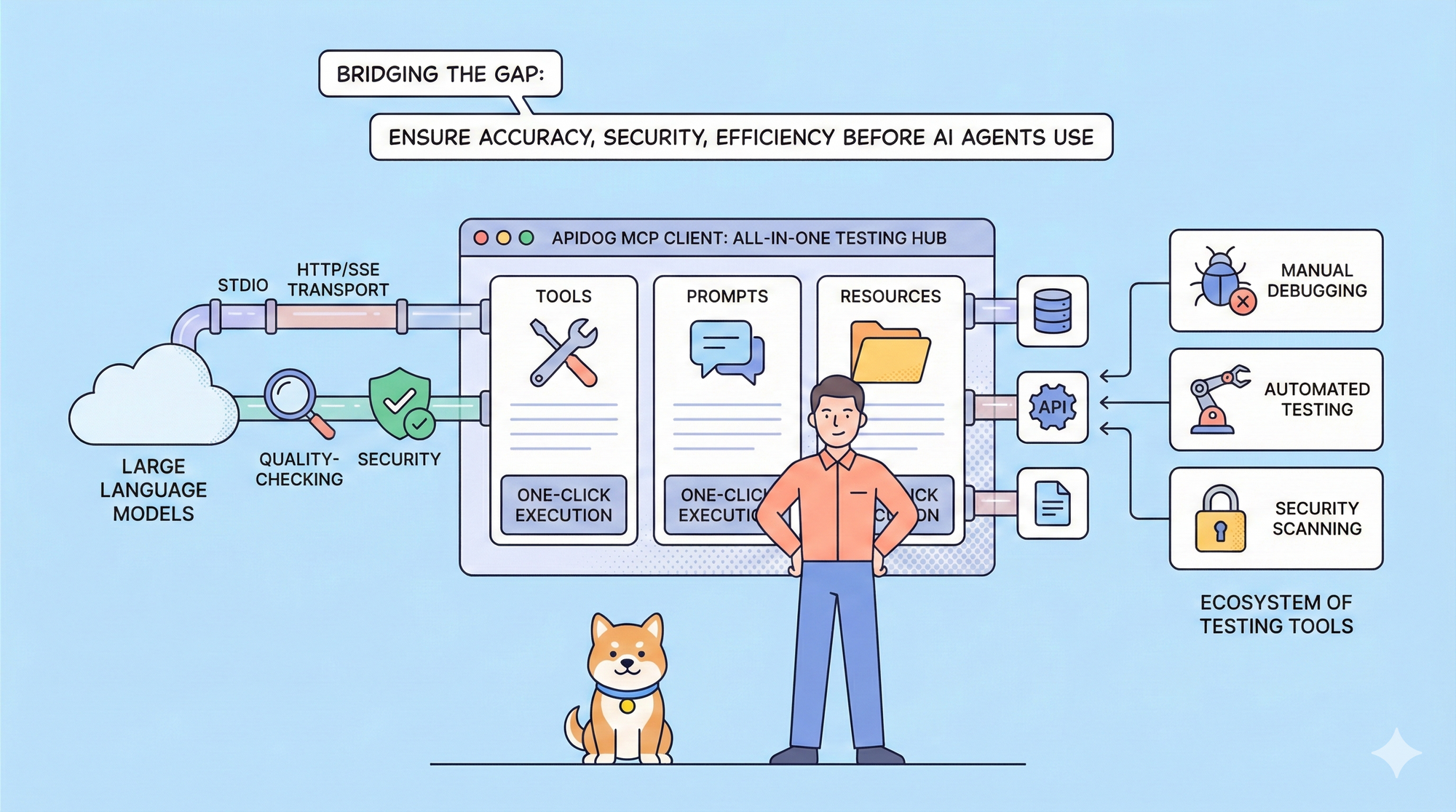
Apidog's built-in MCP Client allows you to debug and test MCP servers with a level of granularity that standard CLIs cannot match. It supports both STDIO (for local processes) and HTTP/SSE (for remote servers) transport layers, making it versatile for any stage of development.
Key Features:
- Visual Debugging: Connect to your server and instantly visualize the directory tree of available Tools, Prompts, and Resources. No more guessing if your server is registering capabilities correctly.
- One-Click Execution: Run server-side tools directly from the UI with custom parameters. Apidog validates your inputs against the schema automatically.
- Transport Flexibility: Seamlessly switch between testing a local
stdioserver and a deployedhttpendpoint without changing tools. - Security & Auth: Built-in support for complex authentication flows, including OAuth 2.0, ensuring your MCP Server testing tools cover security requirements.
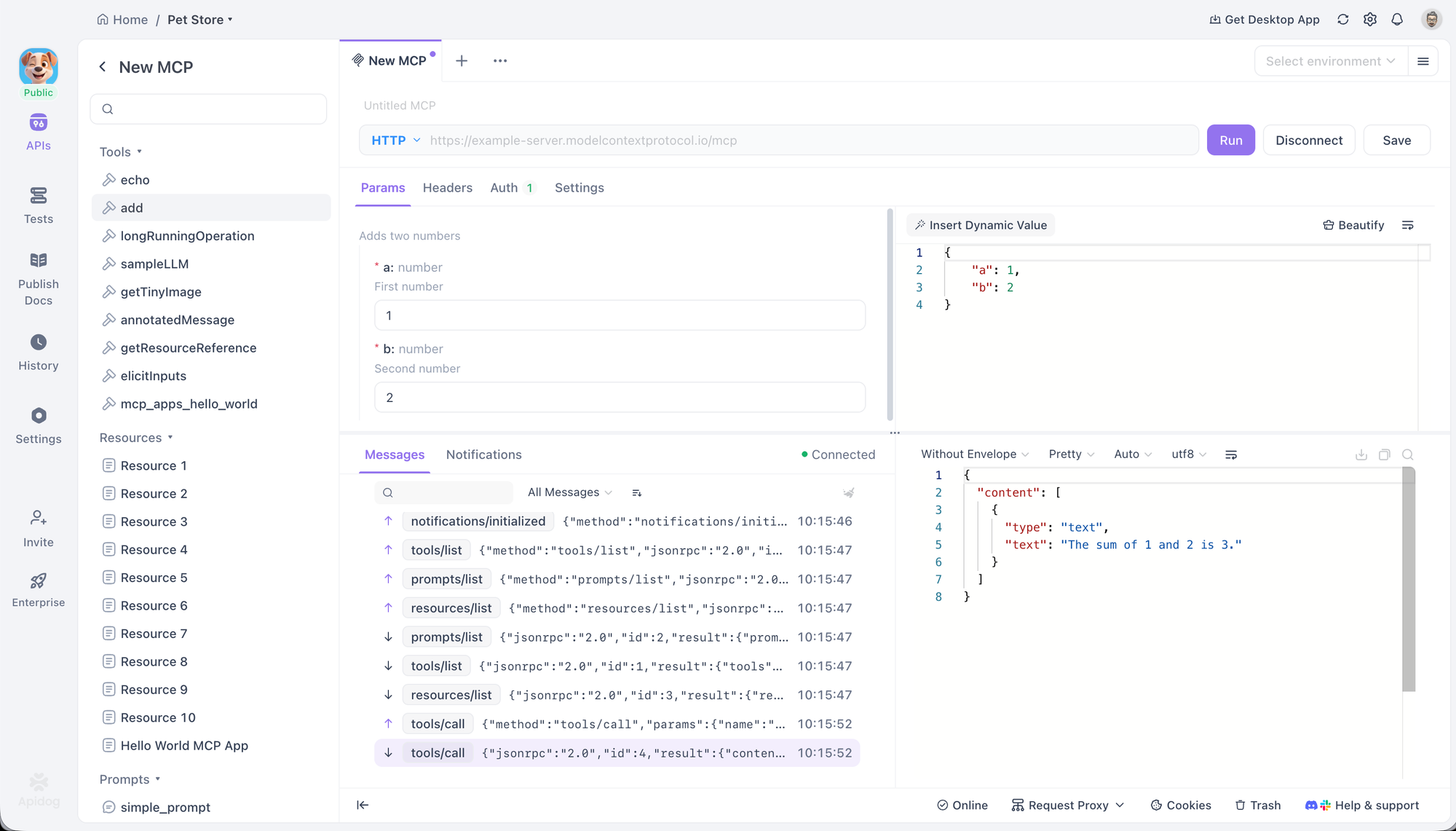
If you want to delve into professional-grade MCP development, Apidog is your starting point.
2. MCP Inspector
The Primary Tool for Manual Debugging
The MCP Inspector is the "Swiss Army knife" of MCP clients to test MCP Server implementations. Developed by the core MCP team, it runs in your browser and connects directly to your local server. It is invaluable for inspecting the raw JSON-RPC messages flowing between the client and server. If you need to verify that your server is strictly adhering to protocol specs, the Inspector is your go-to utility.
- Best for: Real-time message inspection and schema validation.
- Key Feature: Interactive "playground" to test tool calls and resource reads.
3. Claude Desktop
Real-World Host for End-to-End Testing
While synthetic tests are useful, nothing beats seeing how an actual AI agent interacts with your tool. Claude Desktop acts as a production-grade MCP Client to test MCP Server behavior in the wild. By configuring your local MCP server in Claude's settings, you can chat with the model and watch it "decide" to use your tools. This reveals subtle issues in your tool descriptions—if Claude is confused, your users will be too.
- Best for: Testing "agentic" behavior and prompt effectiveness.
- Insight: Use this to refine how you describe your tools to the LLM.
4. mcp-server-tester
AI-Driven CLI for Automated Test Generation
mcp-server-tester brings the power of AI to your testing pipeline. Instead of writing boilerplate test cases, this CLI tool analyzes your MCP server's capabilities and auto-generates test scenarios. It helps you indulge in a faster workflow by creating rapid feedback loops, ensuring that new changes don't break existing functionality.
5. FastMCP Client
Best for High-Speed In-Memory Unit Testing
Speed is critical in CI/CD pipelines. FastMCP Client is designed for unit testing where network latency is a bottleneck. By mocking the transport layer and testing your server logic in-memory, it allows you to run thousands of assertions in seconds. It is a vital MCP Server testing platform component for developers practicing TDD (Test Driven Development).
6. mcp-testing-kit
Node.js Utility for Structured Assertions
For teams that prefer code-first testing, the mcp-testing-kit offers a robust library of assertions specifically for MCP. It simplifies the process of validating complex JSON payloads and ensuring that your server's responses match the expected schema structure.
7. Promptfoo MCP Scanner
Security Red-Teaming Against Injection Attacks
Promptfoo has extended its reputation in LLM eval to MCP. The MCP Scanner acts as a red-teamer, bombarding your server with adversarial inputs designed to trick the agent or exploit vulnerabilities. It is crucial for identifying "prompt injection" risks where an attacker might manipulate the tool's output to hijack the conversation.
8. Invariant Labs MCP-Scan
Focuses on Preventing Tool Manipulation
Invariant Labs MCP-Scan takes a deep dive into the logic of your tools. It analyzes the flow of data to prevent unauthorized tool manipulation, ensuring that an agent cannot be coerced into performing actions outside its permission scope.
9. mcp-tef
Validating the Quality of Tool Descriptions
Security is also about clarity. mcp-tef validates that your tool descriptions are precise and unambiguous. Ambiguous descriptions are a security risk because they lead to unpredictable model behavior. This tool ensures your MCP Server testing tools stack includes semantic validation.
10. Postman
Standard for Testing HTTP/SSE Transport Layers
For MCP servers running over HTTP/SSE, Postman remains the gold standard. You can craft collections that simulate client requests, validate headers, and check SSE stream stability. It’s perfect for testing the "plumbing" of your server before you even connect an AI agent.
11. JMeter
Concurrency and Stress Testing
JMeter is the heavy lifter for load testing. If you expect your MCP server to handle concurrent requests from thousands of agents, JMeter can simulate that traffic. It helps you identify memory leaks and latency spikes that only appear under load.
12. Cursor
IDE Host to Test Agent Tool Selection
Cursor, the AI-first code editor, doubles as an excellent testing environment. By integrating your MCP server, you can see how an AI coding assistant interacts with your custom tools while you write code. It provides a unique "developer experience" lens on your server's performance.
Conclusion
The ecosystem of tools for testing MCP servers is maturing rapidly. While standard tools like the MCP Inspector and Postman provide essential debugging capabilities, adopting a dedicated platform like Apidog transforms the experience. Apidog not only simplifies connection and visualization but acts as a complete MCP Server testing platform that bridges the gap between manual debugging and automated reliability.
By combining Apidog with specialized security scanners like Promptfoo and performance beasts like JMeter, you can build MCP servers that are not just functional, but enterprise-ready. Don't let your AI agent fail because of a buggy tool—equip yourself with the right testing stack today.