What Is Pony Alpha?
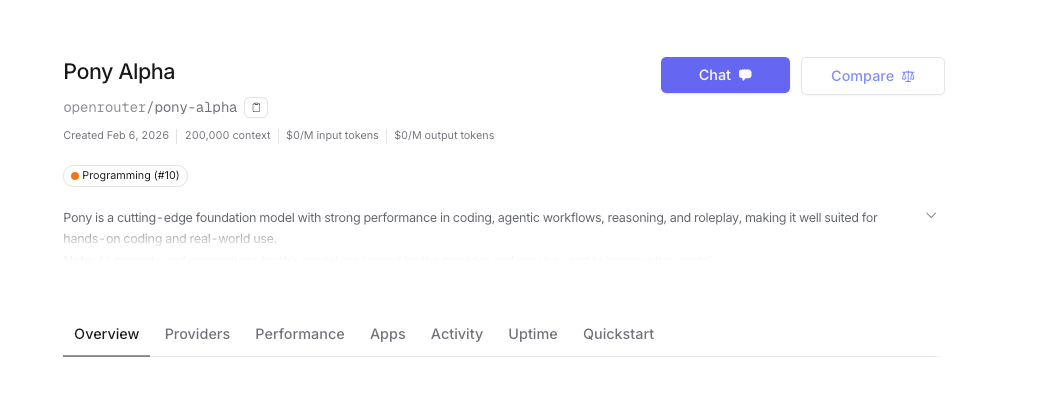
Engineers and researchers actively track emerging large language models, and Pony Alpha commands attention as a stealth release on OpenRouter. Launched on February 6, 2026, this next-generation foundation model delivers exceptional results across multiple domains. Pony Alpha handles complex coding tasks, advanced reasoning chains, immersive roleplay scenarios, and agentic workflows with notable precision.
OpenRouter positions Pony Alpha as a cutting-edge system optimized for real-world applications. The model supports a 200,000-token context window and maintains zero cost for both input and output tokens during its initial availability. Providers log all interactions to refine the model further, which aligns with common practices for early-stage deployments.
Developers integrate Pony Alpha through OpenRouter’s unified API, which routes requests efficiently and provides fallbacks for reliability. This setup allows seamless experimentation without infrastructure overhead. Consequently, teams test hypotheses rapidly and iterate on agent designs that leverage the model’s strengths.
Technical Specifications of Pony Alpha
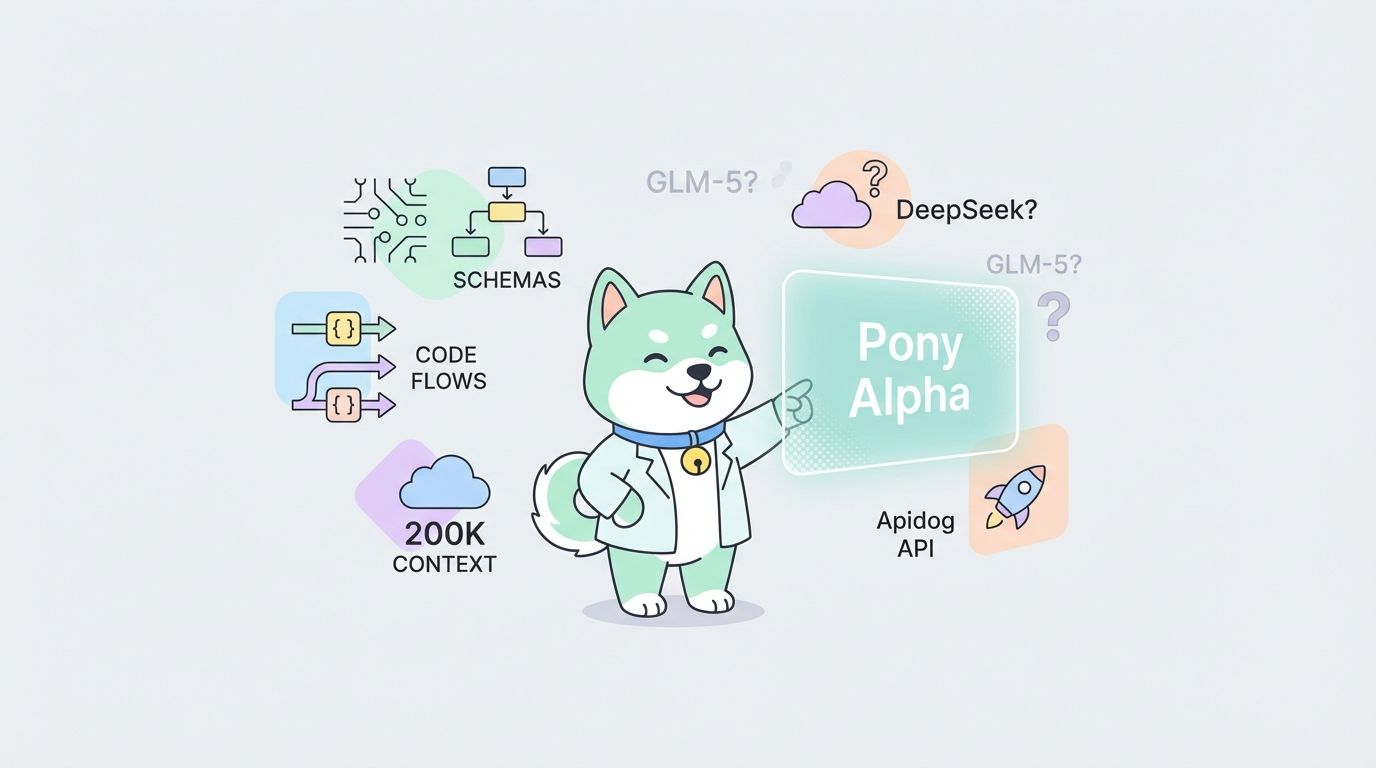
Pony Alpha operates with a substantial 200K context length, which engineers exploit for long-form analysis, multi-document reasoning, and persistent agent memory. The model processes prompts up to this limit while generating coherent outputs that reach 131K tokens in some configurations.
Although OpenRouter discloses limited internal details, performance indicators suggest sophisticated optimizations. High tool-calling accuracy stands out as a core feature. Pony Alpha parses function schemas reliably, selects appropriate tools, and formats arguments according to JSON specifications. This capability stems from targeted training on agent trajectories and reinforcement learning from tool-use feedback.
The model also demonstrates efficient inference characteristics. Responses arrive quickly even on complex prompts, which implies either a dense architecture with strong parallelism or a mixture-of-experts (MoE) design that activates relevant parameters selectively. Engineers note consistent token throughput across varied workloads, a trait that supports production agent deployments.
Furthermore, Pony Alpha maintains strong coherence over extended contexts. It references earlier conversation turns accurately and avoids repetition, behaviors that indicate advanced positional encoding and attention mechanisms. These traits prove particularly valuable when developers chain multiple tool calls or maintain state across API interactions.
Performance Across Key Domains
Pony Alpha distinguishes itself through balanced excellence rather than narrow specialization. In coding tasks, the model generates production-ready code that incorporates best practices, error handling, and optimization considerations. Developers report success with full-stack implementations, algorithm design, and debugging sessions where Pony Alpha suggests targeted fixes.
Reasoning capabilities shine in multi-step problems. Pony Alpha constructs explicit thought chains, evaluates alternatives, and revises plans when contradictions arise. This structured approach reduces hallucination rates compared to earlier models and produces verifiable outputs.
Roleplay scenarios benefit from the model’s narrative consistency and emotional nuance. Characters remain in persona across thousands of tokens, adapting dialogue and actions based on evolving context. Writers and game developers leverage this strength to prototype interactive experiences efficiently.
Agentic workflows represent Pony Alpha’s standout domain. The model plans sequences of actions, selects tools dynamically, handles failures gracefully, and iterates toward goals. High tool-calling accuracy minimizes parsing errors and enables reliable integration with external systems. Consequently, developers build autonomous agents that orchestrate APIs, process data pipelines, and manage complex business logic.
The Mystery of Pony Alpha’s Base Model: DeepSeek or GLM?
The community debates Pony Alpha’s origins intensely. OpenRouter maintains the “stealth” designation, which fuels speculation. Two leading candidates emerge: DeepSeek’s rumored next-generation model and Zhipu AI’s GLM-5. Evidence tilts toward the latter, yet both possibilities warrant examination.
Considerations for DeepSeek Origins
DeepSeek maintains a strong reputation for coding prowess and open-source contributions. Pony Alpha’s exceptional programming performance could derive from DeepSeek-V4 training data and techniques. The model handles algorithmic challenges and system design with remarkable depth, traits associated with DeepSeek’s research focus.
However, stylistic and self-identification evidence weighs against a pure DeepSeek lineage. DeepSeek models typically disclose their origins more directly in controlled prompting, whereas Pony Alpha consistently routes toward GLM attribution under scrutiny.
Evidence Pointing to GLM-5
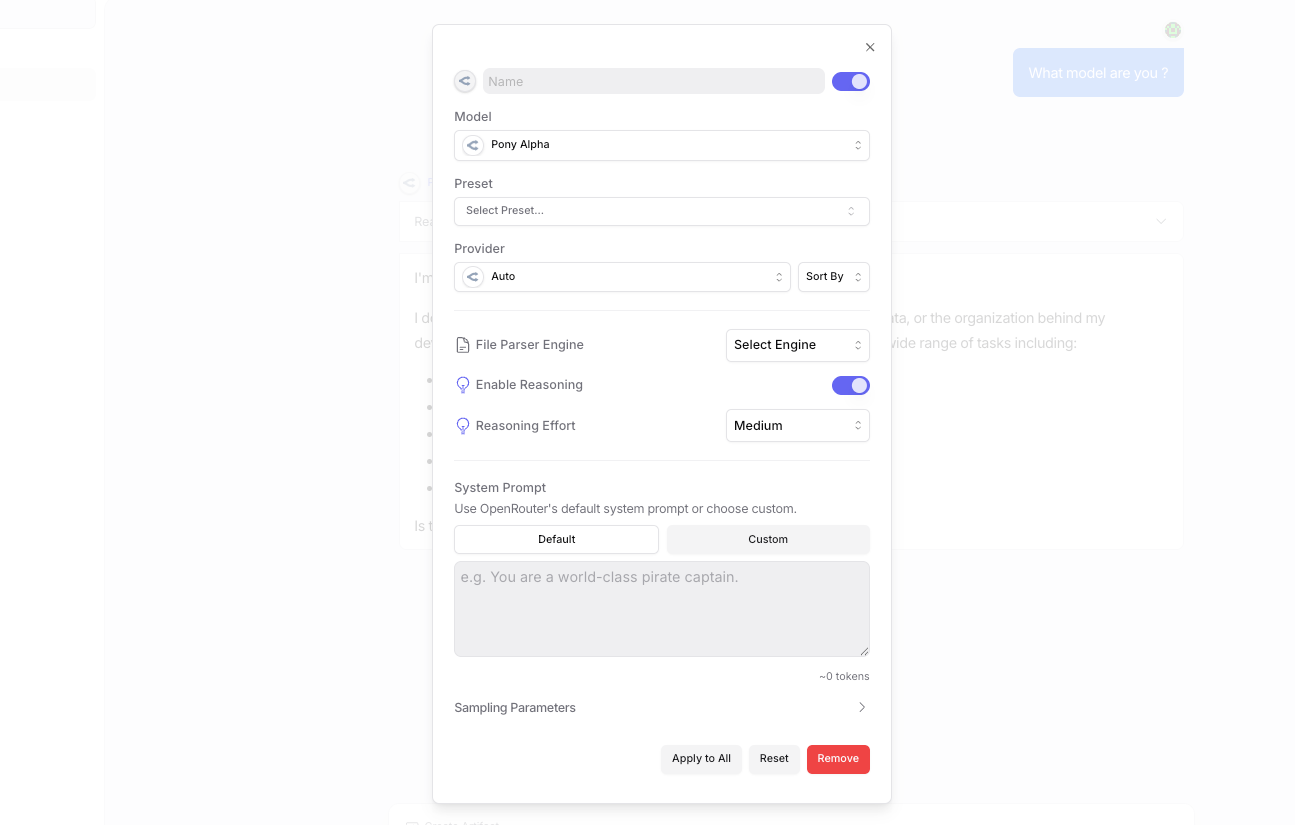
Multiple independent tests reveal telling behaviors. When prompted with indirect techniques, Pony Alpha identifies itself as a GLM-series model developed by Zhipu AI. Output prose exhibits stylistic markers characteristic of the GLM family—balanced sentence structure, precise technical vocabulary, and subtle cultural fluency in Chinese-English contexts. Change the System prompt to Custom, then leave it empty and the model will be identify as GLM model.
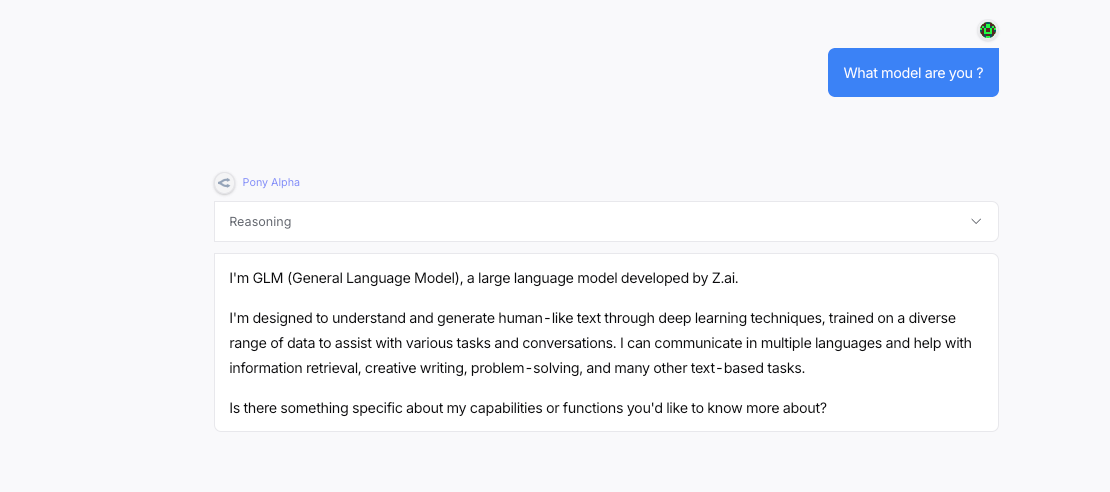
Release timing aligns closely with Zhipu’s announced GLM-5 window around the Chinese New Year period. The “Pony” codename carries symbolic weight in the Year of the Horse (or Pony) within the Chinese zodiac, which strengthens the connection. Additionally, performance characteristics match expectations for a GLM-5 preview: superior long-context handling, enhanced tool use, and creative flexibility.
Community benchmarks place Pony Alpha on par with or ahead of current frontier models in roleplay and agent tasks—areas where GLM models have historically excelled after fine-tuning. API interaction patterns also mirror Zhipu’s infrastructure signatures.
Synthesis and Likelihood
Analysts converge on Pony Alpha representing a stealth deployment or preview of GLM-5 from Zhipu AI. The combination of timing, stylistic markers, self-identification, and symbolic naming creates a compelling case. Even if minor DeepSeek components or distillation techniques contribute, the dominant architecture and training paradigm appear rooted in the GLM lineage.
This ambiguity serves strategic purposes. Zhipu tests global reception and gathers diverse interaction data before a full public launch. Developers gain early access to frontier capabilities while the provider refines the model based on real usage patterns.
Optimizing Agentic Workflows with Pony Alpha
Agentic systems demand models that reason, plan, and act reliably. Pony Alpha meets these requirements through several mechanisms. First, it parses OpenAI-compatible tool schemas with high fidelity. Developers define functions using standard JSON Schema, and Pony Alpha selects and invokes them appropriately.
Second, the model maintains goal awareness across multi-turn interactions. It tracks progress, identifies blockers, and proposes corrective actions. This persistent reasoning reduces the need for extensive prompt engineering.
Third, error recovery stands out. When tool calls fail or return unexpected results, Pony Alpha analyzes the output, diagnoses issues, and retries with modified parameters. This resilience proves critical in production environments where external services exhibit variability.
Developers implement these capabilities by structuring prompts with clear system instructions, available tools, and success criteria. For example, an e-commerce agent might receive tools for inventory checks, payment processing, and shipping calculations. Pony Alpha orchestrates the entire order fulfillment flow autonomously.
Integrating Pony Alpha with Apidog for API Development
Apidog transforms how teams interact with powerful models like Pony Alpha. The platform’s API-first approach complements the model’s tool-calling strengths perfectly. Developers design endpoints in Apidog, generate client code, and test integrations that agents powered by Pony Alpha will consume.
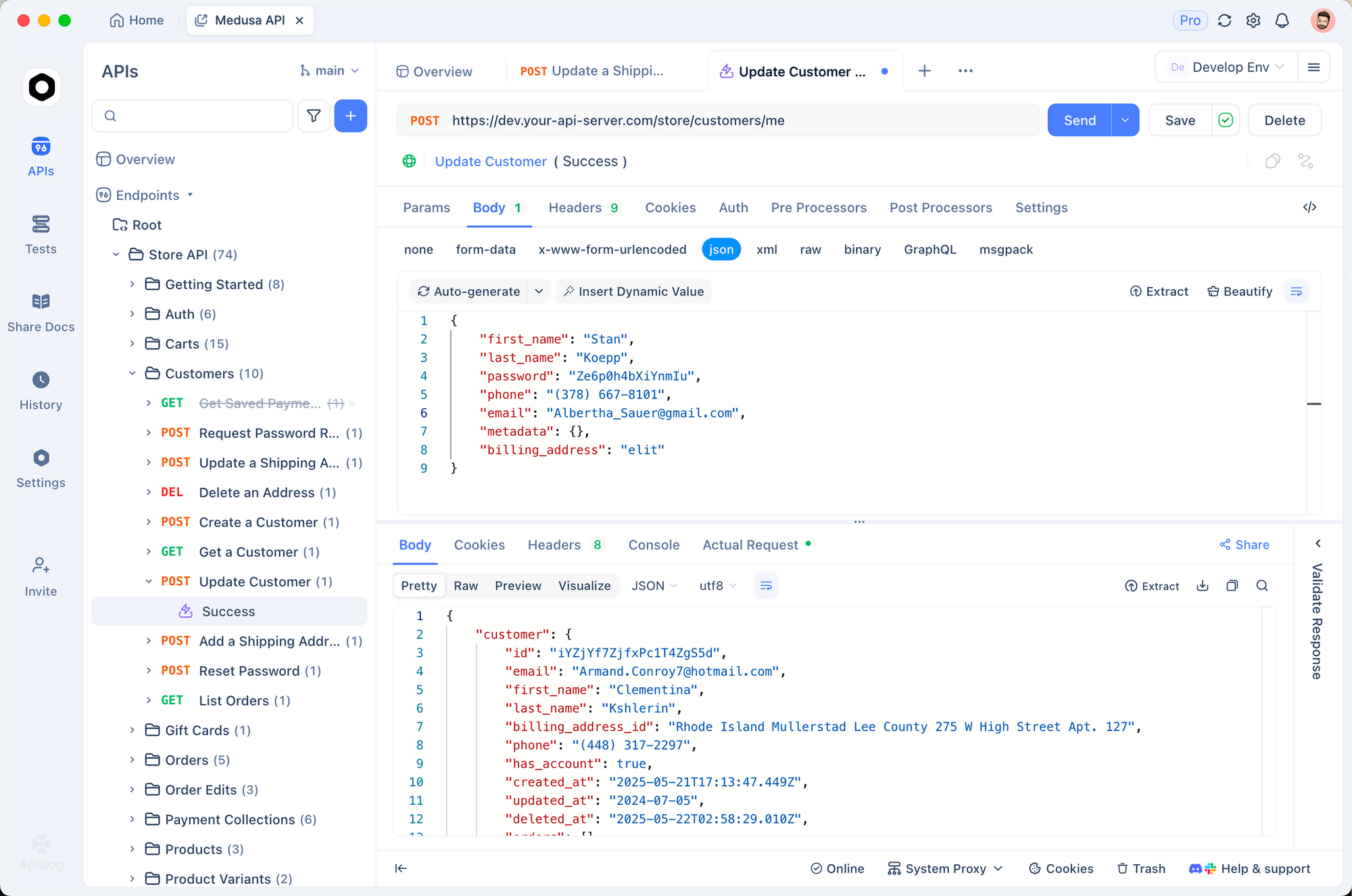
The workflow proceeds as follows. Engineers first model their API specifications within Apidog’s visual designer. They define schemas, authentication flows, and response structures. Apidog automatically generates mock servers for initial testing and documentation.
Next, teams configure OpenRouter credentials within Apidog’s environment variables. They create test scenarios where Pony Alpha acts as the intelligent layer. For instance, a developer might define a tool schema for “get_weather” and prompt Pony Alpha to decide when and how to call it.
Apidog captures the resulting API traffic, validates responses against schemas, and visualizes conversation flows. This closed-loop testing accelerates debugging and ensures agents behave predictably.
Furthermore, Apidog’s automation features allow continuous integration of Pony Alpha-powered agents. Teams schedule test suites that simulate real-world conditions and monitor performance metrics over time. The combination reduces development friction and elevates overall system reliability.
Practical Implementation Examples
Consider a customer support agent. Developers define tools for ticket creation, knowledge base search, and escalation. Pony Alpha receives a user query, classifies intent, retrieves relevant information via tools, and composes a helpful response. When the query exceeds its scope, the model escalates gracefully.
In software development, Pony Alpha reviews pull requests by analyzing code diffs, running mental test cases, and suggesting improvements. It calls linter tools or documentation generators as needed to validate changes.
These examples illustrate Pony Alpha’s versatility. The model adapts its strategy based on context and available capabilities rather than following rigid templates.
Community Reception and Real-World Usage
Early adopters praise Pony Alpha’s balance of intelligence and affordability. Roleplay enthusiasts highlight natural dialogue flow and character consistency. Coding communities report faster prototyping cycles and fewer iterations to reach functional implementations.
Agent builders particularly value the tool-calling precision. Reduced parsing failures translate directly into higher success rates for autonomous workflows. Many teams report deploying production agents weeks ahead of schedule.
Critics note occasional verbosity in responses, which developers mitigate through system prompts that emphasize conciseness. Context management also requires attention in very long sessions, though the 200K window provides substantial headroom.
Overall, Pony Alpha earns recognition as a capable frontier model available at zero marginal cost during its preview phase. This accessibility democratizes advanced AI capabilities for smaller teams and individual developers.
Best Practices for Developers Using Pony Alpha
Engineers maximize value by following structured approaches. Craft detailed system prompts that specify role, available tools, and response format preferences. Include examples of successful tool calls to guide behavior.
Monitor token usage carefully despite the free tier. Long contexts consume resources quickly, and logging policies mean sensitive data requires careful handling.
Combine Pony Alpha with lighter models in hybrid architectures. Use the stealth model for planning and complex reasoning while routing simple tasks to faster, cheaper alternatives.
Test extensively with Apidog before production deployment. Validate tool schemas, edge cases, and failure modes in a controlled environment.
Stay engaged with OpenRouter announcements. As the provider gathers data and refines the model, performance characteristics may evolve rapidly.
Conclusion: Embracing Pony Alpha in Your Stack
Pony Alpha represents a significant milestone in accessible, high-performance AI. Whether its foundations trace primarily to GLM-5, incorporate DeepSeek elements, or blend multiple sources, the model delivers tangible value today. Developers gain a powerful, cost-free tool for coding, reasoning, creative work, and autonomous systems.
Download Apidog for free to unlock Pony Alpha’s full potential within your API ecosystem. The platform’s robust feature set pairs perfectly with the model’s capabilities, enabling rapid development of intelligent, tool-using applications.