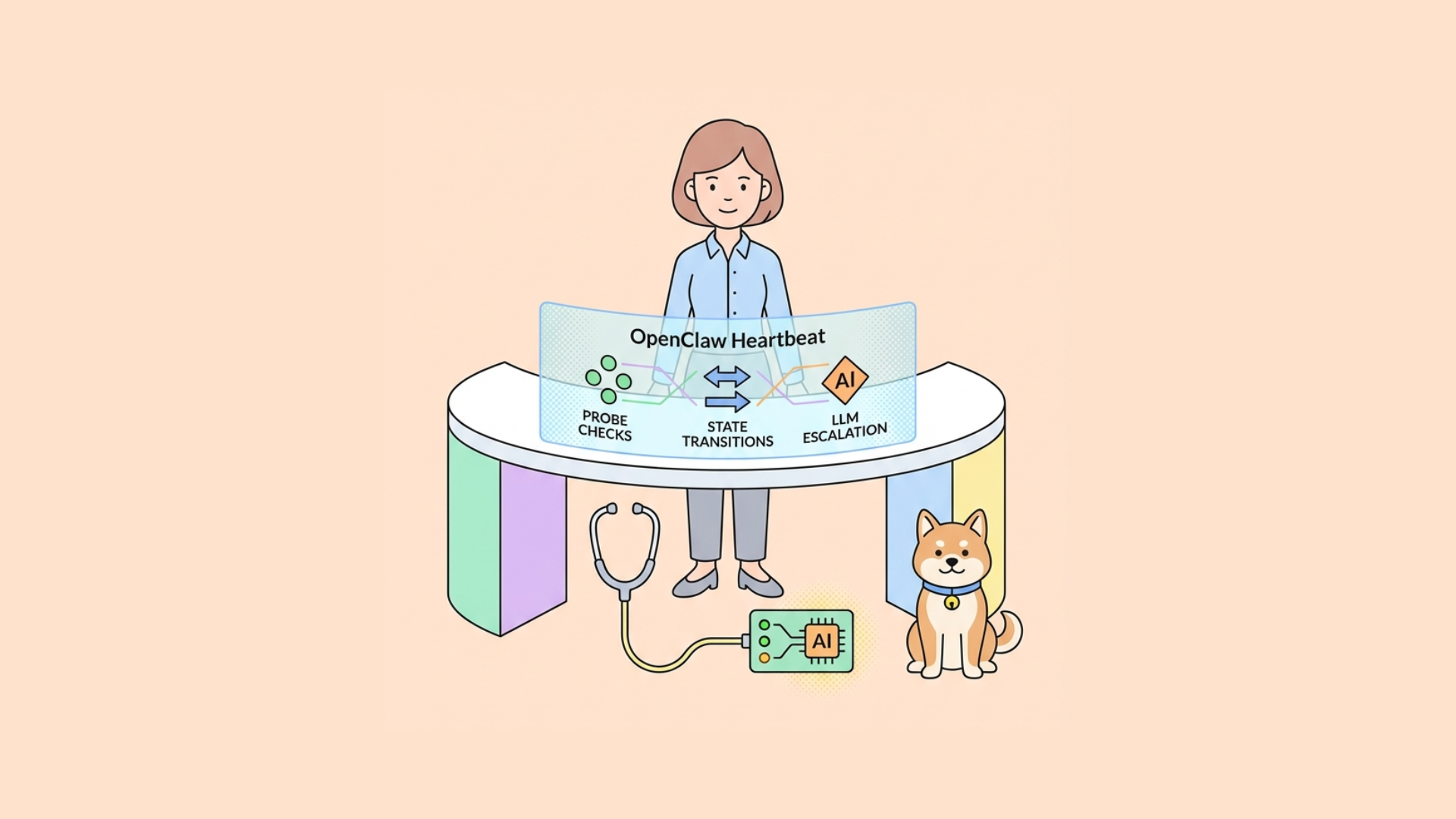
OpenClaw (formerly Moltbot/Clawdbot) became popular fast because it focuses on practical local automation: watch your machine, detect drift, and act before problems pile up. The heartbeat feature is central to that promise.

A heartbeat is a periodic health and state signal. In OpenClaw, it does more than uptime pings. It runs a layered decision pipeline:
- Cheap deterministic checks first (process, files, queue depth, API status)
- Rule evaluation against thresholds and policies
- Optional model escalation only when ambiguity remains
This “cheap checks first, models only when needed” pattern is exactly what developers asked for in recent community discussions: better cost control, more predictable behavior, and fewer unnecessary LLM calls.
If you are building agent infrastructure, this is the key idea: heartbeats are control-plane primitives, not just monitoring events.
OpenClaw heartbeat architecture in one view
At runtime, OpenClaw heartbeats are typically implemented as a loop with five stages:
- Scheduler triggers heartbeat ticks (for example every 15s/30s/60s).
- Probe runner executes deterministic probes.
- Policy engine computes state transitions and severity.
- Escalation gate decides whether an LLM/tool planner is needed.
- Action dispatcher emits alerts, remediation tasks, or no-op.
A practical event envelope looks like this:
{
  "agent_id": "desktop-a17",
  "heartbeat_id": "hb_01JX...",
  "ts": "2026-02-11T10:18:05Z",
  "probes": {
    "cpu_load": 0.72,
    "disk_free_gb": 21.4,
    "mail_queue_depth": 0,
    "service_api": {
      "status": 200,
      "latency_ms": 83
    }
  },
  "policy": {
    "state": "degraded",
    "reasons": [
      "disk_free_below_warn"
    ]
  },
  "escalation": {
    "llm_required": false,
    "confidence": 0.93
  }
}
The key system behavior:
- Deterministic probe results are the primary truth.
- Policy outputs are reproducible and testable.
- LLM use is sparse, auditable, and bounded by strict gates.
What “cheap checks first” means in implementation
In OpenClaw, cheap checks should be:
- Low-latency (milliseconds to low hundreds of ms)
- Low-cost (no model token spend)
- Deterministic (same input => same output)
- Side-effect free by default
Typical probe categories:
- Local runtime: process alive, memory pressure, thread count
- I/O health: disk free, inode pressure, permissions changes
- Integration health: target API status code, timeout, p95 latency
- Task health: queue lag, retry storm indicators
- Policy preconditions: valid credentials, cert expiry windows
Probe contract
Use a strict probe schema so downstream logic is stable:
yaml ProbeResult: name: string ok: boolean observed_at: datetime value: number|string|object|null severity_hint: info|warn|critical error: string|null ttl_ms: integer
ttl_ms matters. If data is fresh enough, skip duplicate checks during burst windows.
When OpenClaw should escalate to model reasoning
Model escalation should happen only when deterministic logic cannot safely decide.
Good escalation triggers:
- Conflicting probe signals (API 200 but business KPI collapsing)
- Novel error clusters with no matching known signature
- Multi-step remediation planning under constraints
- Human-readable summary generation for incidents
Bad escalation triggers:
- Every warning event
- Static threshold breaches with known runbooks
- High-frequency flapping where debounce would solve noise
State machine design: avoid alert flapping
Most heartbeat pain comes from unstable transitions. Use a state machine with hysteresis:
healthydegradedcriticalrecovering
Transition rules should include:
- Entry thresholds (e.g., disk < 15% => degraded)
- Exit thresholds (e.g., disk > 20% for 3 intervals => healthy)
- Debounce windows (N consecutive samples)
- Action cooldown (avoid repeated remediation)
Example:
yaml transitions: healthy->degraded: condition: disk_free_pct < 15 consecutive: 2 degraded->critical: condition: disk_free_pct < 8 consecutive: 1 degraded->healthy: condition: disk_free_pct > 20 consecutive: 3 critical->recovering: condition: remediation_applied == true recovering->healthy: condition: disk_free_pct > 20 consecutive: 2
This drastically reduces noisy oscillation.
API design for heartbeat ingestion and control
If you expose heartbeat APIs, keep them explicit and idempotent where possible.
Suggested endpoints:
POST /v1/heartbeats— ingest heartbeat eventGET /v1/agents/{id}/status— latest computed statePOST /v1/heartbeats/{id}/ack— operator acknowledgmentPOST /v1/policies/simulate— dry-run policy against sample payload
Security boundaries for agent heartbeats
Community interest around sandboxing and safe agent execution is growing for good reason. Heartbeats often trigger actions, so security boundaries are non-negotiable.
Minimum controls:
- Signed heartbeat payloads (HMAC or mTLS identity)
- Per-agent scoped tokens (least privilege)
- Policy/action allowlists (no arbitrary tool invocation)
- Sandboxed execution for remediations
- Audit trail for every state transition and action
If a model is involved:
- Treat LLM output as untrusted planning text
- Validate tool calls against schema and policy
- Require deterministic guard checks before execution
In short: heartbeat detection can be flexible; heartbeat actions must be constrained.
Observability and debugging strategy
To debug heartbeat systems, instrument these metrics first:
- heartbeat ingest rate
- late/missed heartbeat ratio
- probe latency by type
- policy evaluation latency
- escalation rate (%)
- model token spend per agent/day
- false positive and false negative incident labels
Testing OpenClaw-style heartbeat APIs with Apidog
Heartbeat systems fail at boundaries: malformed payloads, replay events, and race conditions. Apidog helps you test those boundaries in one workspace.
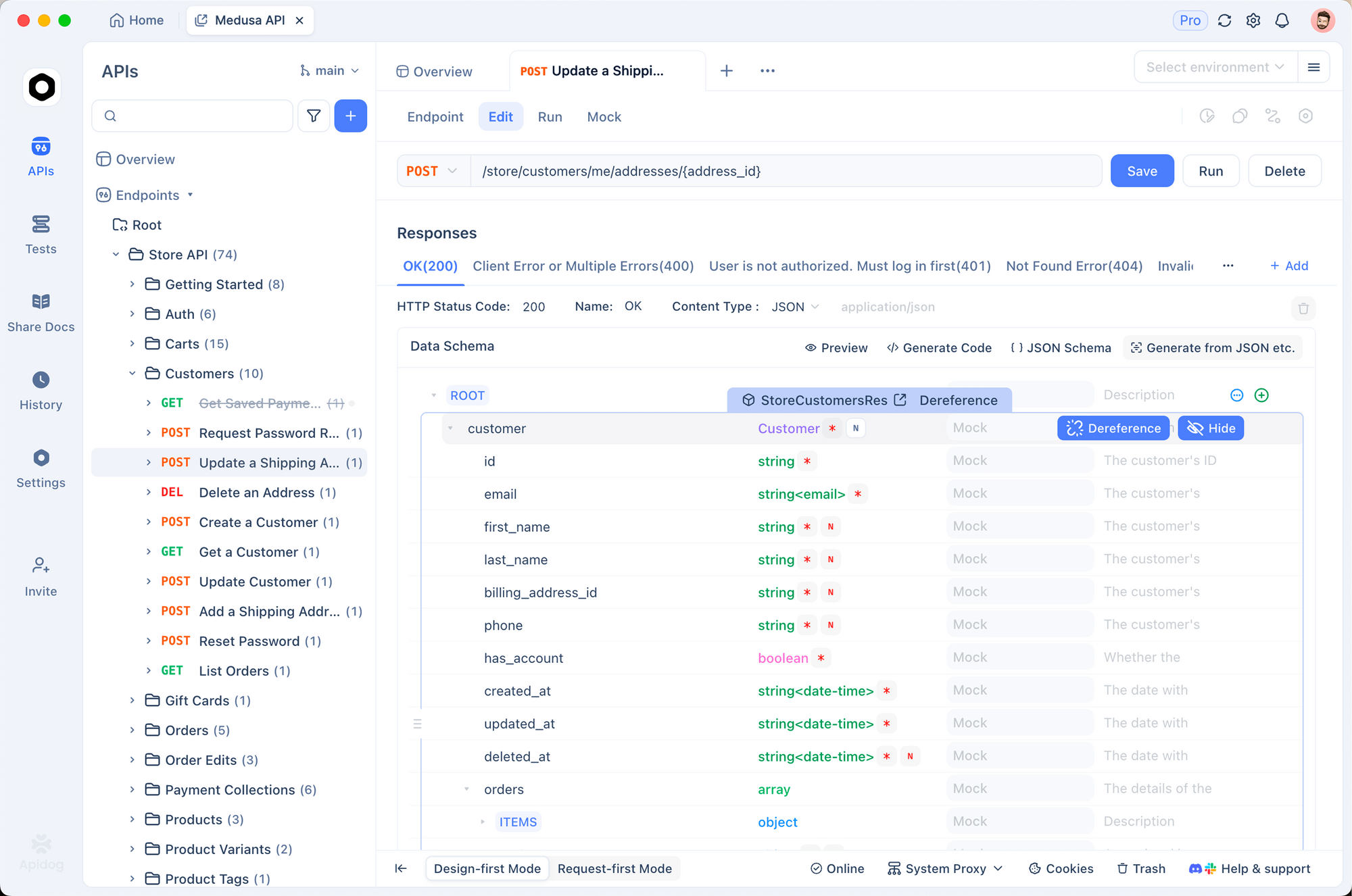
A practical flow:
- Define heartbeat endpoints using OpenAPI in Apidog’s visual designer.
- Build test scenarios for normal, delayed, duplicated, and corrupted heartbeat events.
- Add visual assertions on state transitions and action outputs.
- Mock downstream channels (Slack/webhook/remediation service) with dynamic responses.
- Run suites in CI/CD as a regression gate.
Example test cases
ingest_valid_heartbeat_returns_200duplicate_idempotency_key_no_duplicate_actioncritical_state_triggers_single_alert_with_cooldowninvalid_signature_returns_401novelty_trigger_causes_model_escalation_when_enabled
Because Apidog combines design, testing, mocking, and documentation, your API contract and behavior stay aligned as heartbeat logic evolves.
If your team currently splits this across multiple tools, consolidating in Apidog cuts drift and speeds debugging.
Edge cases engineers usually miss
Clock skew
- Agent timestamps can drift.
- Accept bounded skew and store server-received time separately.
Network partitions
- Heartbeats may arrive in bursts after reconnect.
- Use sequence numbers and reorder windows.
Backpressure storms
- If policy engine slows down, queues can amplify lag.
- Apply admission control and degrade gracefully.
Silent probe failure
- “No data” is not “healthy.”
- Encode unknown state explicitly.
Runaway remediation loops
- Action triggers condition that triggers same action repeatedly.
- Add per-action cooldown and max retry budgets.
Model drift in escalation outcomes
- Keep evaluation fixtures for model-assisted decisions.
- Re-validate on model/version changes.
Migration note: Moltbot/Clawdbot to OpenClaw naming
The rename history caused confusion in package names, docs, and endpoint prefixes. If you maintain integrations:
- Keep backward aliases for a deprecation window.
- Version event schemas explicitly (
event_version). - Publish a migration map (old topic names -> new topic names).
- Add contract tests for both legacy and current payloads.
This reduces ecosystem breakage while the community converges on OpenClaw naming.
Recommended production baseline
If you want a sane default for heartbeat rollout:
- Interval: 30s
- Probe timeout: 500ms each, 2s total budget
- Debounce: 2 consecutive failures for warn
- Cooldown: 5 minutes per action type
- Escalation cap: max 5% of heartbeats invoke model
- Retention: 30 days hot, 180 days cold for audits
Then tune by workload. Developer desktop agents and server agents usually need different policies.
Final takeaways
OpenClaw’s heartbeat feature is valuable because it treats agent health as a disciplined control loop, not a chat-first workflow. The winning pattern is clear:
- deterministic probes first,
- explicit policy state machine second,
- model escalation only for uncertainty.
That design gives you lower cost, higher predictability, and safer automation.
When you implement heartbeat APIs, invest heavily in contracts, idempotency, policy simulation, and test automation. Apidog is a strong fit here because you can design OpenAPI specs, mock dependencies, run regression tests, and publish docs in one place.
If you’re building or integrating OpenClaw-style heartbeats now, start with strict deterministic rules and add model intelligence gradually. Reliability comes from constraints first, intelligence second.