If you're building APIs today, you’ve probably noticed a shift in how teams approach API design. Instead of coding first and documenting later (which often leads to inconsistent, undocumented, or broken APIs), modern engineering teams are adopting a contract-first development workflow and honestly, it’s a game changer.
But what really makes contract-first effective isn’t just the methodology. It’s the toolstack behind it.
But here's the thing: contract-first development is only as good as the tools you use to support it. The right toolstack doesn't just make this approach possible; it makes it delightful, efficient, and collaborative.
In this guide, I'll walk you through the complete, modern toolstack that makes contract-first development not just a philosophy, but a practical, powerful workflow.
Now, let's build the ultimate contract-first development toolkit.
What is Contract-First Development? A Quick Refresher
Before we dive into tools, let's clarify the philosophy. Contract-first development means:
- Design the API contract before writing any implementation code. This contract defines endpoints, request/response structures, status codes, authentication, and more.
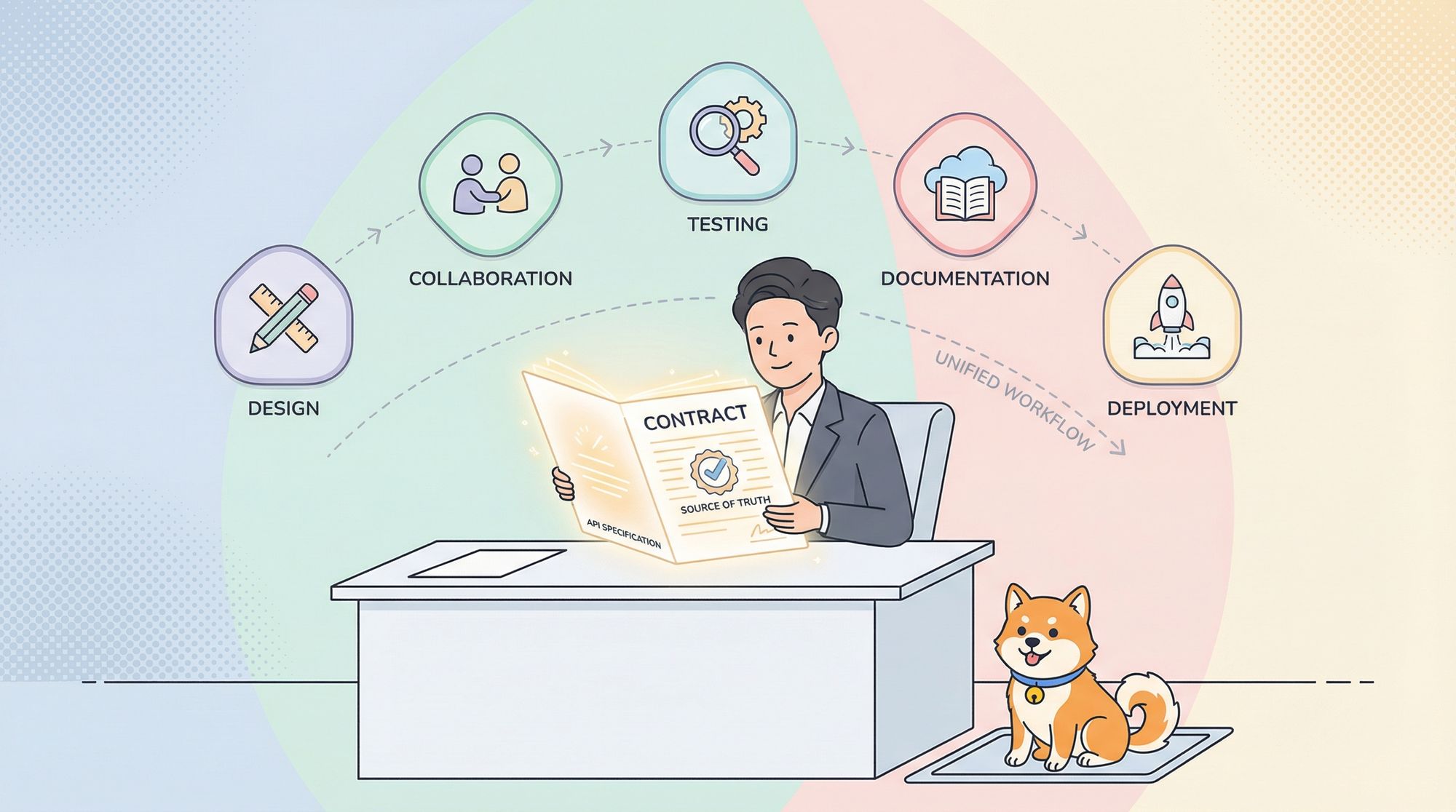
- Treat the contract as the single source of truth. All stakeholders frontend, backend, QA, product agree on and work from this document.
- Generate artifacts from the contract: Mock servers, documentation, tests, and even code stubs.
The benefits are huge: fewer integration surprises, parallel development, better documentation, and a more thoughtful API design.
Instead of guessing what an endpoint should do, everyone aligns on a shared schema.
Why this matters?
1. API consistency improves dramatically
No more mismatch between docs and API responses.
2. Teams parallelize development
Frontend teams can build UI screens using mocks before the backend is finished.
3. Faster onboarding for new developers
The contract explains everything clearly.
4. Automated testing becomes easier
Schema validation, request rules, and expected responses are defined upfront.
5. Fewer breaking changes
Contract-breaking decisions are caught earlier.
Now that contract-first is becoming the standard, it raises a big question:
What toolstack should you actually use?
Let’s walk through the ideal setup.
The Complete Contract-First Toolstack
A robust contract-first workflow involves several stages, each with its ideal tools. Here's the complete stack, from design to deployment.
Stage 1: Contract Design & Authoring
This is where you create the actual API specification. The industry standard is OpenAPI (formerly Swagger).
Core Tool: OpenAPI Specification
OpenAPI is a language-agnostic, machine-readable format for describing RESTful APIs. It's the foundation of everything that follows.
- Why it's essential: It's the universal language for API contracts. Almost every tool in the ecosystem understands OpenAPI.
- Format: YAML or JSON files (typically
openapi.yamloropenapi.json).
Tool Recommendations for This Stage:
- Stoplight Studio (Visual Designer):
- Best for: Teams that prefer a visual, UI-driven approach over writing YAML.
- Strengths: Excellent visual editor, real-time validation, built-in style guides, and easy collaboration features.
- Perfect if: You want to design APIs quickly without memorizing OpenAPI syntax.
2. Swagger Editor (Code-First Design):
- Best for: Developers who are comfortable with YAML/JSON and want maximum control.
- Strengths: It's the official editor, provides real-time validation, and shows a live preview of your documentation.
- Perfect if: You're an OpenAPI purist who wants to work directly with the specification language.
3. Apidog (The All-in-One Contender):
- Best for: Teams that want design integrated with the rest of the workflow.
- Strengths: While Apidog shines in later stages, it also provides a capable visual interface for designing APIs. The big advantage is that you're designing within the same tool you'll use for testing and collaboration, creating a seamless flow.
- Perfect if: You want to avoid context switching between different tools.
Stage 2: Collaboration & Contract Review
An API contract shouldn't be designed in a vacuum. You need feedback from frontend, backend, product, and QA teams.
Tool Recommendations:
1. Git + GitHub/GitLab/Bitbucket:
- Why: Your OpenAPI file should be version-controlled like any other important code artifact.
- Workflow: Store your
openapi.yamlin a repository. Use Pull/Merge Requests for proposed changes. Team members can review the diff, leave comments, and suggest modifications before anything is merged.
2. Apidog's Collaboration Features:
- Why: While Git is great for developers, it's less accessible for non-technical stakeholders (like product managers). Apidog provides a more user-friendly interface for collaboration.
- Strengths: Team workspaces, role-based access, commenting directly on endpoints, and change history. Everyone can see and discuss the API design in a format they understand.
3. Stoplight Platform:
- Why: Similar to Apidog, Stoplight offers cloud-based collaboration features built around the OpenAPI spec, with good review workflows.
Stage 3: Mocking & Early Integration
This is where contract-first development pays immediate dividends. Once you have a contract, you can generate a mock server that simulates the API's behavior.
Tool Recommendations:
- Prism (by Stoplight):
- Best for: High-quality, spec-accurate mocking.
- Strengths: It's a dedicated mock server that uses your OpenAPI spec to generate realistic responses, including status codes and example data. It can even do "proxy mode" where it passes through to the real API for endpoints that are implemented.
- Perfect if: You need a robust, standalone mock server for frontend development.
2. Apidog's Mock Server:
- Best for: Instant mocks integrated with your design.
- Strengths: The moment you design an endpoint in Apidog, it can generate a mock URL. Frontend developers can start coding against real API responses immediately. No configuration or deployment needed.
- Perfect if: You want the shortest possible path from design to mock.
3. WireMock:
- Best for: Advanced mocking scenarios and testing.
- Strengths: Extremely flexible and programmable. You can simulate delays, faults, and complex response scenarios. Great for testing how your client handles edge cases.
- Perfect if: You need sophisticated mock behavior beyond what's defined in your OpenAPI spec.
Stage 4: Documentation Generation
Never write API documentation by hand again. Generate beautiful, interactive docs directly from your contract.
Tool Recommendations:
1. Swagger UI / ReDoc:
- Why: These are the industry-standard OpenAPI documentation renderers.
- Strengths: Swagger UI provides the familiar, interactive "Try it out" interface. ReDoc offers beautiful, clean documentation focused on readability. Both can be easily hosted anywhere.
- Workflow: Automatically generate and deploy docs from your CI/CD pipeline whenever your OpenAPI spec changes.
2. Apidog's Documentation:
- Why: If you're already designing in Apidog, the documentation is automatically generated and always up-to-date.
- Strengths: No separate generation step. The docs are a living view of your current API design. They're shareable with a simple link.
3. ReadMe / Stoplight Documentation:
- Why: For enterprise-grade, branded developer portals.
- Strengths: These platforms let you create comprehensive developer hubs with not just API reference (from OpenAPI) but also guides, tutorials, and support. They often include analytics on API usage.
- Perfect if: You're publishing a public API and need a professional developer experience.
Stage 5: Testing & Validation
Your contract isn't just for design it's also your testing blueprint.
Tool Recommendations:
1. Apidog (again!):
- Best for: Integrated API testing.
- Strengths: Create test suites that validate your actual API implementation against the contract. Run automated tests, check status codes, response schemas, and performance. Because Apidog understands your API design, it can generate smart test cases.
- Perfect if: You want a single tool for design and validation.
2. Postman / Newman:
- Best for: Teams heavily invested in the Postman ecosystem.
- Strengths: You can import your OpenAPI spec into Postman to create a collection. Then write comprehensive tests and run them via Newman (Postman's CLI) in your CI/CD pipeline.
- Perfect if: You need complex test scripting and are already using Postman.
3. Schemathesis / Dredd:
- Best for: Property-based/contract testing.
- Strengths: These are specialized tools that automatically generate test cases based on your OpenAPI spec. They try to find edge cases and violations by sending unexpected data to your API.
- Perfect if: You need rigorous, automated contract compliance testing.
Stage 6: Code Generation & Implementation
Finally, we write the actual backend code. But even here, the contract guides us.
Tool Recommendations:
1. OpenAPI Generator / Swagger Codegen:
- Why: Generate server stubs and client SDKs from your OpenAPI spec.
- Strengths: Supports dozens of languages and frameworks. You can generate a complete Spring Boot, Express.js, or Django server skeleton with all your routes defined. Frontend teams can generate TypeScript/JavaScript clients.
- Workflow: Run the generator in your build process. Developers implement the business logic in the generated stubs.
2. tsoa (TypeScript):
- Best for: TypeScript/Node.js teams.
- Strengths: Lets you write your API using TypeScript decorators in your controller code, then generates the OpenAPI spec from your code. It's "code-first that generates contract-first artifacts."
- Perfect if: Your team prefers to design in code but still wants the benefits of an OpenAPI spec.
3. FastAPI (Python):
- Best for: Python teams.
- Strengths: Automatically generates OpenAPI documentation from your Python code. It's incredibly intuitive and productive.
- Perfect if: You're building Python APIs and want automatic OpenAPI generation.
Why Apidog Stands Out in This Stack
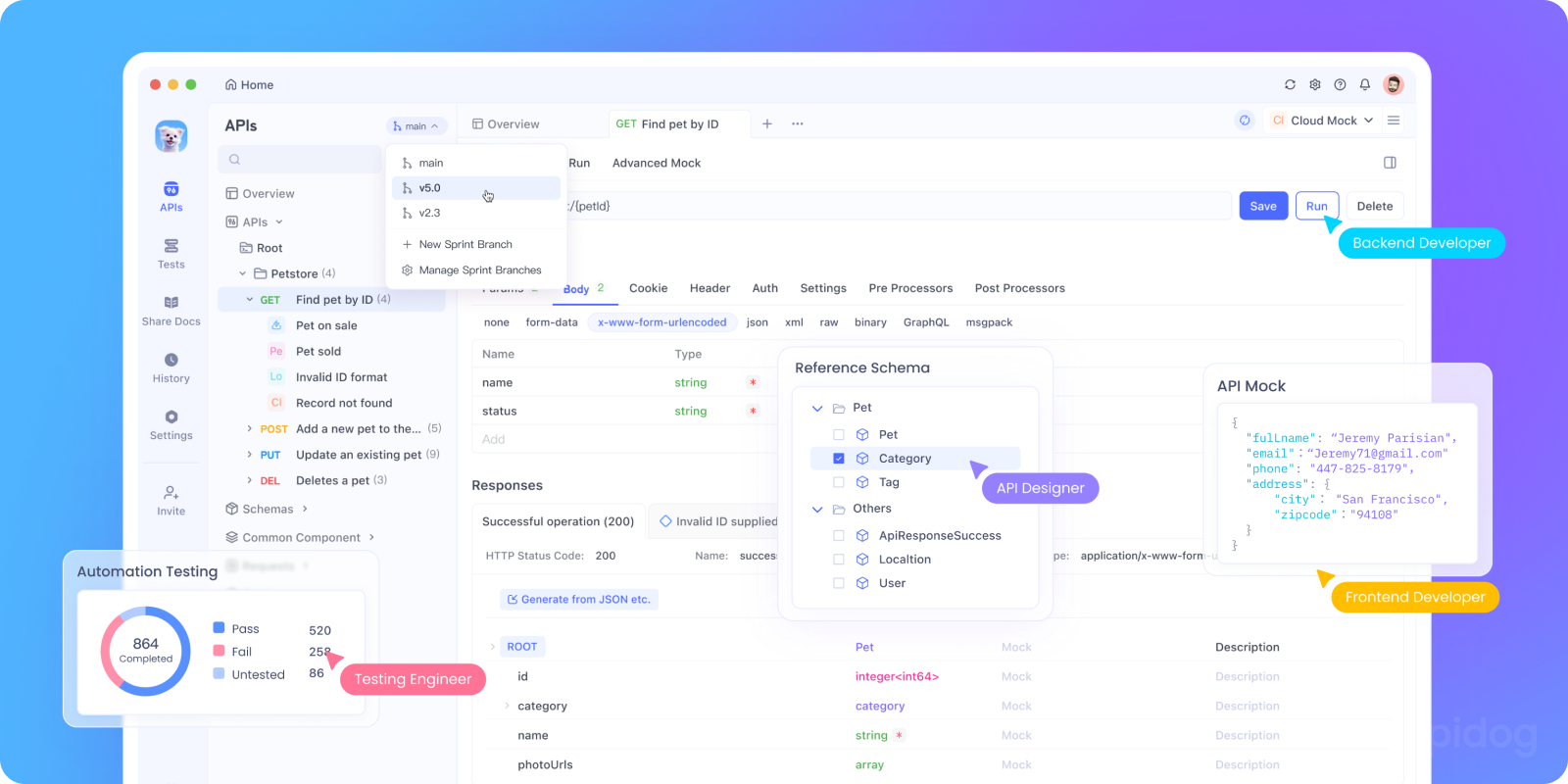
You've probably noticed Apidog appearing in multiple categories. That's its superpower. While specialized tools excel at one thing, Apidog provides an integrated experience that covers:
- Design (visual OpenAPI editor)
- Collaboration (team workspaces, comments)
- Mocking (instant mock servers)
- Testing (comprehensive test suites and automation)
- Documentation (always up-to-date, shareable docs)
For teams wanting to reduce tool sprawl and streamline their workflow, Apidog offers a compelling "one tool to rule them all" solution that aligns perfectly with the contract-first philosophy.
Conclusion: Building on a Solid Foundation
Contract-first development transforms API creation from a risky, after-the-fact process into a predictable, collaborative discipline. The right toolstack doesn't just support this approac it accelerates it, making it the natural and efficient way to build APIs.
Whether you choose a collection of specialized best-in-class tools or an integrated platform like Apidog, the key is to establish a workflow where the contract is the single source of truth that drives every subsequent step.
By investing in these tools and this methodology, you'll build better APIs, faster, with happier teams and more satisfied consumers. The initial time spent designing the contract pays dividends throughout the entire development lifecycle.
Ready to try a comprehensive approach to contract-first development? Download Apidog for free and experience how a unified platform can streamline your entire API workflow from design to deployment.