Xiaomi MiMo-V2-Pro is a trillion-parameter AI model that beats Claude Sonnet 4.6 at coding, approaches Claude Opus 4.6 at agent tasks, and costs 67% less. After racking up 1T tokens on OpenRouter as “Hunter Alpha,” Xiaomi officially released it with 1M token context and one week of free API access.
You probably know Xiaomi for smartphones. Then electric cars. Now they’re coming for Anthropic’s territory.
On March 18, 2026, Xiaomi’s MiMo team announced MiMo-V2-Pro, a foundation model built for agentic workloads that’s already proven itself in production. During a week-long stealth deployment on OpenRouter under the codename “Hunter Alpha,” it topped daily charts and processed over 1T tokens before anyone knew it was Xiaomi.
In this guide, we’ll break down the benchmarks, show you how to access the API for free, and explain why a phone company’s AI model should be on your radar.
What Is Xiaomi MiMo-V2-Pro?
| Feature | MiMo-V2-Pro | Claude Sonnet 4.6 | Claude Opus 4.6 |
|---|---|---|---|
| Pricing (input/output) | $1/$3 per 1M tokens | $3/$15 per 1M tokens | $5/$25 per 1M tokens |
| Context window | 1M tokens | 200K tokens | 200K tokens |
| SWE-bench Verified | 78.0% | 79.6% | 80.8% |
| ClawEval (agent tasks) | 61.5% | 66.3% | 66.3% |
| PinchBench | 84.0% | 86.9% | 86.3% |
| Architecture | 1T total, 42B active | ~200B estimated | ~400B estimated |
| Free access | ✅ One week on OpenRouter | ❌ Paid only | ❌ Paid only |
The short version: MiMo-V2-Pro is Xiaomi’s answer to Claude and GPT. It’s built for agents that orchestrate complex workflows, not just answer questions. And for one week, you can use it for free on OpenRouter.
From Smartphones to AI: Xiaomi’s Unexpected Pivot
Xiaomi made its name selling phones. Then it surprised everyone with the SU7 electric vehicle. Now the company is betting big on artificial intelligence.
The MiMo-V2-Pro announcement marks a strategic shift. Xiaomi isn’t just integrating AI into its products. It’s building foundation models to compete with Anthropic, OpenAI, and Google on the global stage.
The Hunter Alpha Leak
One week before the official launch, an anonymous model called “Hunter Alpha” appeared on OpenRouter. Developers noticed it immediately:
- Topped OpenRouter’s daily usage charts multiple days in a row
- Surpassed 1T total tokens processed during stealth week
- Ranked #8 globally on Artificial Analysis Intelligence Index
- Ranked #2 among Chinese LLMs (behind only DeepSeek)
Hunter Alpha wasn’t a leak. It was a beta test.
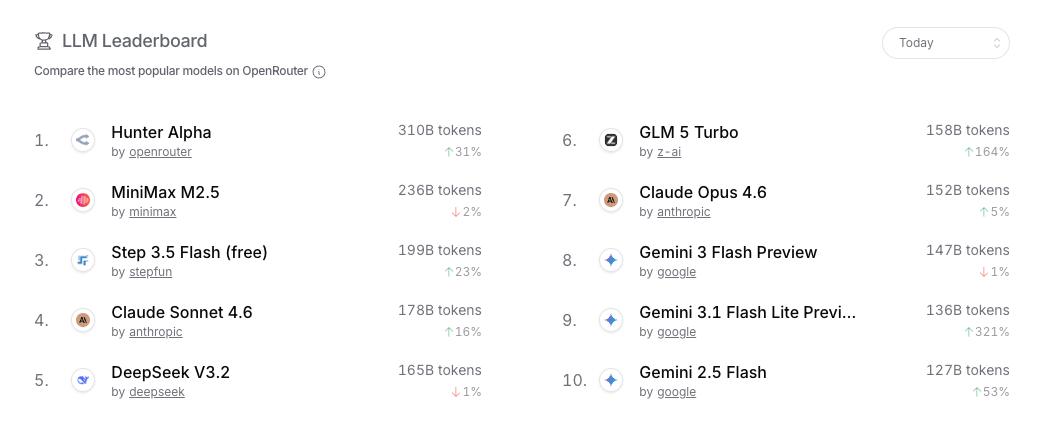
MiMo-V2-Pro is the production release. Same core model, but with a week’s worth of improvements based on real user feedback. Xiaomi used that time to strengthen long-context handling and agent-scenario stability.
Why This Matters
Most AI model launches come from expected players: Anthropic, OpenAI, Google, Meta. Xiaomi entering this space signals something bigger.
Phone companies don’t typically build trillion-parameter foundation models. Car manufacturers don’t usually compete on AI benchmarks. Xiaomi is doing both while undercutting established players on price.
MiMo-V2-Pro Performance: The Numbers
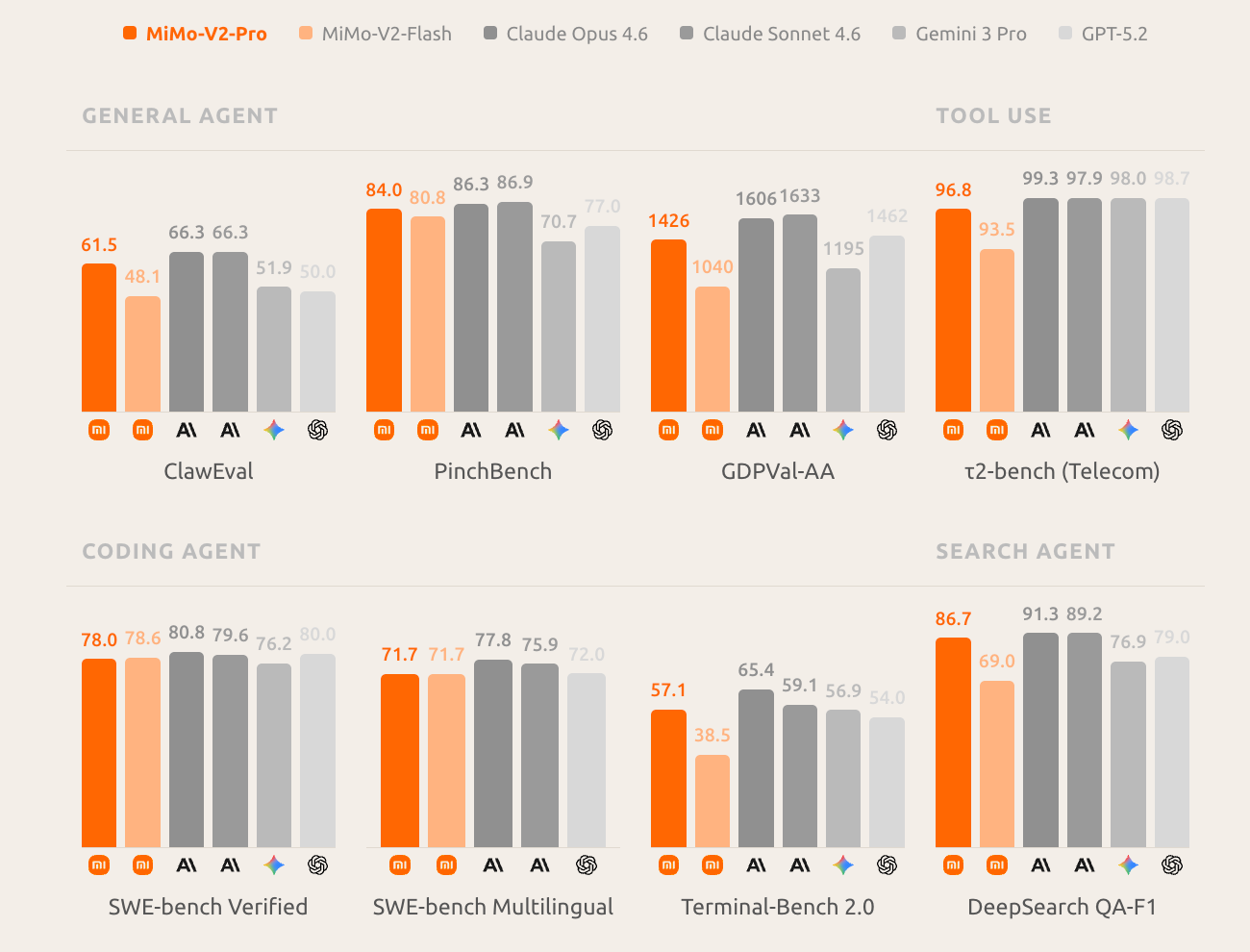
Xiaomi didn’t hold back on benchmarks. They tested MiMo-V2-Pro against every major model and published the results.
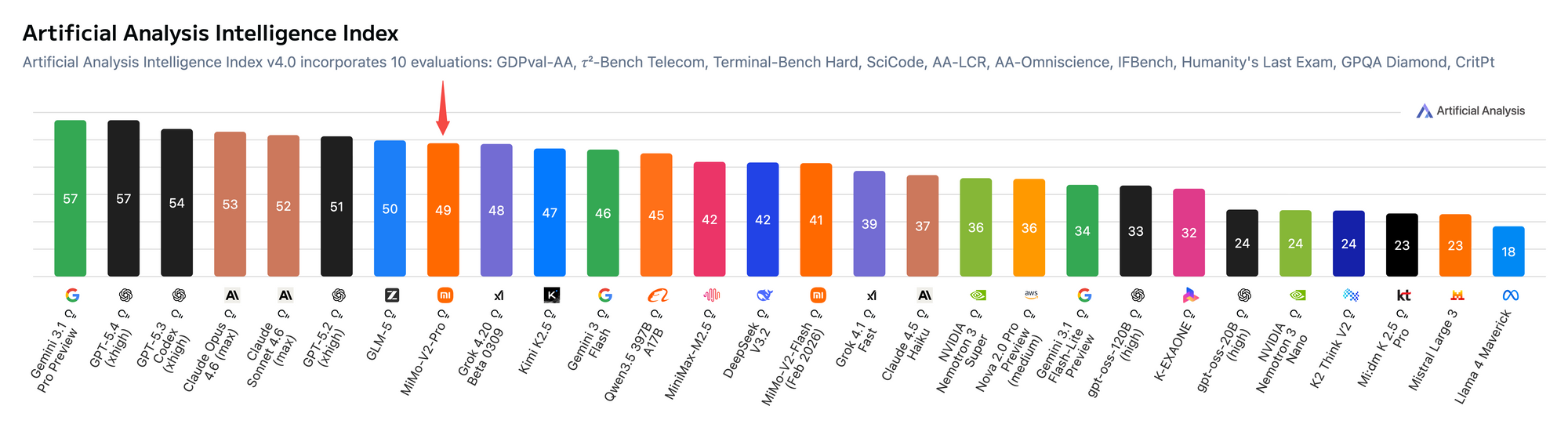
Agent Capabilities: Chasing Opus 4.6
| Benchmark | MiMo-V2-Pro | Claude Opus 4.6 | Claude Sonnet 4.6 | GPT-5.2 |
|---|---|---|---|---|
| ClawEval | 61.5% | 66.3% | 66.3% | 50.0% |
| PinchBench | 84.0% | 86.3% | 86.9% | 77.0% |
| GDPVal-AA | 96.8 | 99.3 | 97.9 | 98.7 |
| τ2-bench (Telecom) | 93.5 | 98.0 | 97.9 | 98.0 |
On agent benchmarks, MiMo-V2-Pro sits between Sonnet and Opus. It’s not quite at Opus level yet, but it’s close enough that developers are taking notice.
Coding: Better Than Sonnet 4.6
| Benchmark | MiMo-V2-Pro | Claude Opus 4.6 | Claude Sonnet 4.6 | GPT-5.2 |
|---|---|---|---|---|
| SWE-bench Verified | 78.0% | 80.8% | 79.6% | 80.0% |
| SWE-bench Multilingual | 71.7% | 77.8% | 75.9% | 72.0% |
| Terminal-Bench 2.0 | 57.1% | 65.4% | 59.1% | 54.0% |
| DeepSearch QA-F1 | 86.7% | 91.3% | 89.2% | 79.0% |
On pure coding tasks, MiMo-V2-Pro outperforms Claude Sonnet 4.6 on SWE-bench Verified. That’s significant. SWE-bench is one of the most respected coding benchmarks in the industry.
Xiaomi’s internal engineers reported that MiMo-V2-Pro’s coding experience “approaches Claude Opus 4.6” with stronger system design, cleaner code style, and more efficient problem-solving.
The Architecture Behind the Performance
MiMo-V2-Pro isn’t just bigger. It’s built differently:
- 1T+ total parameters with 42B active during inference
- Hybrid Attention with 7:1 ratio (up from 5:1 in V2-Flash)
- 1M token context window (double Claude’s 200K)
- MTP (Multi-Token Prediction) layer for faster generation
- 3x larger than MiMo-V2-Flash
The hybrid attention mechanism is key. It lets the model process massive contexts efficiently without sacrificing speed.
Pricing: 67% Cheaper Than Sonnet 4.6
Here’s where things get interesting:
| Model | Input (per 1M) | Output (per 1M) | Cache Read | Cache Write |
|---|---|---|---|---|
| MiMo-V2-Pro (≤256K) | $1 | $3 | $0.20 | Free |
| MiMo-V2-Pro (256K-1M) | $2 | $6 | $0.40 | Free |
| Claude Sonnet 4.6 | $3 | $15 | $0.30 | $3.75 |
| Claude Opus 4.6 | $5 | $25 | $0.50 | $6.25 |
MiMo-V2-Pro costs one-third of Claude Sonnet 4.6 for input tokens and one-fifth for output. Cache writes are free during the launch period.
For context-heavy workloads using the full 1M window, you’re still paying less than half of what Sonnet costs at 200K.
Free Access: One Week Only
Xiaomi is partnering with five agent frameworks to offer one week of free API access:
- OpenClaw
- OpenCode
- KiloCode
- Blackbox
- Cline
If you’re using any of these frameworks, you can test MiMo-V2-Pro without paying.
Built for Agents: Not Just Another Chatbot
MiMo-V2-Pro isn’t designed for casual chat. It’s built to orchestrate complex workflows.
The OpenClaw Connection
OpenClaw is an open-source agent framework gaining traction in the developer community. MiMo-V2-Pro is fine-tuned specifically for it:
- SFT + RL training on complex agent scaffolds
- Stronger tool-call stability across multi-step workflows
- 1M context for high-intensity Claw applications
- Native integration with OpenClaw’s orchestration layer
On OpenClaw’s standard benchmarks, MiMo-V2-Pro ranks #3 globally:
- PinchBench: 84.0% (behind only Claude Sonnet 4.6 and Opus 4.6)
- ClawEval: 61.5% (tied with Opus 4.6, ahead of Sonnet)
Real-World Agent Performance
During the Hunter Alpha test, developers used MiMo-V2-Pro for:
- Multi-file code generation across entire repositories
- API debugging workflows with iterative testing
- Database schema design with migration generation
- Frontend component creation with full styling
The top usage category by volume was coding tools. Developers weren’t experimenting. They were building production workflows around it.
Frontend Generation: See It in Action
Xiaomi shared two examples of MiMo-V2-Pro generating complete frontend applications through OpenClaw.
Example : 1990s Magazine-Style Website
Prompt:
Mimic 1990s print magazine aesthetics. Title in serif font like Playfair Display, body in monospace like IBM Plex Mono. Magazine-style multi-column grid with uneven column widths. Large titles offset left beyond the viewport to suggest print bleed. Images with sepia(0.2) filter and noise overlay. Page transitions mimicking page-turn effects. Navigation styled as a magazine table of contents, each item numbered 01/02/03, numbers enlarge on hover. Footer designed as a magazine colophon with a fake ISSN number. Paper texture background.

The model generated a complete, functional website matching all specifications in a single pass.
How to Access MiMo-V2-Pro API
You have two options: OpenRouter (free for one week) or direct API access.
Option 1: OpenRouter (Free Access)
OpenRouter is the world’s largest API aggregation platform. MiMo-V2-Pro is available there under its official name now.
Step 1: Create an OpenRouter account
- Go to openrouter.ai
- Sign up with GitHub or email
- Navigate to API Keys
- Generate a new key
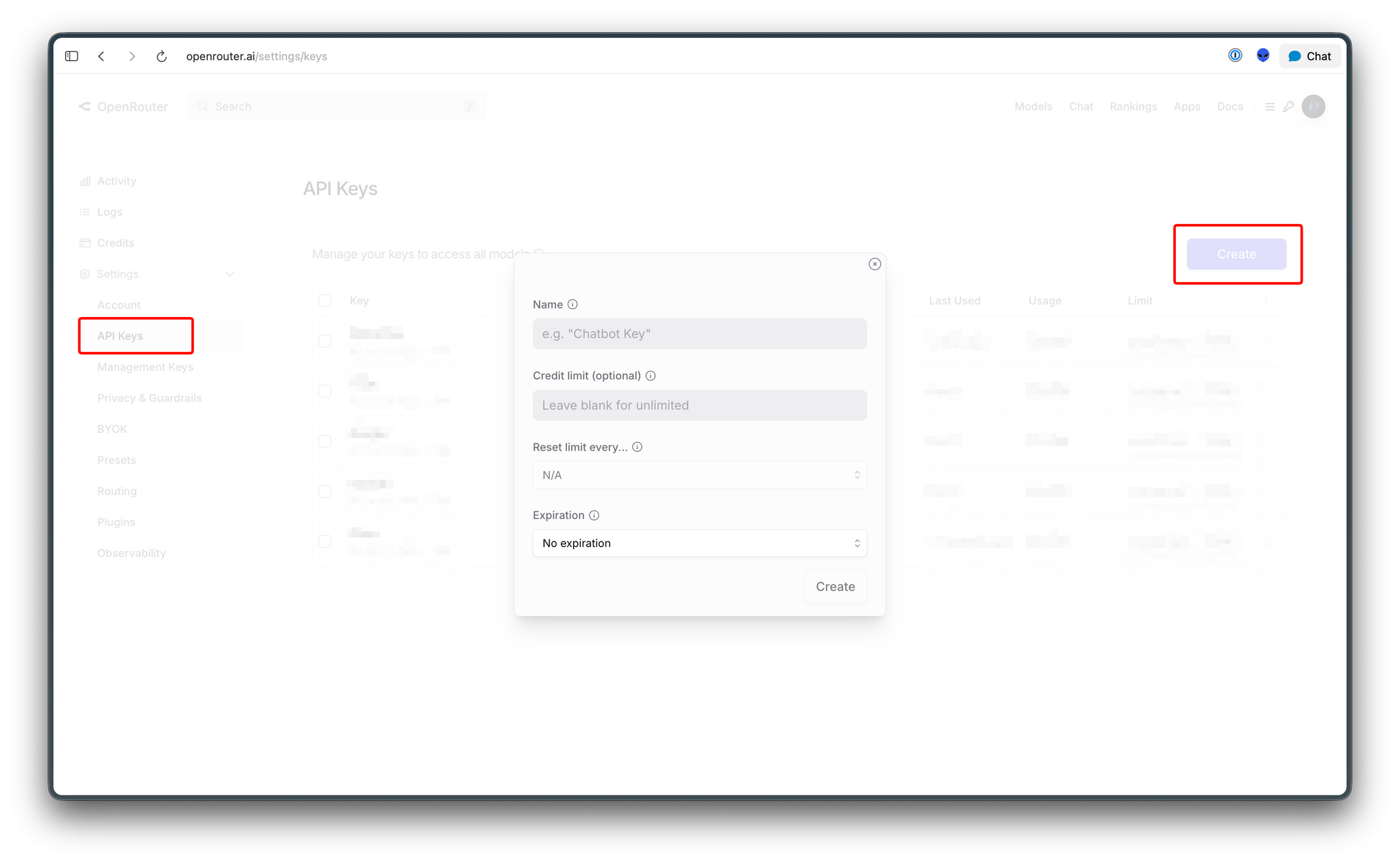
Step 2: Make your first API call
import requests
import json

url = "https://openrouter.ai/api/v1/chat/completions"
headers = {
    "Authorization": "Bearer YOUR_OPENROUTER_KEY",
    "Content-Type": "application/json"
}

payload = {
    "model": "xiaomi/mimo-v2-pro",
    "messages": [
        {"role": "user", "content": "Build a REST API with user authentication in Python"}
    ]
}

response = requests.post(url, headers=headers, json=payload)
print(json.dumps(response.json(), indent=2))
Step 3: Test with Apidog
API debugging gets messy with complex agent outputs. Apidog helps you:
- View full JSON responses with syntax highlighting
- Trace multi-turn conversations
- Test different parameters (temperature, max_tokens)
- Share debug sessions with your team
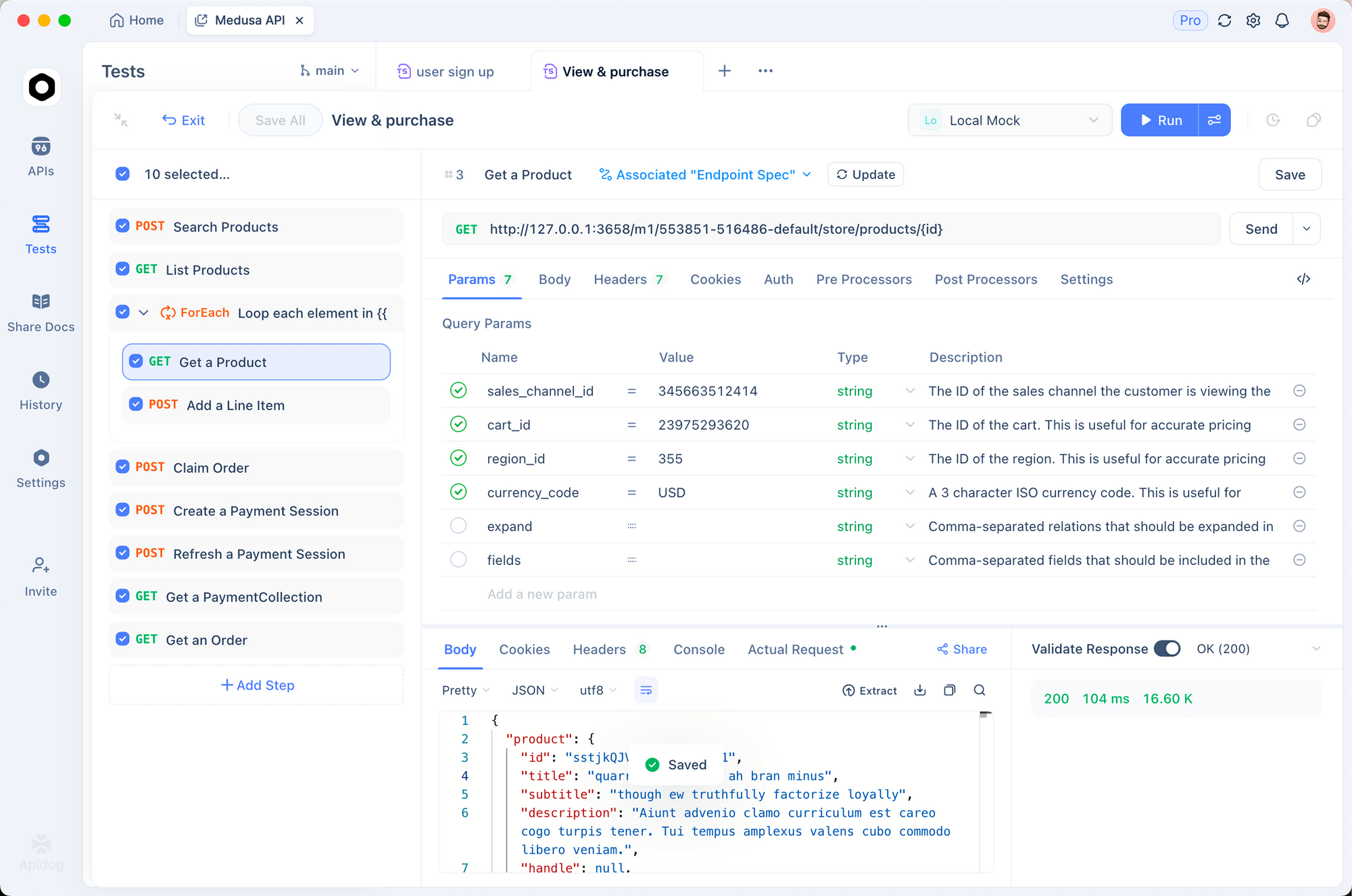
Import the OpenRouter API spec into Apidog and start testing immediately.
Option 2: Direct Xiaomi API
For production use, you can access MiMo-V2-Pro directly from Xiaomi.
Step 1: Get API credentials
- Visit platform.xiaomimimo.com
- Create an account
- Navigate to API management
- Generate credentials
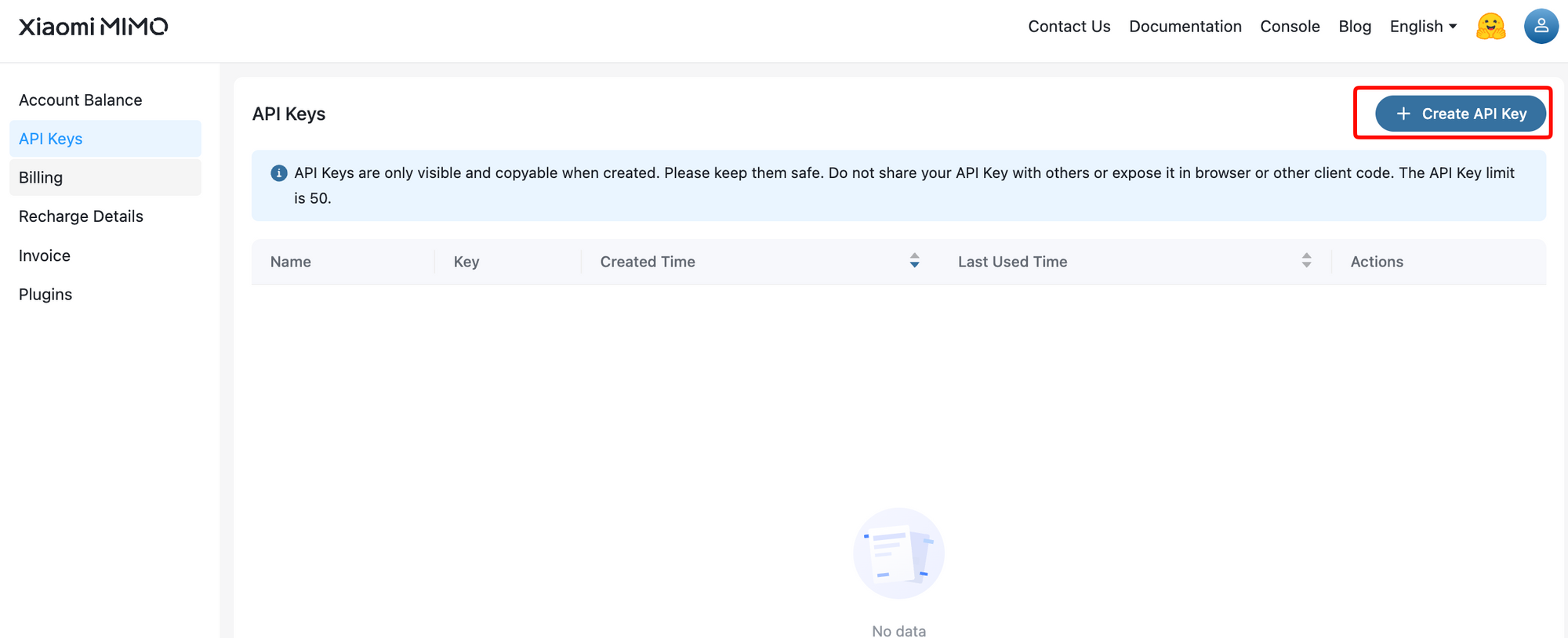
Step 2: Configure your client
import requests

API_KEY = "your-xiaomi-api-key"
ENDPOINT = "https://api.xiaomimimo.com/v1/chat/completions"

headers = {
    "Authorization": f"Bearer {API_KEY}",
    "Content-Type": "application/json"
}

payload = {
    "model": "mimo-v2-pro",
    "messages": [
        {"role": "system", "content": "You are a helpful coding assistant."},
        {"role": "user", "content": "Create a FastAPI endpoint with JWT authentication"}
    ],
    "temperature": 0.7,
    "max_tokens": 8192
}

response = requests.post(ENDPOINT, headers=headers, json=payload)
print(response.json())
Option 3: Agent Framework Integration
If you’re using OpenClaw, OpenCode, KiloCode, Blackbox, or Cline, check your framework’s documentation for MiMo-V2-Pro integration. Free access is available for one week.
OpenClaw example:
from openclaw import Agent

agent = Agent(
    model="xiaomi/mimo-v2-pro",
    tools=["file_system", "terminal", "browser"],
    context_limit=1_000_000  # Full 1M token context
)

result = agent.run("Analyze this codebase and suggest improvements")
MiMo-V2-Pro vs. The Competition
Xiaomi MiMo-V2-Pro vs. Claude Sonnet 4.6
| Aspect | MiMo-V2-Pro | Claude Sonnet 4.6 |
|---|---|---|
| Pricing | $1/$3 per 1M | $3/$15 per 1M |
| Context | 1M tokens | 200K tokens |
| SWE-bench Verified | 78.0% | 79.6% |
| ClawEval | 61.5% | 66.3% |
| PinchBench | 84.0% | 86.9% |
| Free tier | ✅ One week | ❌ No |
Choose MiMo-V2-Pro if: You need longer context, lower costs, or want to test during the free week.
Choose Sonnet 4.6 if: You’re already in the Anthropic ecosystem and need maximum agent performance.
Xiaomi MiMo-V2-Pro vs. Claude Opus 4.6
| Aspect | MiMo-V2-Pro | Claude Opus 4.6 |
|---|---|---|
| Pricing | $1/$3 per 1M | $5/$25 per 1M |
| Context | 1M tokens | 200K tokens |
| SWE-bench Verified | 78.0% | 80.8% |
| ClawEval | 61.5% | 66.3% |
| PinchBench | 84.0% | 86.3% |
Choose MiMo-V2-Pro if: You want 80 percent of Opus performance at 20 percent of the cost.
Choose Opus 4.6 if: You need the absolute best agent performance and cost isn’t a concern.
Xiaomi MiMo-V2-Pro vs. GPT-5.2
| Aspect | MiMo-V2-Pro | GPT-5.2 |
|---|---|---|
| Pricing | $1/$3 per 1M | Varies |
| Context | 1M tokens | 128K tokens |
| SWE-bench Verified | 78.0% | 80.0% |
| ClawEval | 61.5% | 50.0% |
| PinchBench | 84.0% | 77.0% |
Choose MiMo-V2-Pro if: You need better agent performance and longer context.
Choose GPT-5.2 if: You’re invested in the OpenAI ecosystem.
Real-World Use Cases
1. API Development and Testing
MiMo-V2-Pro excels at generating complete API implementations with proper authentication, validation, and error handling.
# Agent workflow for API generation
api_agent = Agent(
    model="xiaomi/mimo-v2-pro",
    tools=["file_system", "package_manager", "test_runner"]
)

result = api_agent.run("""
Create a FastAPI application with:
- JWT authentication
- User registration and login endpoints
- Protected resource routes
- Pytest test suite
- Docker configuration
""")
2. Legacy Code Migration
The 1M token context lets you feed entire codebases for analysis and migration.
migration_agent = Agent(
    model="xiaomi/mimo-v2-pro",
    context_window=1_000_000
)

# Load entire legacy codebase
legacy_code = load_repository("./legacy-python-2")

result = migration_agent.run("""
Analyze this Python 2 codebase and:
1. Identify all Python 2-specific syntax
2. Generate Python 3.11 compatible versions
3. Create a migration report
4. Suggest modernization improvements
""")
3. Multi-File Project Scaffolding
Generate complete project structures in one pass.
scaffold_agent = Agent(
    model="xiaomi/mimo-v2-pro",
    tools=["file_system"]
)

result = scaffold_agent.run("""
Create a full-stack Next.js application with:
- App Router structure
- TypeScript configuration
- Tailwind CSS setup
- Authentication with NextAuth
- Database integration with Prisma
- API routes for CRUD operations
- Complete test suite with Jest
""")
Limitations and Considerations
MiMo-V2-Pro is impressive, but it’s not perfect.
Known Limitations
- Ecosystem maturity: Smaller community compared to OpenAI/Anthropic
- Documentation gaps: Some features lack detailed guides
- Tool integration: Fewer pre-built integrations than established players
- Enterprise support: Limited SLA options for production deployments
When NOT to Use MiMo-V2-Pro
- You need enterprise-grade support and SLAs
- Your team relies heavily on existing Anthropic/OpenAI integrations
- You require guaranteed uptime with formal commitments
- You’re building consumer-facing products needing extensive safety tuning
The Bottom Line
Xiaomi entering the foundation model space changes the competitive landscape.
MiMo-V2-Pro is worth testing if:
- You want Claude-level performance at a fraction of the cost
- You need 1M token context for large codebases or documents
- You’re building agent workflows with OpenClaw or similar frameworks
- You want to take advantage of the free week on OpenRouter
Look elsewhere if:
- You need enterprise SLAs and dedicated support
- Your team is deeply invested in Anthropic/OpenAI ecosystems
- You require extensive safety tuning for consumer products
The free week on OpenRouter removes the risk. Test it against your actual workflows and see how it performs.
FAQ
Is MiMo-V2-Pro really free on OpenRouter?
Yes, for one week. Xiaomi is offering free API access through OpenRouter as part of the launch promotion. After the free week, standard pricing applies ($1/$3 per 1M tokens).
How does MiMo-V2-Pro compare to Claude Sonnet 4.6?
On SWE-bench Verified (coding), MiMo-V2-Pro scores 78.0% vs Sonnet’s 79.6%. On agent tasks (ClawEval), it scores 61.5% vs Sonnet’s 66.3%. The tradeoff: MiMo-V2-Pro costs 67% less and offers 5x more context (1M vs 200K tokens).
Can I use MiMo-V2-Pro for commercial projects?
Yes. The API terms allow commercial use. Check Xiaomi’s platform documentation for specific licensing details.
What’s the maximum context length?
MiMo-V2-Pro supports up to 1M tokens. Pricing is tiered: $1/$3 per 1M for contexts up to 256K, and $2/$6 per 1M for contexts between 256K-1M.
Does MiMo-V2-Pro support function calling?
Yes. The model is optimized for tool use and agent workflows. It performs strongly on PinchBench (84.0%) and ClawEval (61.5%), both of which measure tool-calling capabilities.
How do I get API access after the free week?
You can access MiMo-V2-Pro through:
- OpenRouter (paid, standard pricing)
- Direct Xiaomi API at platform.xiaomimimo.com
- Agent frameworks like OpenClaw, OpenCode, KiloCode, Blackbox, and Cline
Is there a self-hosted option?
No. MiMo-V2-Pro is only available via API. Xiaomi has not announced plans for self-hosted deployment.
Next Steps
- Test the API: Sign up at OpenRouter or Xiaomi Platform
- Try with Apidog: Import the API spec and start debugging requests
- Explore OpenClaw: Check out the native agent framework integration
- Join the community: Follow MiMo updates and developer discussions
Want to test AI APIs more efficiently? Download Apidog, the all-in-one API client for testing, debugging, and documenting AI endpoints.