You're building a microservices architecture, and your frontend team is ready to start coding. But there's a problem: the authentication service your UI depends on won't be ready for another three weeks. The payment API is still in design. Your development is about to grind to a halt.
This is the exact scenario API mocking tools were created to solve. For years, WireMock has been the go-to solution for many developers a powerful, Java-based tool that lets you create realistic mock APIs. But as the API landscape has evolved, so have the tools available.
Perhaps you're seeking something easier to set up, with a more intuitive UI, or one that integrates more seamlessly with your existing workflow. Whatever your reason, exploring alternatives to WireMock can help you find the perfect tool for your specific needs.
Now, let's explore the vibrant ecosystem of API mocking tools and find the right fit for your project.
What Is WireMock?
WireMock is an HTTP mocking framework originally designed for developers who needed to simulate external services during testing.
At its core, WireMock allows you to:
- Stub HTTP endpoints
- Define request–response mappings
- Run mocks locally or as a standalone server
- Simulate delays, errors, and edge cases
Because of this, WireMock became extremely popular in:
- Integration testing
- Microservices testing
- Backend-focused development workflows
For a long time, it solved a real problem very well.
Why Teams Start Looking for Alternatives to WireMock
Despite its strengths, WireMock isn’t always the best fit for modern API teams especially those working collaboratively.
Here are some common reasons teams look for alternatives.
1. WireMock Is Developer-Centric, Not Team-Centric
WireMock works great for individual developers. However, collaboration often requires:
- Shared workspaces
- Visual API definitions
- Easy onboarding for non-backend roles
WireMock relies heavily on:
- JSON files
- Code-based configuration
- Local setups
This can be a barrier for frontend developers, QA engineers, and product teams.
2. Steep Learning Curve for Non-Developers
Because WireMock is configuration-heavy, non-backend roles often struggle to:
- Understand mappings
- Modify responses
- Explore API behavior
As a result, teams end up with a “WireMock expert” instead of shared ownership.
3. Limited Built-In API Design and Documentation
WireMock mocks endpoints, but it doesn’t:
- Design API contracts
- Generate documentation
- Act as a source of truth
This often leads to a disconnect between:
- API specs
- Mock behavior
- Actual implementation
4. Manual Syncing as APIs Evolve
When APIs change, WireMock configurations must be updated manually.
Over time, this causes:
- Outdated mocks
- Inconsistent responses
- False confidence in tests
This is where contract-driven alternatives start to shine.
What to Look for in a WireMock Alternative
Before jumping into specific tools, let’s define what makes a good alternative.
A modern WireMock alternative should ideally support:
- Contract-first API definitions
- Automatic mock generation
- Easy collaboration
- Environment management
- Versioning
- Low setup overhead
- Optional self-hosting
With that in mind, let’s explore the best alternatives.
Apidog: A Contract-First Alternative to WireMock
Let’s start with Apidog, because it approaches mocking from a fundamentally different and more modern angle.
Instead of starting with mock rules, Apidog starts with API contracts.
Why Apidog Is Often Chosen Over WireMock
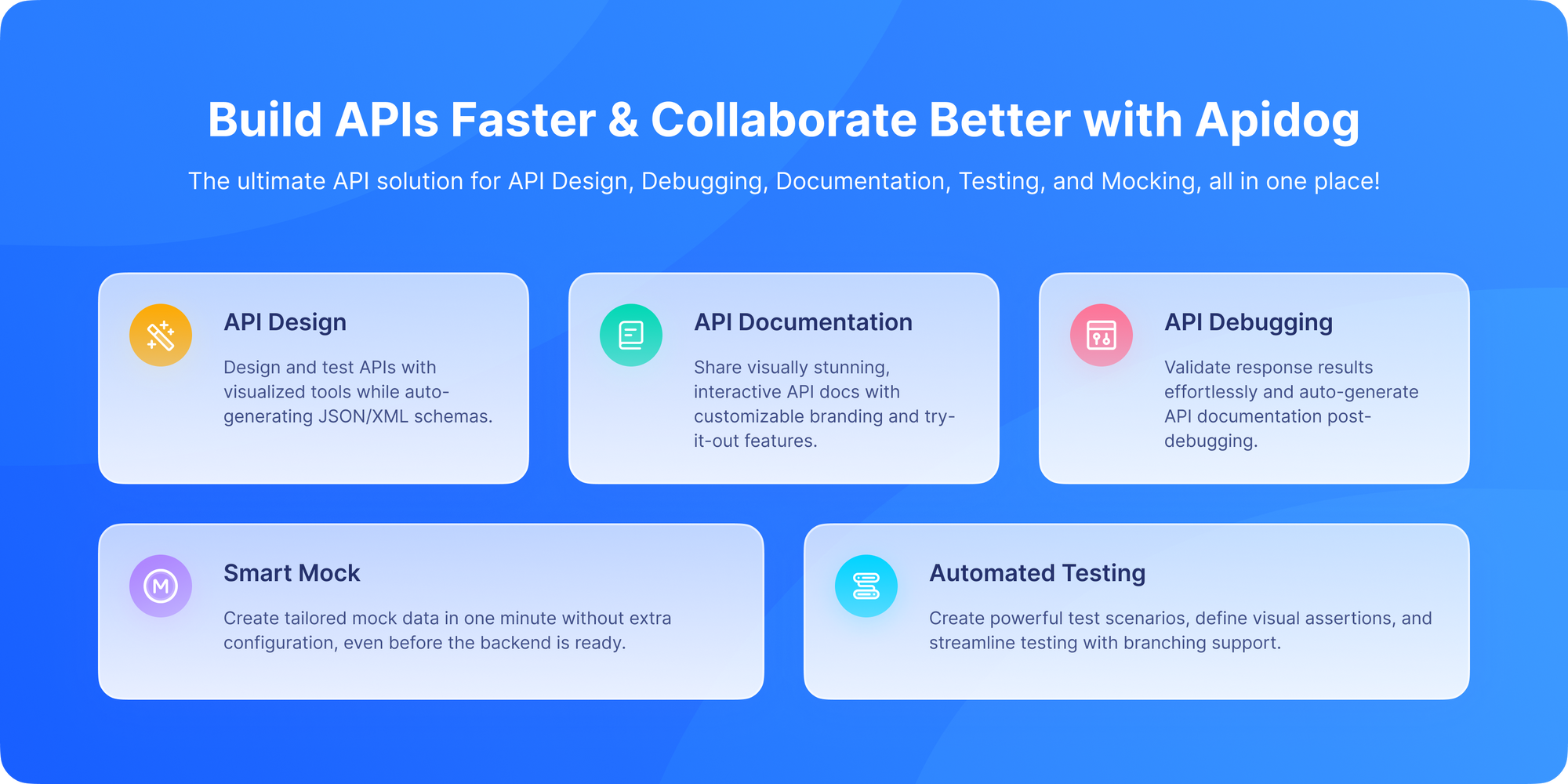
Apidog combines:
- API design
- Contract validation
- Mock servers
- Request testing
- Documentation
- Collaboration
all in one platform. This makes it especially attractive for teams that want to move beyond local, file-based mocks.
How Mocking Works in Apidog

In Apidog, mocking follows a simple flow:
- Define API endpoints and schemas
- Enable mock responses
- Instantly get mock URLs
- Share mock endpoints with the team
Because mocks are generated from contracts:
- They stay in sync automatically
- There’s no duplication of effort
- API changes propagate immediately
This alone eliminates one of WireMock’s biggest pain points.
Postman as a WireMock Alternative
Postman is another common alternative teams consider.
Strengths:
- Familiar UI
- Built-in mock servers
- Shared collections
Limitations:
- Mocking is often collection-based, not contract-based
- Documentation and mocks can drift
- Advanced collaboration usually requires paid plans
Postman works well, but scaling collaboration can become costly.
Mockoon: A Local-First WireMock Alternative
Mockoon is a desktop-based API mocking tool.
Strengths:
- Completely free
- Easy local setup
- No account required
Limitations:
- Collaboration is manual
- Sharing mocks across teams is difficult
- Not ideal for distributed teams
Mockoon is great for solo developers, but less so for teams.
Beeceptor and Hosted Mocking Services
Hosted mock services like Beeceptor focus on simplicity.
Strengths
- Quick setup
- Public mock URLs
Limitations
- Limited contract support
- Minimal collaboration features
- Not ideal for complex APIs
They’re useful for demos, but not full API workflows.
Stoplight — The Design-First WireMock Alternative
Stoplight is another powerful platform centered on API design (with OpenAPI/Swagger). Its mocking is a core feature of its "Prism" component.
- Pros: Excellent, rigorous design-first approach. Mocking is based on your OpenAPI spec, ensuring accuracy. Good for governance and large organizations.
- Cons: Can feel enterprise-heavy and complex for small teams. The focus is strongly on the specification, which can be a barrier for less technical team members.
- Best for: Large organizations with strong API governance requirements and a commitment to the OpenAPI specification.
Mountebank — Multi-protocol WireMock Alternative
Mountebank takes a unique approach, calling itself an "over-the-wire test double." It's multi-protocol (HTTP, HTTPS, TCP, SMTP) and incredibly flexible.
- Pros: Extremely powerful and scriptable with JavaScript. Not tied to any particular language stack. Great for testing non-HTTP protocols.
- Cons: Steep learning curve. Configuration is complex (JSON with injected JavaScript). It's a tool for experts.
- Best for: Advanced testing scenarios involving multiple protocols or teams that need deep, programmatic control over mock behavior.
MockServer — Less Java-centric WireMock Alternative
If you love WireMock's power but want something less Java-centric, MockServer is arguably its closest competitor.
- Pros: Language-agnostic (has clients for Java, JavaScript, Python, Ruby, etc.). Excellent for contract testing and performance testing. Can verify that your application sends the correct requests.
- Cons: Still fairly complex to configure. More of a "testing" tool than a "design and collaborate" tool.
- Best for: Teams that need powerful verification and expectation capabilities across multiple programming languages.
Conclusion: The Right Tool for Your API Journey
The world of API mocking has matured far beyond WireMock. The best tool for you isn't necessarily the most powerful one, but the one that best fits your workflow, team structure, and goals.
- If you need quick, simple mocks for prototyping, use Mocky.
- If you're a Postman-centric team, use their built-in mocks.
- If you're doing advanced, multi-protocol integration testing, explore Mountebank.
- If you want to embed powerful mocks in your JVM tests, WireMock is still fantastic.
However, if you're looking to streamline your entire API development process, reduce silos between teams, and make mocking a natural, collaborative part of your API-first strategy, then modern all-in-one platforms like Apidog offer a compelling vision for the future.
By integrating design, mocking, testing, and documentation, they turn API development from a fragmented series of tasks into a smooth, efficient pipeline. Download Apidog for free today and experience how a unified approach can transform not just your mocking strategy, but your entire API workflow.