You've just finished designing the perfect API. You have a beautiful, comprehensive OpenAPI specification document that clearly defines every endpoint, parameter, and response. Your frontend team is eager to start building against this API, but there's one problem: your backend team hasn't written a single line of implementation code yet.
This is the exact moment when a mock server becomes your superhero. It takes your OpenAPI schema and instantly creates a working, fake version of your API that returns realistic, schema-compliant responses. This enables parallel development, rapid prototyping, and early testing.
But with so many options available, how do you choose the right mock server for your team's schema-first workflow? I've tested, used, and wrestled with dozens of them. Today, I'm sharing my top 10 picks, breaking down their strengths, weaknesses, and ideal use cases.
Now, let's dive into the world of API mocking and find the perfect tool for your needs.
What Is an OpenAPI Schema-First Workflow?
Before recommending tools, let’s quickly clarify what “schema-first” actually means.
A schema-first workflow (often called design-first) means:
- You begin by creating the OpenAPI specification (YAML/JSON file).
- Teams agree on endpoints, request bodies, response formats, authentication, and schemas.
- Frontend, backend, and QA all work in parallel using mock servers.
- The actual implementation is written after the design is approved.
Why This Workflow is Booming?
- It reduces confusion across teams
- It eliminates mismatched expectations
- It empowers frontend development to start early
- It ensures consistent API governance
- It streamlines integration testing
- And most importantly, it unlocks automated mock servers
Why Mocking Matters in a Schema-First World
Before we look at the tools, let's understand why mock servers are non-negotiable in modern API development.
In a schema-first workflow, you design your API contract (using OpenAPI/Swagger) before writing any implementation code. This approach has massive benefits:
- Clear Contract: Everyone agrees on the API's behaviour upfront.
- Parallel Development: Frontend and backend teams can work simultaneously.
- Early Testing: You can test integration points before the real API exists.
- Documentation: Your OpenAPI spec is your documentation.
A mock server is the engine that brings this static contract to life. It reads your OpenAPI spec and says, "I'll pretend to be the real API, returning appropriate fake data based on your definitions."
What Makes a Great Mock Server for OpenAPI Schema-First Ecosystems?
When evaluating mock servers for modern OpenAPI-driven teams, here's what matters:
- Direct OpenAPI Import (YAML/JSON): No manual configuration, no laborious mapping, just drop in your schema and go.
- Automatic Mock Generation: Mocks should generate instantly based on types, formats, examples, defaults, or randomization.
- Support for Multiple Environments: Different mock environments for dev, staging, QA, or CI.
- Dynamic Responses: Ability to generate realistic, randomized, or rule-based mock outputs.
- Validation Against Schema: To ensure integrations break early, not in production.
- Collaborative Features: Since OpenAPI schema-first workflows are team-centric, collaboration matters.
- Ability to Deploy or Host: Locally, in cloud, or self-hosted depending on team needs.
Any mock server that checks these boxes is a great fit.
1. Apidog: Best All-Around OpenAPI Schema-First Mock Server
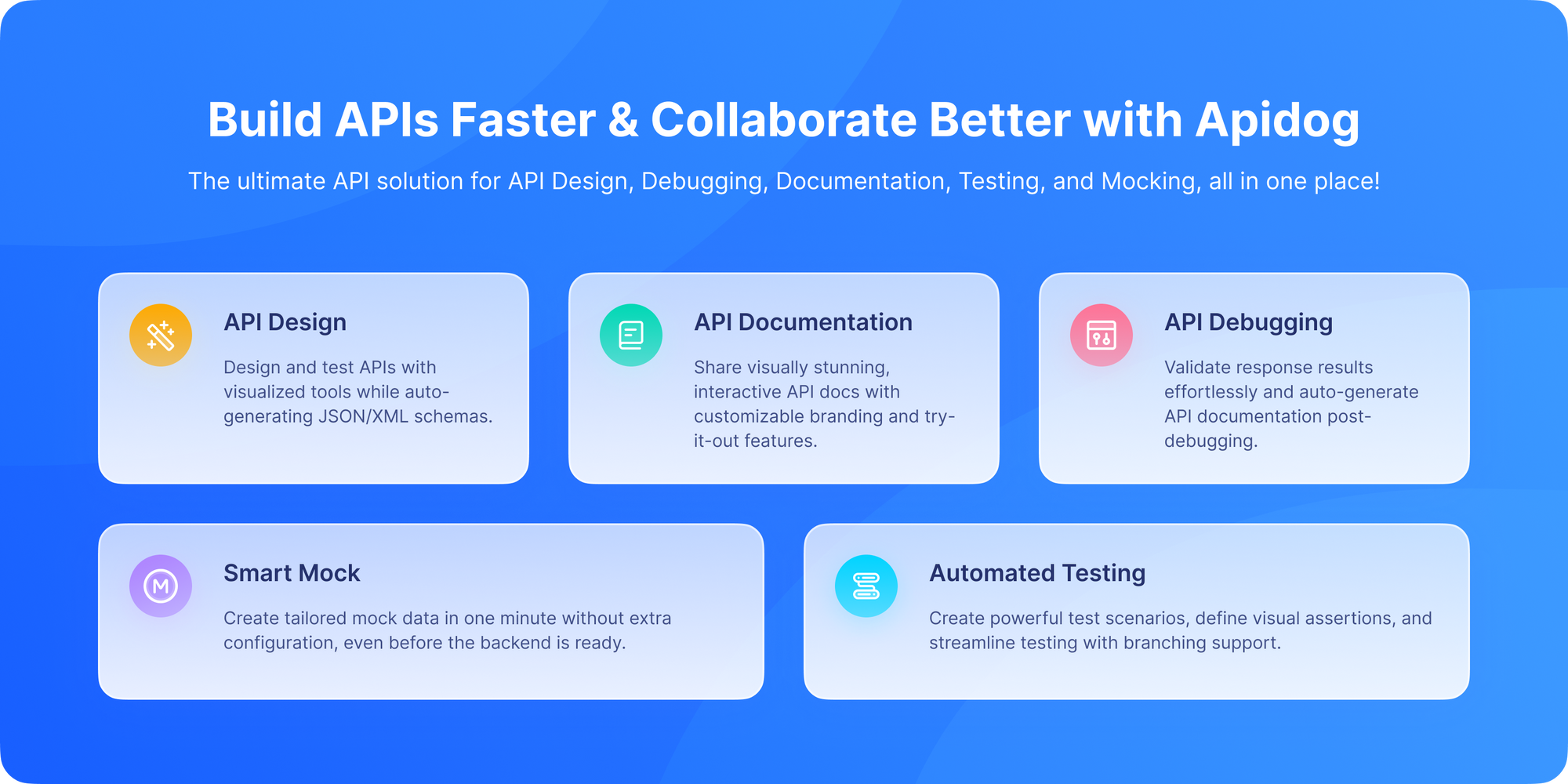
Let’s begin with the one tool that covers not just mocking but the entire API lifecycle.
Apidog is a powerful API design + documentation + testing + mocking platform that integrates seamlessly into schema-first workflows.
Why It's #1 for Schema-First Workflows
Apidog supports bi-directional OpenAPI syncing, meaning:
- If you update your OpenAPI file → your mocks update.
- If you modify an API model in the GUI → your spec updates.
This is a huge advantage over single-purpose mock servers.
Key Features of Apidog Mock Server:
- Automatic mock server generation from OpenAPI
- Support for mock rules, variables, randomization, and model inheritance
- Environment support (dev, test, staging, global teams)
- Cloud mocks + self-hosted mock server runner
- Team collaboration (comments, versioning, revisions)
- Instant debugging tools
- Beautiful documentation tied directly to the spec
- Real-time schema validation
Strengths:
- Zero-Configuration Mocks: Mocks are created instantly with no extra setup.
- Deep Schema Integration: Generates highly realistic fake data based on your defined models (e.g., correctly formatted emails, realistic names).
- Visual Management: Easily manage different response examples (success, error) through a clean UI.
- Team-Centric: Mock servers are shared with your team in the workspace, perfect for collaboration.
Weaknesses:
- Platform Commitment: You're adopting Apidog as your primary API tool, not just a mock server.
- Less "Local-First": While it offers great features, it's primarily a cloud-based platform.
Why Developers Love It
Because Apidog does more than mock it creates a single source of truth for your entire API.
Design-first developers especially value the OpenAPI integration and how easy it is to test generated mock endpoints.
Apidog is easily the most complete platform in this list.
2. Prism by Stoplight: Mock Server for OpenAPI Purists
Prism is one of the most respected OpenAPI-native mocking tools in the community.
What Makes Prism Great?
Prism fully embraces the OpenAPI philosophy:
- Strict validation
- Schema-based responses
- Example-first return values
- CLI + Docker + programmatic use
Key Features:
- Full OAS 3.0 support
- Dynamic responses
- Validates incoming requests
- Can simulate errors based on OAS rules
- Perfect for contract testing
Strengths:
- Incredibly Fast & Lightweight: Runs locally, no cloud dependency.
- Dynamic Examples: If you define
examplesin your OpenAPI spec, Prism can cycle through them. - Request Validation: It can validate incoming requests against your schema, which is fantastic for testing.
- "Proxy" Mode: Can act as a proxy to your real API, forwarding calls but returning mocks for unimplemented endpoints.
Weaknesses:
- CLI-First: No GUI. Great for developers, less so for non-technical team members.
- Limited Logic: Advanced response customization requires more complex setup.
Why it's popular
It's open-source, highly accurate, and integrates perfectly with OpenAPI schemas ideal for schema-first workflows.
3. WireMock: Best for Enterprise Mocking with OpenAPI Extensions
WireMock is a longtime favorite for larger organizations with complex backend systems.
Why WireMock Works Well for OpenAPI
WireMock now supports:
- OpenAPI imports
- Automatic stub generation
- Transformer extensions for customizing response logic
Advantages:
- Ideal for microservices environments
- Integration with CI/CD
- Stateful mocking support
- Dynamic rules
- Reliable for enterprise-level testing
Weaknesses:
- High Complexity: Significant learning curve. Overkill for simple schema mocking.
- Configuration-Heavy: Requires detailed stub mapping configuration for full power.
If your schema-first workflow includes advanced backend validations or legacy systems, WireMock shines.
4. Mockoon: Best GUI Mock Server for Schema-First Teams
Mockoon provides an easy-to-use desktop app for creating mock APIs visually.
Why Schema-First Users Like It?
Mockoon now supports:
- OpenAPI import
- Schema-driven route generation
- Multiple mock environments
Strengths:
- Very visual
- Fast onboarding
- No-code mock editing
- Local-first
Weaknesses:
- OpenAPI as Import-Only: It imports a spec to create routes, but the mocks are managed within Mockoon. There's no live sync if your spec changes, you must re-import or update manually.
- Not Schema-Driven at Runtime: The mocking logic is defined in the app, not dynamically interpreted from a live OpenAPI file.
Best for: Frontend developers and testers who want a powerful, visual, local mock server and don't need deep, dynamic OpenAPI integration.
For developers who hate YAML but still follow schema-first practices, Mockoon is a lifesaver.
5. SwaggerHub Auto-Mock — SmartBear
SwaggerHub is built around OpenAPI design-first workflows, so mocking is well integrated.
Key Advantages:
- Cloud-hosted mock servers
- Enterprise features
- API versioning
- Standardized collaboration
Strengths:
- Native OpenAPI Hosting: The mock server works directly with your hosted spec no import/export needed.
- Auto-Generated Examples: If you don't provide examples, it can generate basic ones from your schema.
- Professional Documentation & Mocking Combined: The mock server powers the interactive documentation.
Weaknesses:
- Pricing: Advanced features, including more customizable mocking, are in paid tiers.
- Less Flexible for Complex Logic: Best for straightforward, example-based mocking.
It’s more expensive and less flexible than Apidog or Prism.
Best for: Teams using SwaggerHub as their central API design and documentation hub who need integrated, simple mocking.
But for large enterprise teams already using SmartBear, it’s a natural fit.
6. Postman Mock Server
While Postman is not 100% OpenAPI-native, it still supports:
- OpenAPI import
- Mock server creation
- Team collaboration
Pros:
- Easy for beginners
- Cloud-based
- Can simulate examples
Cons:
- Limited schema enforcement
- Not fully aligned with schema-first methodologies
- Can become expensive at scale
Still a valid option depending on your stack.
7. OpenAPI Generator — Mock Server Module
OpenAPI Generator is traditionally used for client + server code generation.
But many people forget that it also includes mock server templates.
Great For:
- Code-first + schema-first hybrid teams
- Anyone needing language-specific mock generation
- Tight CI/CD integration
If your spec generates your codebase AND your mock server this tool becomes extremely powerful.
8. Spectral Mock Environment — Stoplight Platform
Stoplight’s cloud platform includes mock capabilities that integrate with Spectral validation.
Highlights:
- Ruleset-driven validation
- Auto mock generation
- Collaborative interface
- Works great with design-first teams
This is ideal for teams already using Spectral for linting.
9. Beeceptor: Rule-Based Mock Server with OpenAPI Imports
Beeceptor can import OpenAPI schemas and generate mock routes quickly.
Pros:
- Simple
- Cloud-based
- Good rule system
Cons:
- Less dynamic than Apidog or Prism
- Limited advanced schema features
Still very good for small to medium-sized teams.
10. Mirage JS: Best for Frontend Mocking in Schema-First Workflows
Mirage JS doesn’t import OpenAPI directly (yet), but schema-first developers often use it because:
- You can sync your models with OpenAPI definitions
- It runs directly inside your frontend app
- It’s great for SPA prototyping
Where it fits best:
- React
- Vue
- Next.js
- Svelte
If your schema-first workflow is frontend-driven, Mirage JS helps you stay API-ready even when the backend is just a spec.
Comparison Table: Best Mock Servers for OpenAPI Schema-First Workflows
| Tool | Schema-First Strength | Collaboration | Dynamic Responses | Hosting Options | Highlights |
|---|---|---|---|---|---|
| Apidog | ★★★★★ | ★★★★★ | ★★★★★ | Cloud + Self-hosted | Best overall |
| Prism | ★★★★★ | ★★☆☆☆ | ★★★★★ | CLI/Docker | Best spec accuracy |
| WireMock | ★★★★☆ | ★★★★☆ | ★★★★★ | Local/Cloud | Enterprise-grade |
| Mockoon | ★★★☆☆ | ★★★☆☆ | ★★★☆☆ | Local | Best GUI |
| SwaggerHub | ★★★★☆ | ★★★★☆ | ★★★☆☆ | Cloud | Enterprise |
| Postman | ★★★☆☆ | ★★★☆☆ | ★★★☆☆ | Cloud | Familiar choice |
| OpenAPI Generator | ★★★★☆ | ★★★☆☆ | ★★★★☆ | CLI/Docker | Great CI/CD |
| Stoplight Platform | ★★★★☆ | ★★★★☆ | ★★★☆☆ | Cloud | Design-first |
| Beeceptor | ★★★☆☆ | ★★★☆☆ | ★★★☆☆ | Cloud | Simple rules |
| Mirage JS | ★★★☆☆ | ★★☆☆☆ | ★★★☆☆ | In-app | Best for frontend |
Conclusion: Mocking Empowers Schema-First Workflow
A robust mock server is the bridge that turns your static OpenAPI specification into a dynamic, collaborative asset. It validates your design, unblocks your frontend team, and accelerates development.
Whether you choose a lightweight CLI tool, a powerful desktop app, or an all-in-one collaborative platform, investing in the right mock server will pay dividends throughout your API lifecycle. Start mocking, and watch your schema-first workflow truly come to life.