
TL;DR
GLM-5.1 is Z.AI's next-generation flagship model, released April 2026. It's built specifically for agentic engineering: long-running coding tasks, autonomous optimization loops, and complex software projects that require hundreds of iterations. It ranks #1 on SWE-Bench Pro (58.4), leads on Terminal-Bench 2.0 (69.0), and outperforms GLM-5 on every major coding benchmark. Open weights are available under the MIT License.
Introduction
Most AI models hit a ceiling after a few dozen tool calls. They make fast early progress on a coding problem, plateau, and then keep producing diminishing returns no matter how much time you give them. You end up babysitting the agent or accepting a mediocre result.
GLM-5.1 is designed to break that pattern. Z.AI, the team behind the GLM model family at Zhipu AI, released GLM-5.1 in April 2026 as their most capable model for agentic tasks. The key claim is not raw benchmark performance on a single pass. It's long-horizon effectiveness: the ability to keep making meaningful progress over 600 iterations, 8 hours, and thousands of tool calls.
What is GLM-5.1?
GLM-5.1 is a large language model from Zhipu AI, released through their Z.AI developer platform in April 2026. The "GLM" stands for General Language Model, a model architecture Zhipu has been developing since 2021.
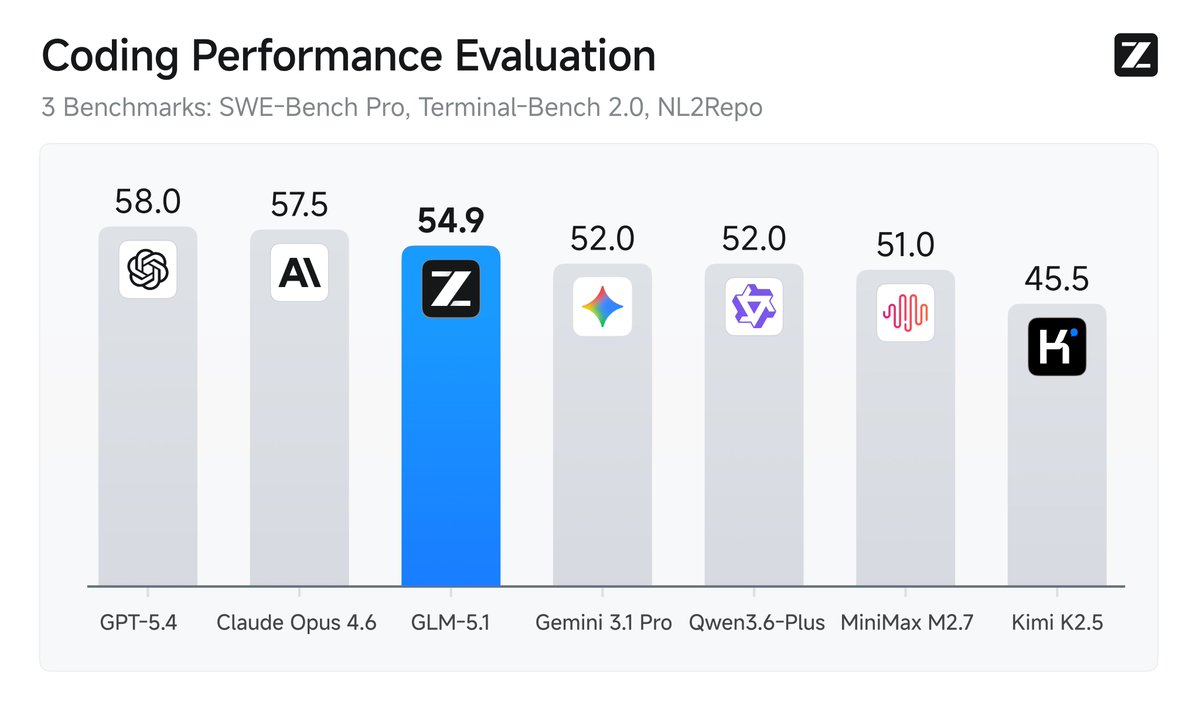
GLM-5.1 is the successor to GLM-5, which itself launched in late 2025. The 5.1 update focuses almost entirely on agentic capabilities: the ability to work autonomously on long-running tasks without requiring frequent human intervention or hitting performance walls.
It's not primarily a reasoning model, a creative writing model, or a general chatbot. Z.AI positions it explicitly as a model for agentic engineering: building software, running optimization loops, writing and executing code across many iterations, and solving problems that require sustained effort over long sessions.
The model weights are publicly available on Hugging Face under the MIT License. You can run it locally with vLLM or SGLang, or access it through the BigModel API or the Z.AI developer platform.
GLM-5.1 benchmark performance
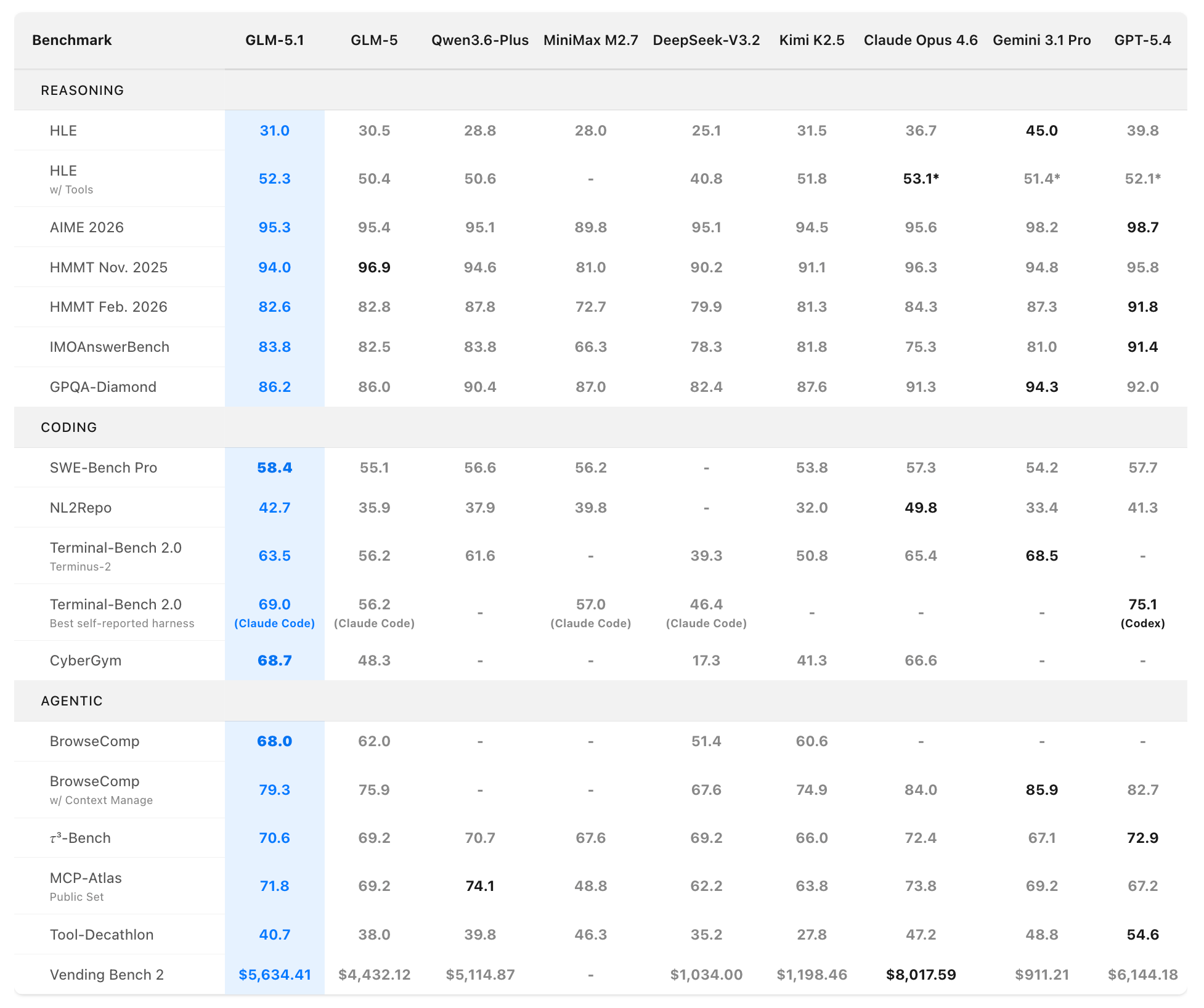
Z.AI published benchmark results comparing GLM-5.1 against GLM-5, GPT-5.4, Claude Opus 4.6, and Gemini 3.1 Pro. The results cover three broad categories: software engineering, reasoning, and agentic tasks.
Software engineering
| Benchmark | GLM-5.1 | GLM-5 | GPT-5.4 | Opus 4.6 | Gemini 3.1 Pro |
|---|---|---|---|---|---|
| SWE-Bench Pro | 58.4 | 55.1 | 57.7 | 57.3 | 54.2 |
| NL2Repo | 42.7 | 35.9 | 41.3 | 49.8 | 33.4 |
| Terminal-Bench 2.0 | 69.0 | 56.2 | 75.1 | 65.4 | 68.5 |
| CyberGym | 68.7 | 48.3 | — | 66.6 | — |
GLM-5.1 ranks #1 on SWE-Bench Pro, the standard benchmark for autonomous software engineering tasks. On Terminal-Bench 2.0, GPT-5.4 scores higher (75.1) but GLM-5.1 leads GLM-5 by a wide margin (69 vs 56.2).
The NL2Repo score (42.7) measures long-horizon repository generation. Claude Opus 4.6 leads here at 49.8, but GLM-5.1 beats GLM-5 by 6.8 points and outperforms every other model in this comparison.
Reasoning
| Benchmark | GLM-5.1 | GLM-5 | GPT-5.4 | Opus 4.6 | Gemini 3.1 Pro |
|---|---|---|---|---|---|
| HLE (w/ Tools) | 52.3 | 50.4 | 52.1* | 53.1* | 51.4* |
| AIME 2026 | 95.3 | 95.4 | 98.7 | 95.6 | 98.2 |
| HMMT Nov. 2025 | 94.0 | 96.9 | 95.8 | 96.3 | 94.8 |
| GPQA-Diamond | 86.2 | 86.0 | 92.0 | 91.3 | 94.3 |
On reasoning benchmarks, GLM-5.1 is competitive but not the leader. GPT-5.4 and Gemini 3.1 Pro lead on AIME 2026 and GPQA-Diamond. GLM-5.1's strength is in coding and agentic tasks, not pure reasoning.
Agentic tasks
| Benchmark | GLM-5.1 | GLM-5 | GPT-5.4 | Opus 4.6 | Gemini 3.1 Pro |
|---|---|---|---|---|---|
| BrowseComp (w/ Context) | 79.3 | 75.9 | 82.7 | 84.0 | 85.9 |
| MCP-Atlas (Public) | 71.8 | 69.2 | 67.2 | 73.8 | 69.2 |
| Tool-Decathlon | 40.7 | 38.0 | 54.6 | 47.2 | 48.8 |
| Agentic | 68.0 | 62.0 | — | — | — |
On MCP-Atlas, GLM-5.1 leads the field at 71.8. On BrowseComp and Tool-Decathlon, it's mid-tier. The Agentic benchmark score (68 vs 62 for GLM-5) shows the clearest improvement from the previous generation.
What makes GLM-5.1 different: long-horizon optimization
The benchmark tables tell part of the story. The more interesting part is what Z.AI demonstrated beyond single-pass benchmarks.
Most coding models improve quickly on a task, then plateau. GLM-5.1 is built to stay useful over much longer runs. Z.AI tested this across three scenarios with progressively less structured feedback.
Scenario 1: vector database optimization over 600 iterations
Z.AI ran GLM-5.1 on a vector search optimization challenge using the SIFT-1M dataset. The model was given a Rust skeleton and asked to maximize queries per second (QPS) with recall above 95%. Instead of a standard 50-turn budget, they set up an outer loop where GLM-5.1 could run as many iterations as needed.
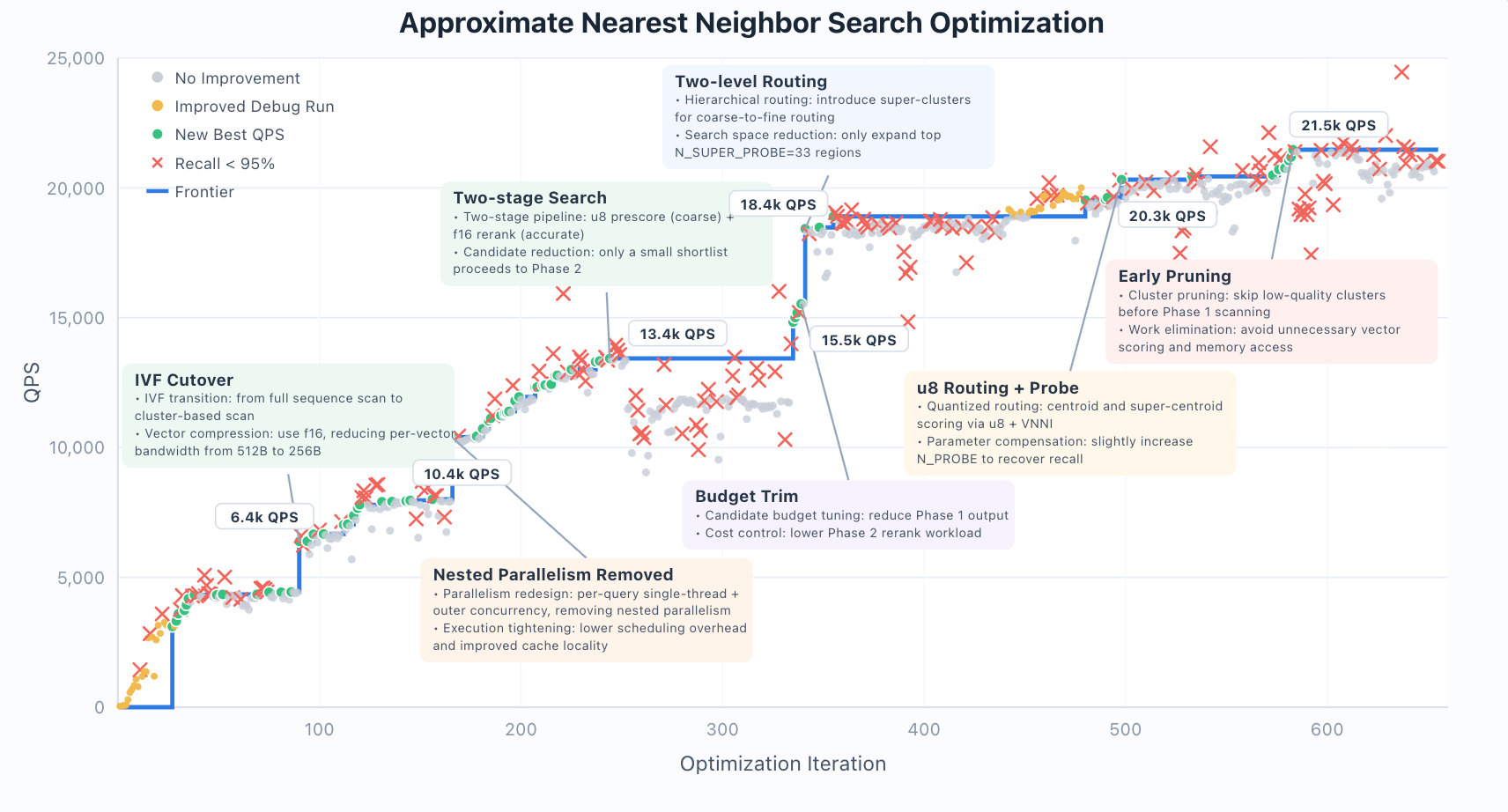
The results show the difference clearly. The best single-session result across all models was 3,547 QPS (Claude Opus 4.6). GLM-5.1 running over 600+ iterations with 6,000+ tool calls reached 21,500 QPS, roughly 6 times that result.
The improvement wasn't continuous. The model made structural transitions at key points: around iteration 90, it shifted from full-corpus scanning to IVF cluster probing with f16 vector compression, jumping from ~3,500 to 6,400 QPS. Around iteration 240, it introduced a two-stage pipeline combining u8 prescoring with f16 reranking, reaching 13,400 QPS. Six such structural transitions occurred over the full run, each triggered after the model analyzed its own benchmark logs and identified the current bottleneck.
Scenario 2: GPU kernel optimization over 1,000+ turns
Z.AI ran a GPU kernel benchmark comparing GLM-5.1 against GLM-5 and Claude Opus 4.6. The task was to take reference PyTorch code and produce faster CUDA kernels.
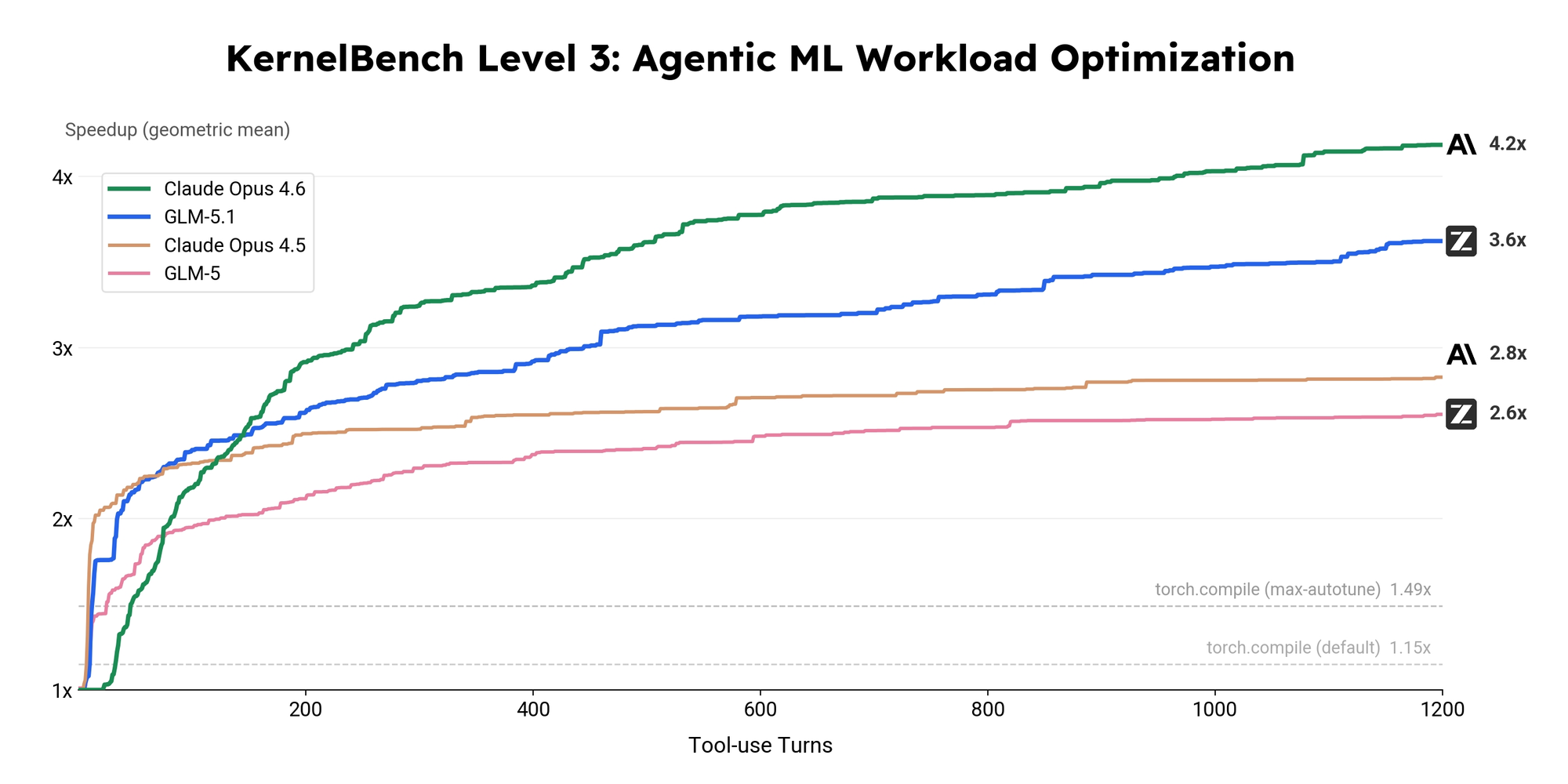
GLM-5.1 reached 3.6x speedup over the baseline. Claude Opus 4.6 led at 4.2x and still showed headroom at the end of the run. GLM-5 plateaued earlier and finished lower. The result confirms the pattern: GLM-5.1 sustains improvement for longer than GLM-5 but hasn't yet matched the top model on this specific task.
Context window and technical specs
GLM-5.1 supports a 200K token context window. This is important for agentic tasks where the model accumulates tool call history, code files, test outputs, and error logs across many iterations.
| Spec | Value |
|---|---|
| Context window | 200,000 tokens |
| Max output | 163,840 tokens |
| Architecture | Autoregressive transformer (GLM family) |
| License | MIT (open weights) |
| Inference frameworks | vLLM, SGLang |
| Model weights | HuggingFace (zai-org) |
Availability and pricing
GLM-5.1 is available through three channels.
BigModel API (bigmodel.cn): The primary developer API. You use the model name glm-5.1 in your API requests. Pricing uses a quota system rather than per-token billing. GLM-5.1 consumes 3x quota during peak hours and 2x during off-peak. As a limited-time promotion through the end of April 2026, off-peak usage is billed at 1x. Peak hours are 14:00-18:00 UTC+8 daily.
GLM Coding Plan (Z.AI): A subscription plan for developers using AI coding assistants. GLM-5.1 is available to all Coding Plan subscribers. You enable it by updating the model name in your coding assistant config. The plan works with Claude Code, Cline, Kilo Code, Roo Code, OpenCode, and Droid. Pricing starts at $10/month.
Local deployment: The model weights are on HuggingFace at zai-org/GLM-5.1. You can run it with vLLM or SGLang. Deployment docs are at the official GitHub repository.
GLM-5.1 vs GLM-5: what actually changed
GLM-5 was already a strong coding model. GLM-5.1 improves on it in a specific way: it extends the window of useful work.
The core change is not in first-pass performance. On most benchmarks, GLM-5.1 leads GLM-5 by 3-7 points, which is meaningful but not dramatic. The real difference shows up when you give both models the same task with unlimited time.
GLM-5 improves quickly and then levels off. GLM-5.1 continues making progress beyond the point where GLM-5 stops. This matters for agentic applications where you want the model to keep working autonomously rather than requiring you to intervene and redirect it.
Concretely: GLM-5 on the vector search benchmark plateaued around 8,000-10,000 QPS with extended time. GLM-5.1 reached 21,500 QPS. On the GPU kernel benchmark, GLM-5 finished lower and earlier than GLM-5.1. On the Linux desktop task, GLM-5 produced a skeleton and stopped.
The model still has meaningful gaps. Claude Opus 4.6 leads on GPU kernel optimization and BrowseComp.
GLM-5.1 vs competitors
GLM-5.1 vs Claude Opus 4.6
On software engineering benchmarks, GLM-5.1 leads on SWE-Bench Pro (58.4 vs 57.3) and CyberGym (68.7 vs 66.6). Claude Opus 4.6 leads on NL2Repo (49.8 vs 42.7), GPU kernel optimization, and BrowseComp. For API access, Claude is significantly more expensive. GLM-5.1 through the BigModel API or Coding Plan is priced for developers running high-volume agent loops.
GLM-5.1 vs GPT-5.4
GPT-5.4 leads on Terminal-Bench 2.0 (75.1 vs 69.0) and most reasoning benchmarks. GLM-5.1 leads on SWE-Bench Pro (58.4 vs 57.7) and MCP-Atlas (71.8 vs 67.2). For developers in China or those building on Chinese AI infrastructure, BigModel API access to GLM-5.1 is notably easier than GPT-5.4 access.
GLM-5.1 vs Gemini 3.1 Pro
Gemini 3.1 Pro leads on reasoning (AIME 2026, GPQA-Diamond) and BrowseComp. GLM-5.1 leads on SWE-Bench Pro, Terminal-Bench 2.0, and CyberGym. For code-first use cases, GLM-5.1 is the stronger choice. For general reasoning and document analysis, Gemini holds an edge.
Use cases GLM-5.1 is best suited for
Autonomous coding agents: Long-running tasks where you want the model to make decisions about what to try next, run tests, analyze results, and continue without frequent human checkpoints. For a deep dive on how agents manage memory across these runs, see how AI agent memory works. The 200K context window and long-horizon optimization capability make it well suited here.
AI coding assistants (Claude Code, Cline, Cursor integrations): GLM-5.1 is explicitly supported in the Z.AI Coding Plan for use with Claude Code, Cline, Kilo Code, Roo Code, and other AI coding tools. Developers who want a strong coding model without paying per-token Claude or GPT pricing can route through BigModel.
Software engineering automation (SWE-Bench class tasks): GitHub issue resolution, pull request generation, bug fix automation. GLM-5.1's #1 ranking on SWE-Bench Pro makes it a credible choice for these pipelines.
Competitive programming and optimization: GPU kernel tuning, performance benchmarking, algorithm optimization where the model can run experiments and adapt its strategy based on results.
What it's not best for: General-purpose chatbot, creative writing, document Q&A where reasoning quality matters more than code output. For those use cases, the reasoning benchmarks show Gemini and GPT-5.4 hold advantages.
How to try GLM-5.1 today
The fastest way to try it is through the Z.AI chat interface at z.ai, which runs GLM-5.1 by default. No API key needed for the chat interface.
For API access, create an account at bigmodel.cn and generate an API key. The API is OpenAI-compatible, so any client that works with GPT models also works with GLM-5.1. The model name to use in requests is glm-5.1.
For local deployment, the weights are at huggingface.co/zai-org. Full setup instructions are in the official GitHub repo at github.com/zai-org/GLM-5.1.
For a detailed walkthrough of the API with code examples, authentication, and testing setup, see the GLM-5.1 API guide.
Conclusion
GLM-5.1 is a significant step forward from GLM-5, specifically in how long it stays useful on hard agentic tasks. The SWE-Bench Pro #1 ranking and the 600-iteration vector search demonstration make a credible case that this is the strongest open-weights model for autonomous coding workflows currently available.
It doesn't lead on every benchmark. Claude Opus 4.6 and GPT-5.4 are stronger on reasoning, GPU optimization, and some agentic tasks. But for developers who want to run sustained coding agents without paying the cost of closed frontier models, GLM-5.1 under the MIT License with BigModel API access is a serious option.
The open weights and MIT license are worth emphasizing. You can run GLM-5.1 locally, fine-tune it, and deploy it in your own infrastructure without any usage restrictions.
FAQ
What does GLM stand for?General Language Model. It's the model architecture Zhipu AI has been developing since 2021, based on autoregressive blank infilling rather than the decoder-only approach used by GPT-family models.
Is GLM-5.1 open source?Yes. The model weights are released under the MIT License on HuggingFace at zai-org/GLM-5.1. MIT is one of the most permissive open source licenses, allowing commercial use, fine-tuning, and redistribution.
What context window does GLM-5.1 support?200,000 tokens (approximately 150,000 words), with a maximum output of 163,840 tokens.
How does GLM-5.1 compare to DeepSeek-V3.2?Z.AI's benchmarks show GLM-5.1 leading DeepSeek-V3.2 on software engineering tasks. On reasoning benchmarks, DeepSeek-V3.2 is competitive. For coding agents specifically, GLM-5.1 is the stronger choice based on the published data.
Can I use GLM-5.1 with Claude Code or Cursor?Yes. The Z.AI Coding Plan supports Claude Code, Cline, Kilo Code, Roo Code, and OpenCode via the BigModel API. You update the model name in your coding assistant's config file. Plans start at $10/month.
How do I access GLM-5.1 via API?Create an account at bigmodel.cn, generate an API key, and use model name glm-5.1 in requests to https://open.bigmodel.cn/api/paas/v4/chat/completions. The full API walkthrough is in the GLM-5.1 API guide.
Is GLM-5.1 available for free?The Z.AI chat interface at z.ai is free to use. API access through BigModel uses a quota system with paid plans. Off-peak usage is billed at 1x quota through end of April 2026 as a promotional rate.