Introduction: The Inevitable Shift
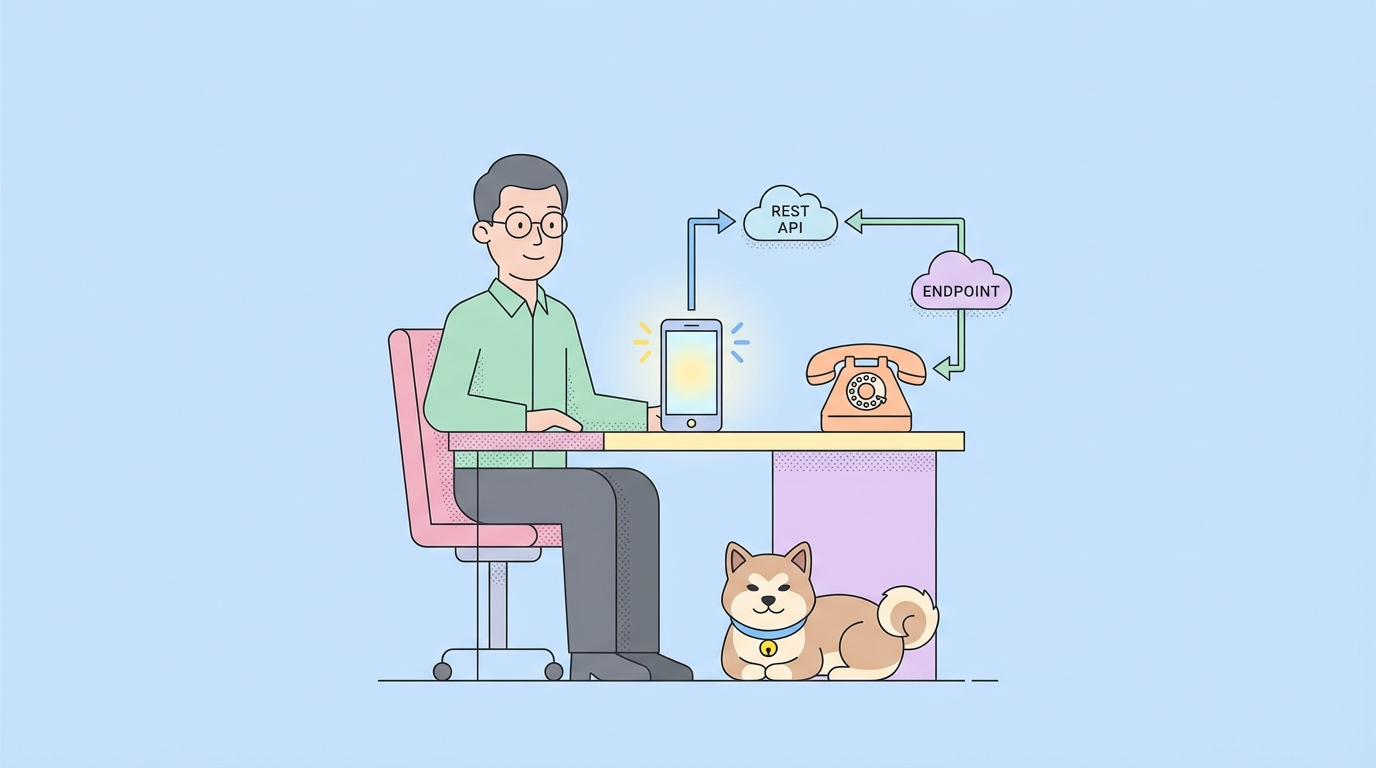
It’s impossible to ignore the current AI hype. While many engineering teams are focused on "sprinkling AI" onto their products as a new feature, they are missing a more fundamental, tectonic shift: AI is rapidly becoming the primary consumer of APIs, not just a component within an application.
This evolution changes the very nature of an API. For years, we have built APIs as deterministic, stateless interfaces where a given input produces a predictable output. That era is ending. This is because AI agents need to perform complex, multi-step tasks that require context preservation across multiple interactions. To serve them, APIs must evolve into "probabilistic policy interfaces"—systems where outputs can vary within an acceptable range of behavior, optimized for machine consumption.
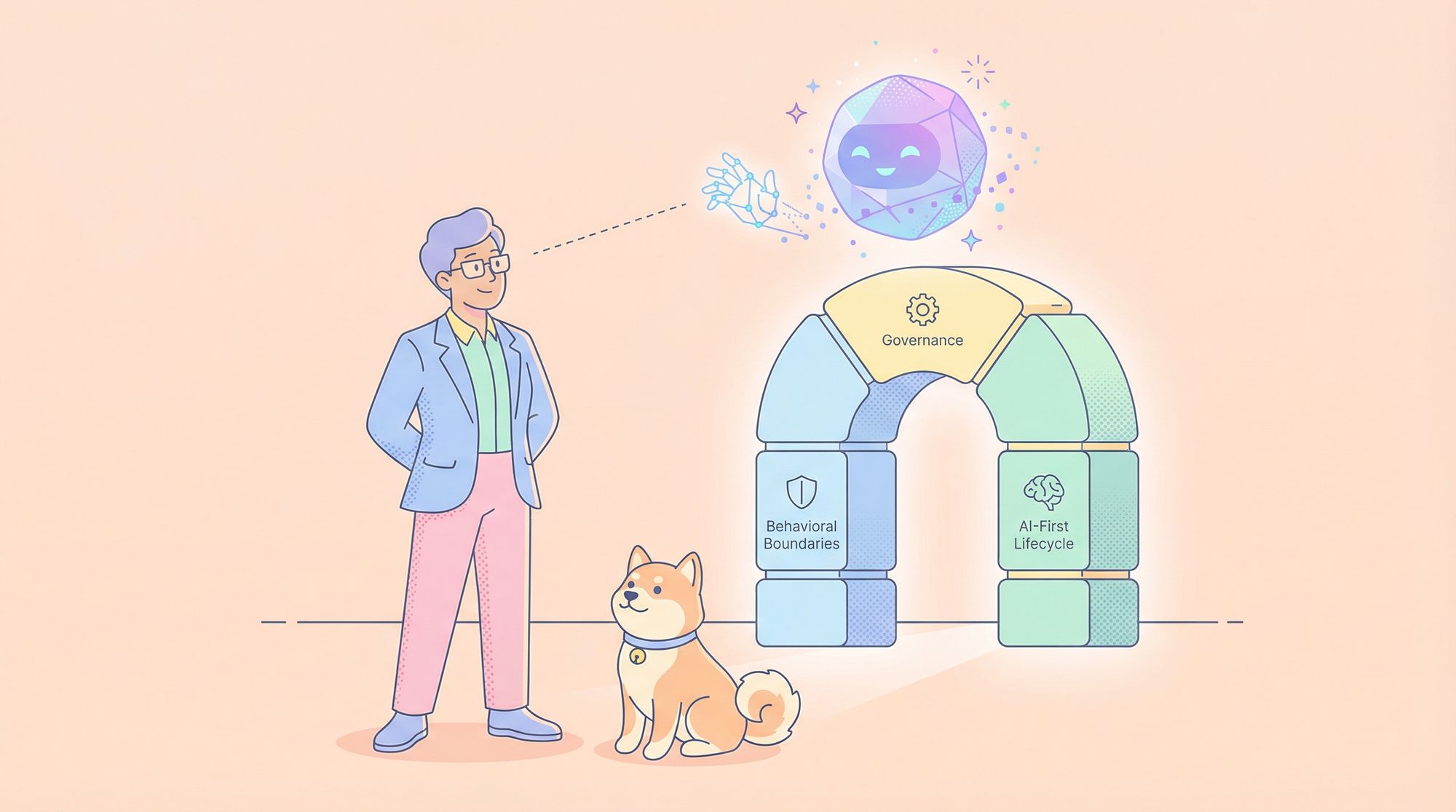
This post will not add to the AI hype. Instead, it will answer a critical question based on observed industry trends: To survive and thrive as AI-first becomes the default, what are the three foundational pillars an engineering team must build today?
1. Your Contract Is No Longer a Checklist—It's a Behavioral Boundary
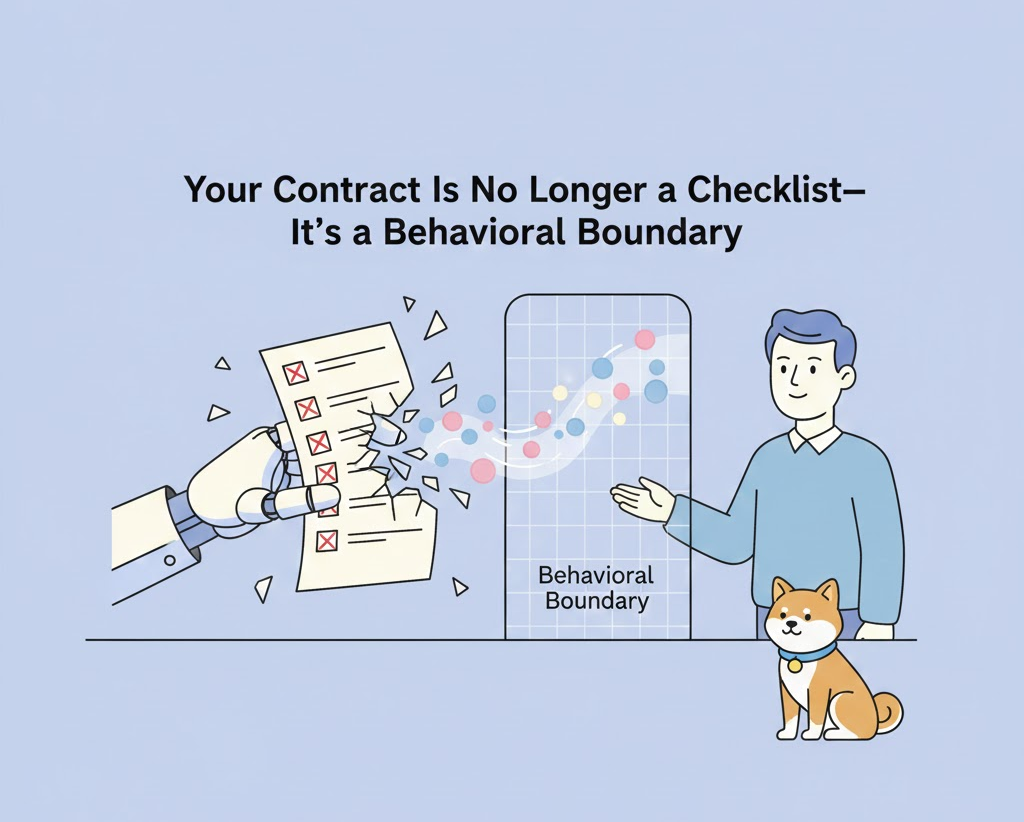
Traditionally, we have viewed an API contract as a rigid checklist. The job of a QA team was to confirm that an API call returned the correct data fields, matched the expected data types, and produced the right status code. The contract was a binary measure of success or failure.
In the new paradigm of AI-first APIs, this checklist mentality is obsolete. The same API call, consumed by an AI agent, might produce outputs that "drift." The new role of an API contract is to define the "behavioral boundaries" of the API (e.g., guaranteeing latency under 200ms, ensuring a specific JSON key is always present, or validating the semantic accuracy of a generated summary). It no longer guarantees a single, specific outcome; instead, it guarantees that any outcome will fall within a predefined corridor of reliability, performance, and contextual accuracy.
This shift forces a complete re-evaluation of how engineering and QA teams measure success. The QA process is no longer about validating a single, expected value but about verifying the API’s behavior against performance thresholds (latency), efficiency metrics (payload size), and the consistent presence of critical data fields even when the overall structure is variable.
"In an AI-first world, QA must verify that an API's 'behavior falls within a reliable range,' not just that it returns a single expected value."
2. Without Governance, AI Will Only Automate Your Chaos
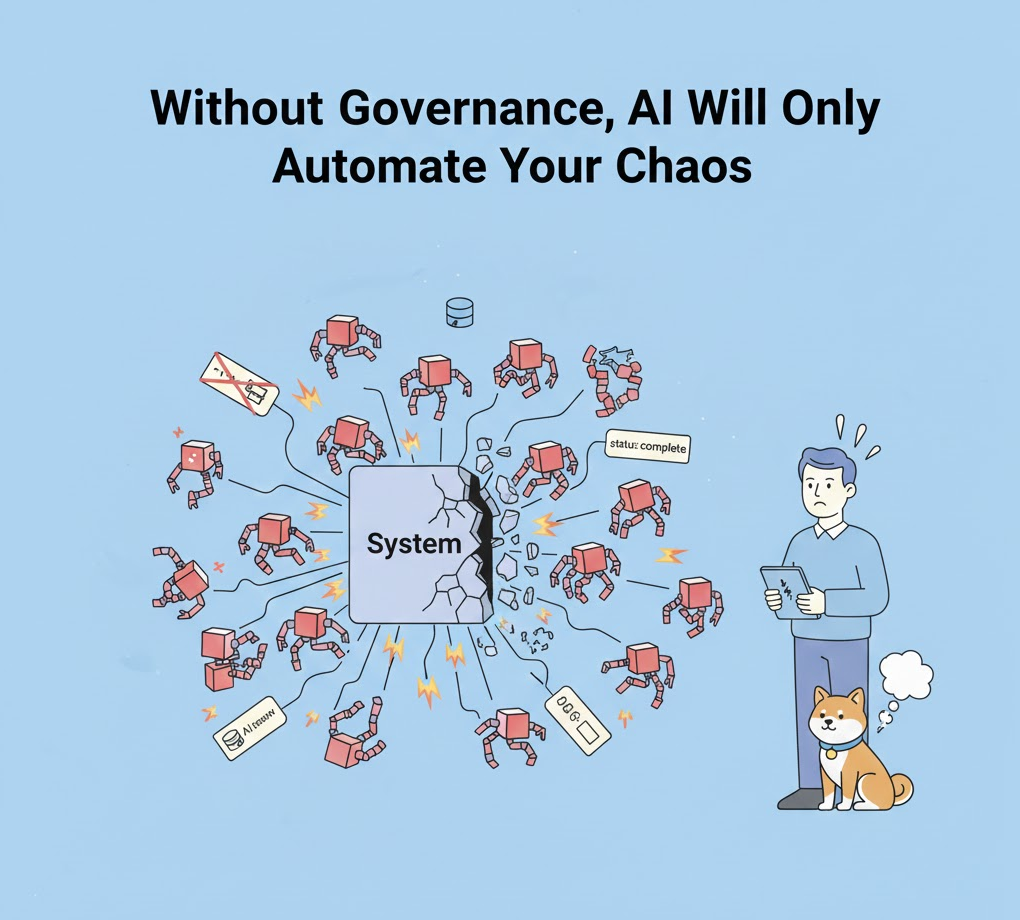
Integrating powerful AI agents into a system that lacks strong API governance and well-defined contracts will not create efficiency; it will automate chaos. An AI agent is an amplification engine, capable of executing thousands of operations per second. Any existing misalignment between your teams will be magnified at an accelerated rate, creating systemic failures.
This chaos manifests in technically destructive ways:
- The AI agent calling the wrong APIs due to ambiguous naming—a direct result of failing to establish the centralized guidelines for schema structure and naming conventions that strong governance provides.
- The agent misinterpreting the semantic meaning of data—for instance, reading a
status: 'complete'field on an order that is actually back-ordered and triggering an erroneous shipping notification. - The agent performing irreversible automated actions based on flawed assumptions derived from an inconsistent API.
This is why foundational "API-first" principles are no longer just best practices—they are non-negotiable prerequisites for successful AI integration. The discipline of defining the API contract first creates a single source of truth. In a true API-first model, the UI itself consumes the same public API, which guarantees that an AI agent has access to the exact same functionality as a human user.
Without a unified specification, disciplined version management, and clear impact analysis for every change, integrating AI will introduce more hard-to-debug accidents than productivity gains.
3. The API Lifecycle Must Become "AI-First Friendly"
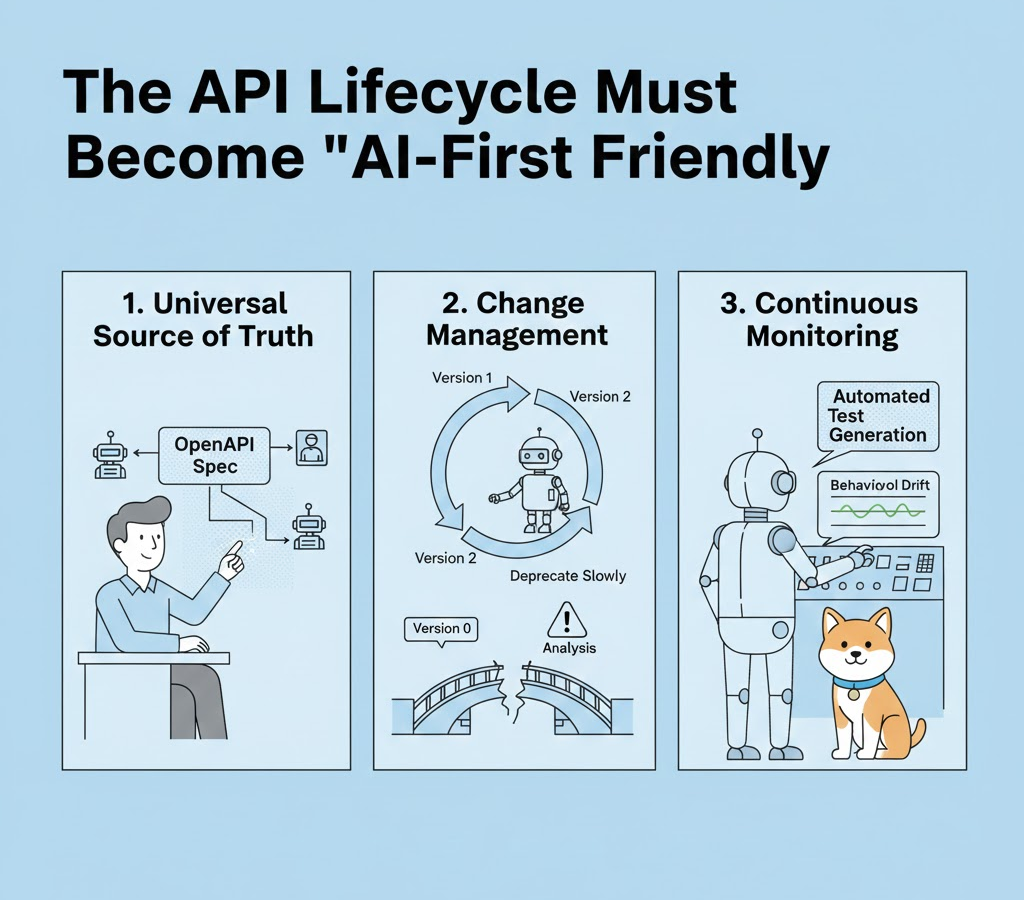
For APIs to serve their new primary consumer, the entire API lifecycle must evolve. We have to move beyond simply creating "documentation for humans and debugging tools for humans" and retool our processes for machine-centric consumption. This evolution stands on three pillars.
- The Spec as a Universal Source of Truth The API specification (e.g., OpenAPI) must be meticulously maintained as the common ground truth for both human developers and AI agents. It is the foundational document that serves as a shared agreement for planning, building, and validation. When the spec is the absolute source of truth, it enables an AI agent to understand every endpoint, every data model, and every possible error state without ambiguity.
- Change Management as a Control Mechanism For an autonomous AI agent performing a complex, multi-step task, an unannounced breaking change isn't an inconvenience; it's a catastrophic operational failure. A clear impact analysis for any API change is therefore critical. Disciplined API versioning is essential to ensure backward compatibility, providing a stable and predictable environment for the AI agents that depend on them. You must deprecate endpoints slowly, allowing consumers time to migrate. Without this control, the operational boundaries of an AI agent become dangerously unpredictable.
- Testing as Continuous Monitoring The nature of API testing must fundamentally change. The process must shift from a human developer manually "writing use cases" to a dynamic system of "automated test generation and continuous monitoring for drift." AI-powered tools can "simulate diverse inputs, and identify edge cases" that manual testing would miss. They can also "analyze performance logs in real time to detect anomalies." This ensures the API's probabilistic behavior remains within its defined, acceptable boundaries over time.
Conclusion: Prepare for the New Default
The transition to an AI-driven ecosystem requires a deliberate and foundational shift in how we build and manage APIs. This involves redefining API contracts as behavioral boundaries, making governance a non-negotiable prerequisite to avoid automating chaos, and evolving the entire API lifecycle to be inherently AI-first friendly.
This work is not about chasing the latest AI hype. It is about architecting for survival and competitive advantage. Building resilient, durable, and future-proof engineering practices is the only way to prepare for a world where AI-driven systems are the default, not the exception.
As we head towards 2026, the question for every engineering leader is no longer if they will adopt AI, but if they have built a foundation strong enough to handle it. Which of these pillars does your team need to strengthen first?