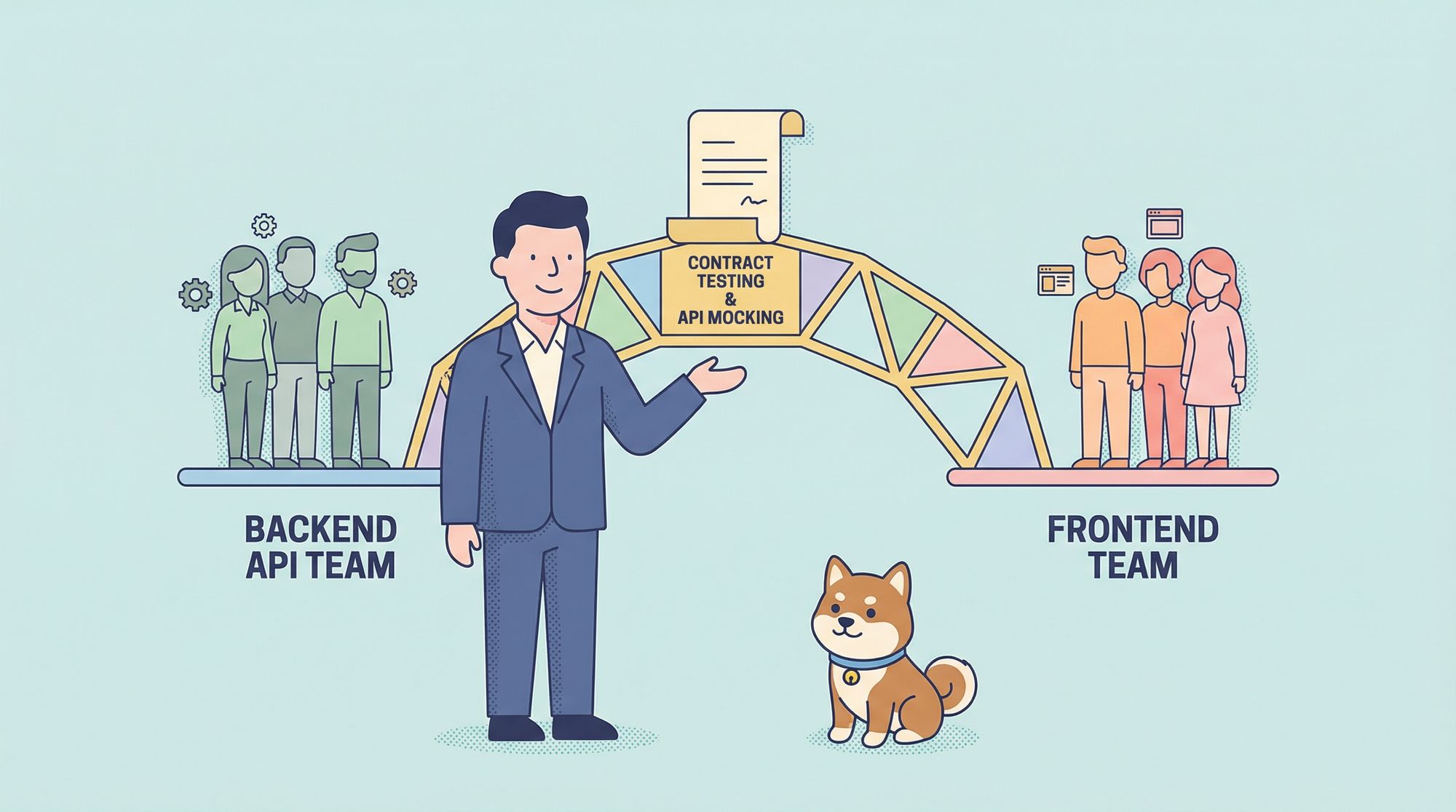
You're leading two development teams: one building the backend API, and one building the frontend that consumes it. They need to work in parallel to hit the deadline, but there's a problem. The frontend team is stuck, constantly asking, "Is the /user endpoint ready yet?" The backend team replies, "Next week!" This dance repeats for every endpoint, slowing everyone down and creating integration nightmares later.
This all-too-common scenario is exactly what contract testing and API mocking are designed to solve. They're the dynamic duo of modern, efficient API development. But with dozens of tools shouting for your attention, how do you choose the right one?
The right tool isn't just about features; it's about fitting into your workflow and empowering your team. It should help you define the API contract, mock it instantly for frontend developers, and then test that the backend implementation adheres to that contract perfectly.
Now, let's explore the landscape of contract testing and mocking tools to help you find your perfect match.
The Core Concepts: Contract Testing vs. Mocking
First, let's make sure we're on the same page about these two powerful concepts.
API Mocking: The Stand-In Actor
Think of API mocking as hiring a stand-in actor for rehearsals. The frontend team needs something to practice against realistic responses, proper status codes, and the right data structure even before the real backend (the lead actor) is ready.
A mock server simulates the API's behavior based on a predefined contract or specification. It allows frontend developers to build and test their UI independently, enabling parallel development.
Key Benefit: Speed and independence. Frontend work doesn't have to wait for backend completion.
Contract Testing: The Quality Inspector
Now, imagine the stand-in actor and the lead actor have the same script (the contract). Contract testing is the process of ensuring both actors deliver their lines exactly as written in that script.
It's a way to verify that the consumer (frontend) and provider (backend) of an API adhere to a shared understanding of the API's structure and behavior. The most common approach is consumer-driven contract testing, where the frontend team defines their expectations, and the backend team ensures their implementation meets them.
Key Benefit: Reliability and prevention of integration failures. It catches breaking changes before they reach production.
The Toolbox: Categories of Solutions
Tools in this space generally fall into a few categories:
- All-in-One API Platforms: Tools that combine design, documentation, mocking, and testing (like Apidog, Postman, Stoplight).
- Specialized Mocking Tools: Tools focused primarily on creating mock servers (like WireMock, MockServer, JSON Server).
- Specialized Contract Testing Tools: Tools built specifically for contract testing paradigms (like Pact, Spring Cloud Contract).
- Code-First Libraries: SDKs you add to your codebase to generate mocks or contracts (like Prism, OpenAPI Mock).
Why Endpoint Mocking Is Closely Tied to Contract Testing
Contract testing and mocking endpoints are two sides of the same coin.
Here’s why they work so well together:
- A contract defines what should happen
- A mock endpoint simulates that behavior
- Consumers can build and test against mocks
- Providers can validate implementations against contracts
Without mocking, contract testing is harder to adopt early.
Without contracts, mocks quickly become unreliable.
That’s why teams increasingly look for tools that support both contract testing and endpoint mocking together.
The Contenders: Tools for Contract Testing and Mocking Endpoints
1. Apidog: The Unified API Platform
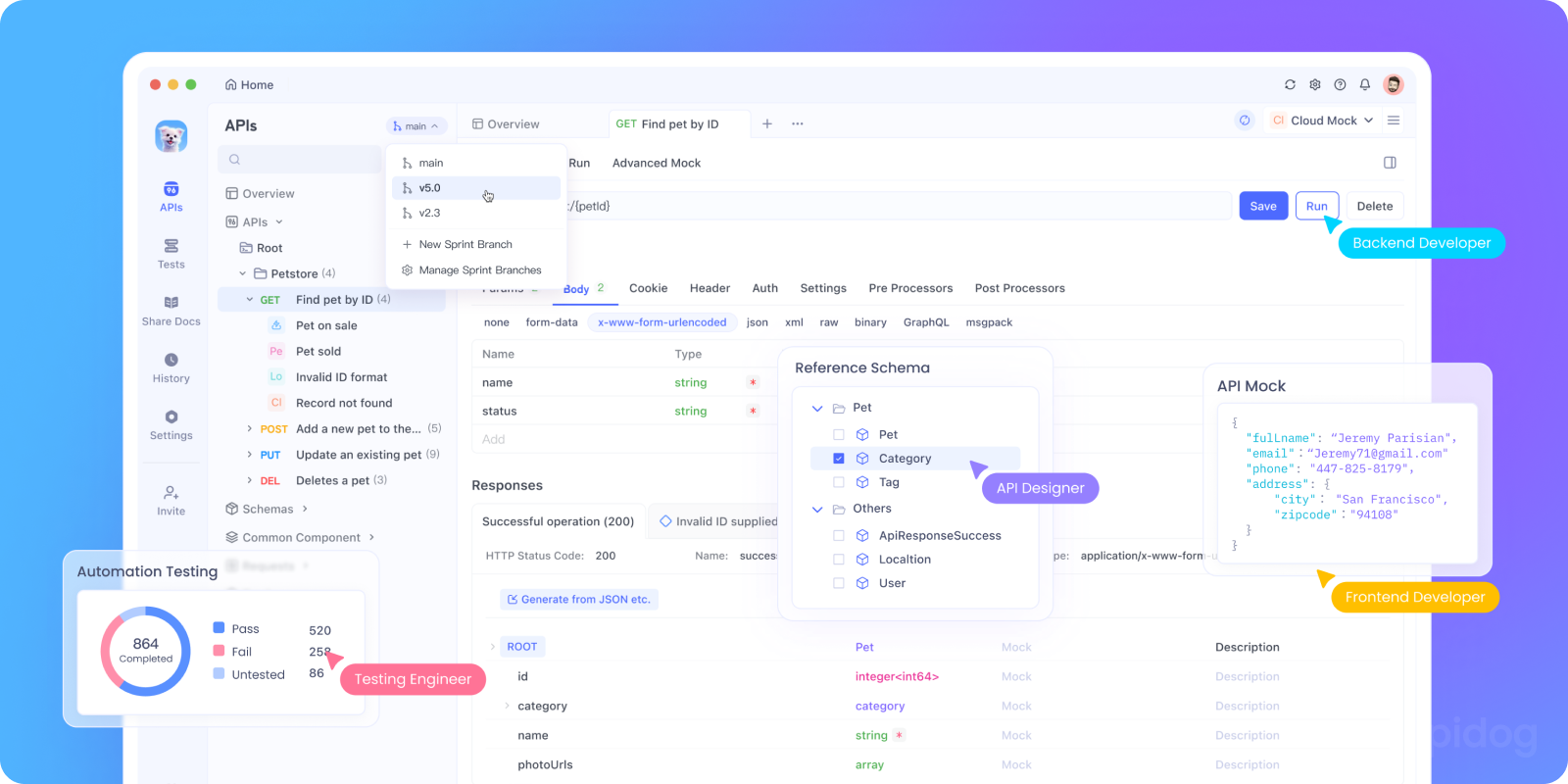
Philosophy: "Design your API contract first, then use it as the single source of truth for mocking, testing, and documentation."
How it works:
- Design: You visually design your API endpoints in Apidog, defining paths, methods, request/response bodies (using JSON Schema), and status codes. This design is your contract.
- Mock: With one click, Apidog generates a live mock server from your design. Frontend developers get a real URL to work against immediately.
- Test: You write integration and contract tests against your real backend using the same Apidog interface, validating that the implementation matches the design.
- Collaborate: The entire process happens in a shared workspace where both frontend and backend teams can comment and review the contract.
Strengths:
- Seamless integration between design, mock, and test phases.
- Excellent for collaboration with a user-friendly GUI.
- Reduces context switching everything is in one place.
- Strong support for OpenAPI (import/export).
Best for: Teams wanting an integrated, visual, and collaborative approach to the entire API lifecycle.
2. Pact: The Contract Testing Specialist
Philosophy: "Let the consumer team define their exact expectations in code, and verify the provider meets them."
How it works (The Pact Flow):
- Consumer Test (Frontend): The frontend team writes a unit test using the Pact framework that defines the HTTP request they will make and the response they expect.
- Pact File Generation: Running this test generates a "pact file" (a JSON document). This file is the contract.
- Share the Pact: The pact file is published to a Pact Broker (a shared server).
- Provider Verification (Backend): The backend team runs a Pact verification task against their real API, using the pact file from the Broker. Pact replays the requests and checks if the responses match the expectations.
- Results: If verification passes, the contract is satisfied. If it fails, the teams know immediately what broke.
Strengths:
- True consumer-driven contracts. The consumer's needs are formally specified.
- Language-agnostic. Pact supports dozens of languages (JavaScript, Python, Java, Go, etc.).
- Excellent for microservices where many teams need to ensure compatibility.
- Deep integration with CI/CD pipelines.
Best for: Organizations with multiple independent teams building microservices who need robust, automated contract verification.
3. WireMock: The Mocking Powerhouse
Philosophy: "Give me complete control to simulate any HTTP service behavior, no matter how complex."
How it works:
WireMock is a Java library (also runnable as a standalone server) that lets you stub out web services with incredible precision. You configure it via a fluent Java API, JSON files, or a REST API itself.
// Example: Stubbing an endpoint with WireMock Java
stubFor(get(urlEqualTo("/api/user/123"))
    .willReturn(aResponse()
        .withStatus(200)
        .withHeader("Content-Type", "application/json")
        .withBody("{\\"id\\": 123, \\"name\\": \\"John Doe\\"}")));
You can simulate delays, random failures, stateful behavior, and even record and playback requests from a real service.
Strengths:
- Extremely powerful and flexible. Can mock virtually any scenario.
- Great for testing edge cases like timeouts, network errors, and malformed responses.
- Can be used for both mocking and contract testing (by recording interactions and then verifying them).
- Standalone or embedded (run it as a server or within your JUnit tests).
Best for: Developers who need fine-grained control over their mock server behavior, especially in JVM-based ecosystems or for complex testing scenarios.
4. Postman: The API Collaboration Giant
Philosophy: "Be the central hub where teams work with APIs through collections, environments, and workspaces."
How it works:
While known as an API client, Postman has expanded into mocking and testing.
- You define requests and save them in a Collection.
- You add examples of responses to those requests.
- You can create a mock server from that collection, which will return your example responses.
- You write tests in JavaScript within Postman and can run them as collections or via the CLI (Newman).
Strengths:
- Ubiquitous and familiar. Most developers have used it.
- Strong collaboration features through team workspaces.
- Excellent for exploratory testing and documentation.
- Powerful scripting environment.
Considerations: Its mocking is example-based rather than schema-based, which can be less precise for contract validation. The contract (the collection) is often defined after the API exists, making it less "design-first."
Best for: Teams already deep in the Postman ecosystem looking to add basic mocking and collection-based testing.
Conclusion: Shift Left, Collaborate, and Automate
The goal of contract testing and mocking isn't just to use cool tools it's to shift left. To catch problems earlier, to enable teams to work independently yet harmoniously, and to build confidence that your system's components will fit together when it's time to integrate.
The right tool for you is the one that fits your team's culture, technical stack, and workflow. For many, an all-in-one platform like Apidog provides the perfect blend of power and simplicity to get started. For complex microservice architectures, a specialist like Pact might be essential.
The most important step is to start. Choose a tool, apply it to one critical API, and experience the reduction in integration headaches and the increase in development velocity. Your future self, especially the one not debugging a production outage caused by a subtle API change, will thank you.