Let's paint a picture. You're on a team building a modern application. The frontend developers are waiting for API endpoints to be finalized. The backend team is coding away but keeps changing parameters. QA engineers are writing tests against specs that are already outdated. Everyone is using different tools, sharing API definitions via email, Slack, or worst of all verbally. Chaos reigns.
This scenario is all too common. The problem isn't a lack of tools; it's a lack of collaborative tools designed for the entire API lifecycle. When your team's workflow revolves around APIs, you need more than just a personal API client. You need a shared workspace, a single source of truth, and a seamless collaborative workflow.
That's where specialized tools for team collaboration on API collections come in. They transform API development from a fragmented, error-prone process into a smooth, integrated, and efficient team sport.
Now, let's explore and compare the best tools that can turn your API development from a solo act into a symphony.
The Problem: The "API Collaboration Gap"
Before we look at solutions, let's define the problems these tools solve:
- Specification Drift: The documented API spec (in a Word doc or wiki) diverges from the actual implementation.
- Communication Overhead: Endless meetings and Slack threads to clarify what an endpoint should return.
- Wasted Time: Frontend developers blocked, waiting for backend endpoints to be ready.
- Testing Nightmares: QA writes tests against outdated specs, leading to false failures and confusion.
- Knowledge Silos: API knowledge lives in one developer's head or local Postman collection.
The right tool bridges this gap by making the API itself the collaborative centerpiece.
What Makes a Great Collaborative API Tool?
When evaluating tools, look for these key features:
- Shared Collections: A central, version-controlled repository for API requests, tests, and documentation.
- Role-Based Access Control (RBAC): Manage who can view, edit, or manage APIs.
- Real-Time Collaboration: Multiple team members working simultaneously, with comments and change tracking.
- Integrated Design & Documentation: The ability to design APIs and generate documentation from the same source.
- Mock Servers: Instantly create mock APIs from designs so frontend and backend teams can work in parallel.
- Testing & Automation: Built-in testing features that the whole team can use and contribute to.
Why Team Collaboration on API Collections Matters More Than Ever?
APIs are no longer something backend engineers quietly maintain in a corner. Today’s product ecosystem looks something like this:
- Mobile apps calling multiple microservices
- Backend and frontend teams shipping features in parallel
- QA needing stable test collections
- Security needing audit-friendly documentation
- Ops needing consistent environments
- Partner developers needing clear published APIs
Everything is connected. And when teams grow, especially across time zones, API collaboration becomes a necessity, not a luxury.
Collaboration problems usually fall into these categories:
Version control chaos: API collections stored locally get out of sync quickly.
Inconsistent environments: Dev, staging, production… each with different auth tokens.
Slow API documentation updates: People forget to update docs after editing endpoints.
Test cases drifting away from reality: A new backend payload breaks tests and nobody notices until CI fails.
Poor onboarding processes: New team members struggle to understand the API lifecycle.
Modern API collaboration platforms fix those problems using unified workspaces, team permissions, shared environments, role-based access control, and automated syncing.
Let’s look at what good tools have in common.
1. Apidog
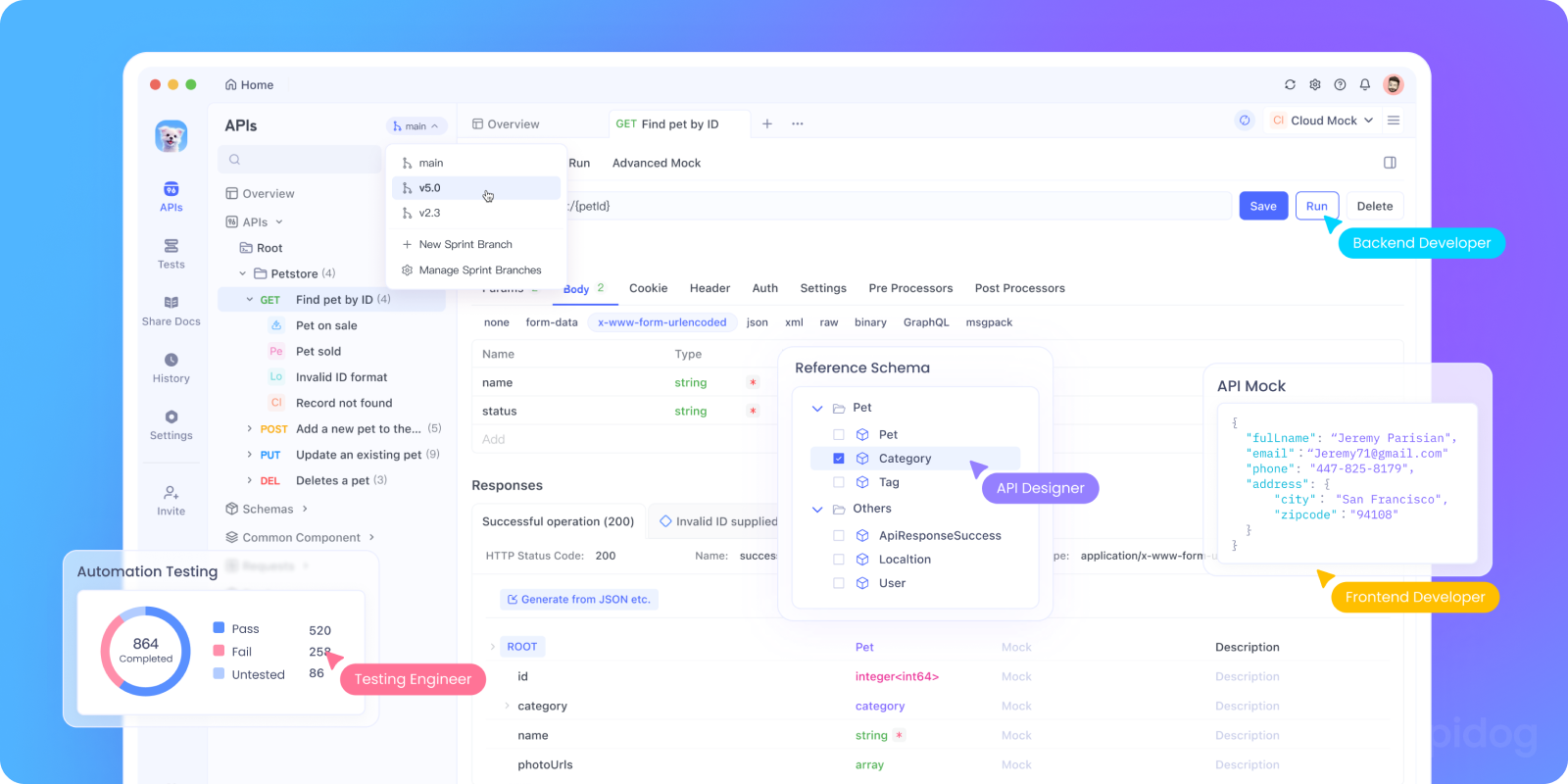
Apidog is built from the ground up for team collaboration. It combines the functionality of an API designer, client, tester, and mock server into a single, cloud-based workspace.
Team Collaboration Features:
- Shared Workspaces: Create dedicated spaces for projects where teams can collaborate.
- Real-Time Editing & Comments: Multiple team members can edit collections and leave inline comments on specific endpoints, fostering direct discussion.
- Granular Permissions: Control access at the workspace, project, or even API level (Viewer, Editor, Admin).
- Version History & Change Tracking: See who changed what and when. Easily revert to previous versions if needed.
- Single Source of Truth: The API design is the documentation is the test suite. No drift is possible.
- Instant Mock Servers: Generate a mock API in one click from your design, enabling parallel development.
Best For: Teams that want a unified platform to manage the entire API lifecycle collaboratively, from design to testing. It's particularly strong for eliminating friction between frontend, backend, and QA.
2. Postman
Postman is the most recognizable name in the API space. Its collaboration features are built as an extension of its powerful personal client.
Team Collaboration Features:
- Shared Workspaces & Collections: The core of Postman collaboration. Teams can share collections, environments, and APIs.
- Commenting & Activity Feed: Discuss APIs directly within the tool.
- Version Control Integration: Sync collections with Git repositories (GitHub, GitLab, Bitbucket).
- Role-Based Access: Manage team member roles.
- Private API Network: A discoverable internal directory of your team's published APIs.
- Monitors & Documentation: Schedule collection runs and publish web-based documentation.
Strengths:
- mature integration ecosystem
- strong cloud syncing
- large community
- popular collection format
- great for automated testing
Weaknesses:
- expensive at scale
- slower sync for large teams
- many features locked behind paid tiers
Best For: Teams already deeply invested in the Postman ecosystem who need robust sharing of collections and environments. It's excellent for teams where the primary need is collaborating on testing and consumption of existing APIs.
3. Stoplight

Philosophy: "Design-first, collaborative API development."
Stoplight focuses heavily on the design and specification phase, using the OpenAPI Specification as its foundation.
Team Collaboration Features:
- Visual API Designer: Collaborative editing of OpenAPI specs with a GUI, reducing YAML/JSON headaches.
- Style Guides & Linting: Enforce API design rules across the entire team automatically.
- Git Integration: Native, bi-directional sync with Git. Every change is a commit; every review is a pull request.
- Mocking & Testing: Generate mock servers and run tests from your designs.
- Centralized Governance: Strong features for large organizations to maintain consistency across many API teams.
Strengths:
- tree-style interface
- strong governance features
- collaborative API modeling
Weaknesses:
- limited advanced testing
- paid plans are expensive
Best For: Teams committed to a strict design-first methodology who want to collaborate deeply on the API contract before any code is written. Ideal for organizations with many API teams needing governance.
4. SwaggerHub
Philosophy: "Collaborative API design and documentation, powered by OpenAPI."
SwaggerHub is the collaborative, hosted version of the Swagger (OpenAPI) tools. It's centered on the OpenAPI spec as the contract.
Team Collaboration Features:
- Centralized OpenAPI Hosting: Teams can store, version, and collaborate on OpenAPI definitions.
- Collaborative Editing: Multiple users can edit specs simultaneously.
- Commenting & Discussions: Threaded discussions on API elements.
- Automated Sync: Sync API definitions with code repositories.
- Mocking & Documentation: Auto-generate interactive documentation and mock servers from the spec.
Strengths:
- perfect for API-first development
- strong versioning
- enterprise integrations
Weaknesses:
- heavy focus on design, less on testing
- limited mock and test automation features
Best For: Teams that are standardizing on the OpenAPI Specification and want a dedicated hub for managing those specs collaboratively. It bridges the Swagger tools into a team environment.
5. Insomnia

Philosophy: "The open-source API client that supports collaboration."
Insomnia is a popular, open-source API client that has added paid team features.
Team Collaboration Features:
- Sync & Share: Sync workspaces across team members.
- Team Dashboard: Manage team members and shared resources.
- Git Sync: Connect workspaces to Git repositories.
- Design Documents: A unique feature that lets you write rich, accompanying documentation alongside your requests.
Strengths:
- strong request editor
- good environment variables
- Git-based workflows
Weaknesses:
- weaker real-time collaboration
- limited team dashboards
Best For: Teams that prefer an open-source foundation and a streamlined, developer-friendly client. Its collaboration is more lightweight compared to Postman or Apidog but is effective for smaller teams.
Comparison Table: Finding Your Team's Fit
| Feature | Apidog | Postman | Stoplight | SwaggerHub | Insomnia |
|---|---|---|---|---|---|
| Core Strength | All-in-one lifecycle & collaboration | Team-based API testing & sharing | Design-first collaboration | OpenAPI-centric collaboration | Open-source client + sync |
| Best Workflow | Unified design → mock → test → doc | Sharing collections for testing/consumption | API design as code (in Git) | Managing OpenAPI definitions | Lightweight team sync for devs |
| Real-Time Collab | ✅ Strong | ✅ | ✅ | ✅ | Limited |
| Integrated Mocking | ✅ (Instant) | ✅ (Requires add-on) | ✅ | ✅ | ❌ |
| API Design Focus | Strong visual designer | Less emphasis | Primary focus | Primary focus (OpenAPI) | Basic |
| Pricing Model | Freemium | Freemium (Teams get expensive) | Paid | Paid | Freemium |
The Game-Changer: How Collaboration Tools Transform Workflows
Implementing the right tool isn't just about features; it's about transforming your team's process.
Before: A linear, blocking process.
- Backend designs API (in their head/wiki).
- Backend implements.
- Backend shares Postman collection with Frontend.
- Frontend builds UI, finds discrepancies.
- Slack arguments ensue. Process repeats.
After (with a tool like Apidog): A parallel, collaborative process.
1. Together: Backend & Frontend co-design the API in Apidog's visual editor. Agreement is reached on the contract.
2. Parallel Work:
- Backend: Implements the real API.
- Frontend: Codes against the instant mock server Apidog generated from the design.
- QA: Writes test suites in Apidog against the same design.
3. Continuous Integration: Apidog tests run against the backend implementation in CI/CD, ensuring it matches the contract.
4. Deployment: Interactive documentation is auto-published from the always-accurate design.
This shift reduces cycle time from weeks to days and eliminates whole classes of bugs and miscommunication.
How to Choose the Right Tool for Your Team
Ask yourself these questions:
- What's our biggest pain point? Is it unclear specs? Slow frontend/backend handoff? Scattered tests?
- What's our team's philosophy? Are we design-first (Stoplight, SwaggerHub) or code-first/iterative (Postman, Apidog)?
- How important is open source? If critical, Insomnia is a strong candidate.
- What's our budget? Postman Teams can become costly. Evaluate the value vs. cost of each platform.
- Do we need an all-in-one platform or a best-of-breed suite? Apidog offers integration. Postman/Stoplight might require stitching together more tools.
Recommendation: For most growing product teams looking to streamline collaboration across frontend, backend, and QA, Apidog presents a compelling, integrated solution that removes friction at every stage. Its focus on turning the API design into a living, collaborative document is a game-changer.
Conclusion: Collaboration as a Competitive Advantage
In today's fast-paced development world, how your team collaborates on APIs is no longer a minor detail it's a core competitive advantage. The right tool moves APIs from being technical artifacts to being collaborative contracts that align your entire team.
It reduces blockers, accelerates development, improves quality, and makes onboarding new team members dramatically easier.
Investing in a dedicated collaborative API platform is investing in your team's velocity, happiness, and output quality. Stop sharing collections over Slack. Stop having meetings about what an endpoint should return. Start building a single source of truth.
Ready to transform your team's API collaboration? Download Apidog for free today and see how a unified workspace can bring your developers, testers, and product managers together to build better APIs, faster. The era of collaborative API development is here.