Agentic AI architecture is at the heart of the next generation of artificial intelligence—AI that does more than just respond; it acts, plans, and adapts with minimal human intervention. As organizations strive for greater automation and intelligence, understanding agentic AI architecture is essential for building systems that can reason, execute complex tasks, and continuously improve.
In this comprehensive guide, you'll learn what agentic AI architecture is, why it matters, its core modules, design patterns, practical implementation strategies, and real-world examples—including how API-centric tools like Apidog empower agentic systems.
What Is Agentic AI Architecture?
Agentic AI architecture refers to the structural design that enables AI systems to act as autonomous agents. Unlike conventional AI, which produces single, reactive outputs, agentic AI can perceive its environment, reason about goals, plan actions, execute them, and learn from feedback—all in a continuous loop.
At its core, agentic AI architecture transforms passive large language models (LLMs) or other AI models into proactive, self-directed agents. These systems can:
- Break down complex goals into actionable steps
- Interact with external tools and APIs
- Maintain and recall context across tasks
- Adapt strategies based on real-world outcomes
This architecture is essential for deploying advanced digital workers, workflow automation, and adaptive enterprise solutions.
Why Agentic AI Architecture Matters
Agentic AI architecture is revolutionizing industries by driving a shift from static automation to dynamic, context-aware intelligence. Its benefits include:
- Autonomy: Agents make decisions and act without constant human oversight.
- Scalability: Systems orchestrate multiple agents to handle complex, multi-step processes.
- Adaptability: Agents learn from outcomes, improving performance and resilience.
- Integration: Agentic AI architectures enable seamless API interactions for enterprise workflows—where tools like Apidog shine.
As businesses demand more from AI—such as end-to-end process automation, autonomous customer support, or intelligent data orchestration—agentic AI architecture offers a blueprint for building these capabilities reliably and ethically.
Core Components of Agentic AI Architecture
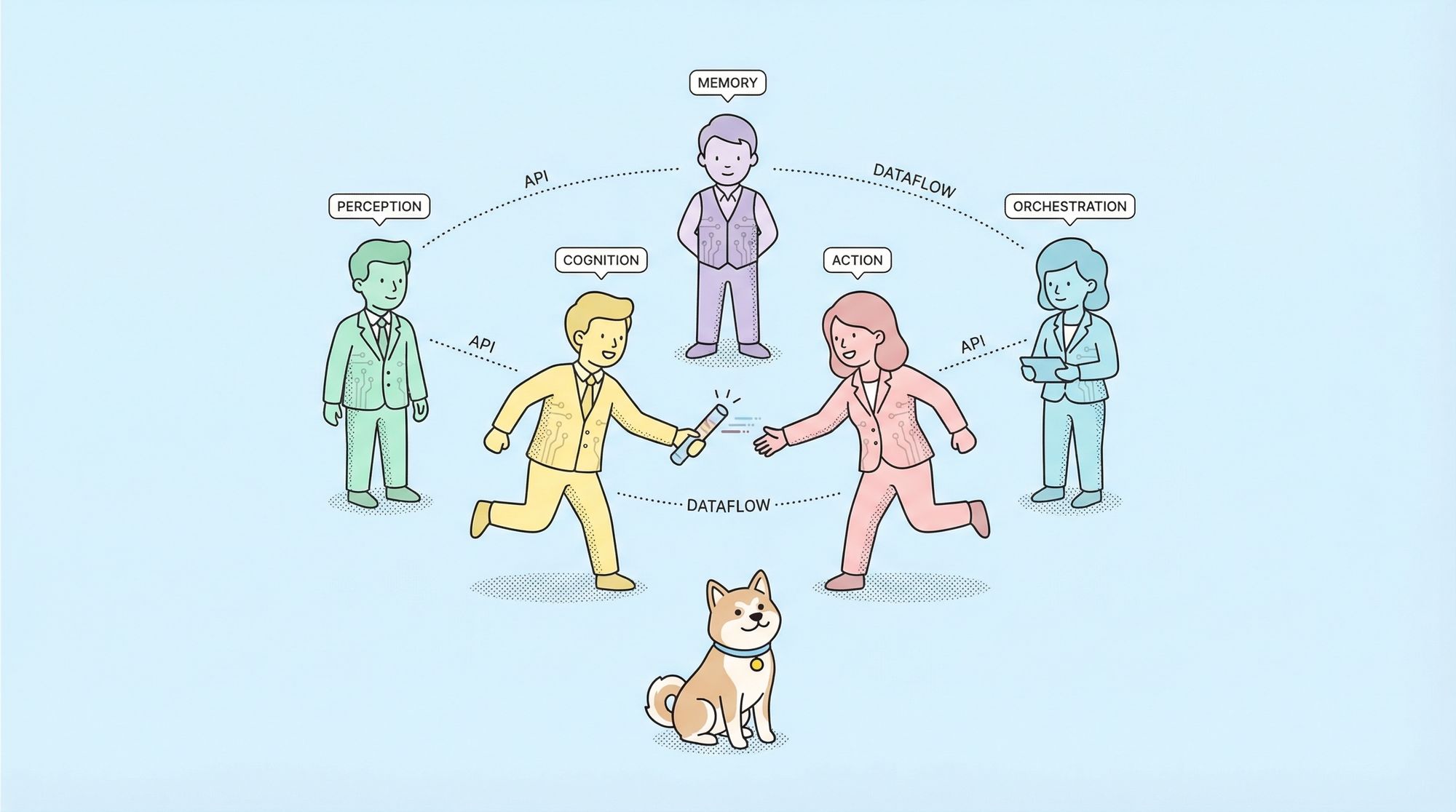
A robust agentic AI architecture is modular, with each component mirroring cognitive functions found in humans. Let's break down the essential modules:
1. Perception Module
The perception module is the agent’s interface to the external world. It gathers data from:
- APIs (structured data, business systems)
- Sensors (IoT, cameras, microphones)
- Databases (internal and external sources)
- User input (text, speech, etc.)
This module uses technologies like natural language processing (NLP), computer vision, and data integration pipelines to convert raw inputs into representations the agent can reason about.
2. Cognitive Module (Reasoning Engine)
This is the “brain” of the agent:
- Interprets inputs and goals
- Decomposes complex objectives into sub-tasks
- Selects strategies and plans actions
Large language models (LLMs) or reinforcement learning engines often serve as the cognitive core. This module is where the agent decides what to do next.
3. Memory Systems
Agentic AI relies on both:
- Short-term memory: Maintains context, dialogue history, and task state within an ongoing session.
- Long-term memory: Stores facts, previous experiences, and knowledge graphs for retrieval across sessions.
Memory allows agents to maintain continuity, learn, and avoid repeating mistakes.
4. Action and Execution Module
The agent executes its plans by:
- Calling APIs (fetching data, triggering business actions)
- Running code (scripts, workflows)
- Controlling devices (IoT, robotics)
This module translates high-level plans into concrete, real-world actions.
5. Orchestration Layer
The orchestration layer coordinates communication among all modules, especially in multi-agent or enterprise settings. It manages:
- Task delegation (assigning sub-tasks to agents)
- Workflow logic (parallelization, prompt chaining, error handling)
- Collaboration between agents and human supervisors
Orchestration ensures smooth, reliable agent operation.
6. Feedback Loop (Learning Mechanism)
A continuous feedback loop is vital for agentic AI architecture:
- The agent evaluates the outcomes of actions
- Updates internal models or strategies based on results
- Learns from success and failure
This loop enables agents to improve over time, adapt to new environments, and handle unpredictability.
Agentic AI Architecture Design Patterns
Agentic AI architecture leverages design patterns to solve recurring challenges. Leading enterprises use these patterns:
Prompt Chaining
Agents decompose goals into sequential prompts, each informing the next step. This allows for multi-step reasoning and complex workflows.
Routing and Delegation
Tasks are dynamically assigned to specialized agents or modules based on context, skill set, or workload.
Parallelization
Multiple agents or components work in parallel to accelerate complex workflows, such as batch processing or simultaneous data retrieval.
Evaluator-Optimizer Loop
Agents assess the quality of their outputs and iteratively refine plans, using evaluation metrics or human-in-the-loop feedback.
Orchestrator-Worker Architecture
A central orchestrator manages distributed worker agents, handling coordination, monitoring, and error recovery.
Tip: Tools like Apidog help facilitate these patterns by providing robust API design, testing, and orchestration capabilities. This is essential when agents need to interact with diverse business systems through APIs.
Building Agentic AI Architectures: Step-by-Step
1. Define Agent Goals and Boundaries
Start by clarifying what your agentic AI should achieve and the constraints it must respect (e.g., compliance, ethics, security).
2. Select Core Technologies
- Choose your perception, reasoning, and memory modules.
- For API interactions, leverage platforms like Apidog to design, mock, and test the APIs your agents will call.
3. Modularize the Architecture
- Organize the system around clear module boundaries (perception, cognition, memory, action, orchestration).
- Use well-defined interfaces, ideally via RESTful APIs or event-driven protocols.
4. Implement Feedback and Monitoring
- Include mechanisms for error detection, performance monitoring, and continuous learning.
- Prioritize explainability and transparency, especially for enterprise deployment.
5. Test and Iterate
- Use mock data and simulated environments (such as Apidog’s mocking tools) to test agent behaviors safely.
- Iterate based on real-world feedback and usage analytics.
Practical Examples of Agentic AI Architecture in Action
Autonomous Customer Support Agent
A telecom company deploys an agentic AI architecture for 24/7 customer support:
- Perception: Gathers customer queries via chat or voice.
- Cognitive Module: Uses an LLM to interpret intent and plan next steps.
- Memory: Maintains customer history for personalized responses.
- Action: Calls billing, support, and provisioning APIs (all designed and tested using Apidog) to resolve issues.
- Feedback: Learns from customer satisfaction scores, improving future responses.
Automated Financial Workflow
A bank implements agentic AI to automate loan approvals:
- Perception: Reads incoming applications via API.
- Cognition: Assesses eligibility using trained models.
- Action: Orchestrates document verification, credit checks, and approval steps by calling various APIs.
- Orchestration: Manages multiple agents handling parallel applications.
- Feedback: Adjusts decision thresholds based on approval rates and defaults.
Smart Manufacturing Agent
A manufacturing firm uses agentic AI architecture to optimize production lines:
- Perception: Collects data from IoT sensors on the factory floor.
- Cognition: Analyzes bottlenecks and predicts maintenance needs.
- Action: Controls machines or dispatches maintenance tasks via industrial APIs.
- Orchestration: Coordinates multiple agents responsible for different factory areas.
- Feedback: Refines scheduling algorithms based on real-time outcomes.
Best Practices for Enterprise-Grade Agentic AI Architecture
- Prioritize Explainability: Ensure agents’ decisions are transparent and auditable.
- Governance and Compliance: Implement strict controls (especially in regulated industries) to prevent unintended actions.
- Continuous Monitoring: Track agent actions, errors, and drift—automate alerts and remediation.
- Security First: Secure all API endpoints and agent interactions; tools like Apidog help standardize API security.
- Human-in-the-Loop: For high-stakes decisions, include checkpoints where human approval is required.
- Scalability: Design agentic architectures to handle increasing workloads by leveraging modular APIs and orchestration layers.
Conclusion: The Future of Intelligent Automation Lies in Agentic AI Architecture
Agentic AI architecture is the foundation for truly autonomous, adaptable, and scalable AI systems. By structuring AI as proactive agents—capable of perception, reasoning, memory, action, orchestration, and learning—organizations unlock new levels of automation, efficiency, and innovation.
As you embark on your agentic AI journey, remember:
- Modular, API-centric design is key—tools like Apidog are invaluable for managing your agentic ecosystem.
- Prioritize transparency, governance, and continuous improvement.
- Start with well-scoped pilots, iterate, and expand as agentic AI architecture demonstrates value.