API orchestration tools have become essential in today’s digital landscape, where seamless integration and automation across multiple APIs is the backbone of high-performing applications and businesses. This guide dives deep into API orchestration tools—what they are, how they work, real-world examples, and how to choose and leverage the best tools (including Apidog) to streamline your workflows.
What are API Orchestration Tools?
API orchestration tools are specialized platforms or software designed to coordinate, sequence, and manage multiple API calls into unified, efficient workflows. Instead of developers writing complex code to interact with each API individually, API orchestration tools provide a central layer or interface to automate and optimize this process.
Imagine needing to process an online order: checking inventory, reserving stock, processing payment, and notifying shipping—all involving different APIs. API orchestration tools allow you to design and manage this multi-step workflow with reliability, visibility, and control.
Why Do API Orchestration Tools Matter?
- Efficiency: Automate repetitive, multi-API processes and reduce manual coding.
- Consistency: Ensure workflows execute in the correct order with standardized error handling.
- Scalability: Easily add, modify, or remove steps in a workflow as business needs change.
- Maintainability: Centralized management of API logic, making updates and debugging easier.
- Resilience: Built-in retry, validation, and error management across API dependencies.
In a world powered by APIs, orchestration tools are the “directors” behind the scenes, ensuring every service works in harmony for a seamless experience.
How API Orchestration Tools Work
Core Functions of API Orchestration Tools
API orchestration tools typically offer the following capabilities:
- Workflow Design: Visual or code-based interfaces to define the sequence and logic of API calls.
- Data Transformation: Mapping and converting data formats between different APIs.
- Parallel and Sequential Execution: Execute API calls concurrently (where possible) or in strict order (where required).
- Error Handling and Retries: Built-in mechanisms to catch failures and retry or reroute as needed.
- Monitoring & Logging: Track workflow execution, performance, and issues centrally.
The Orchestration Layer Explained
The heart of API orchestration tools is the orchestration layer. This sits between clients (such as web apps, mobile apps, or other backend systems) and the underlying APIs. The orchestration layer receives a single request from the client and coordinates all the necessary API calls, collects and transforms the results, and returns a unified response.
Example Diagram:
Client
  |
  v
[Orchestration Layer]
  |        |        |
 API A   API B   API C
This approach abstracts complexity, improves maintainability, and supports rapid development and integration.
Types of API Orchestration Tools
API orchestration tools come in various forms, each tailored to specific needs:
1. Visual Workflow Orchestration Tools
These provide drag-and-drop interfaces for designing API workflows without extensive coding. Examples include:
- n8n
- Zapier
- Microsoft Power Automate
2. Code-Driven Orchestration Tools
For developers needing more flexibility, these tools allow orchestration logic to be written in code:
- Node-RED
- Apache Airflow (with API operators)
- AWS Step Functions
3. API-First Orchestration Platforms
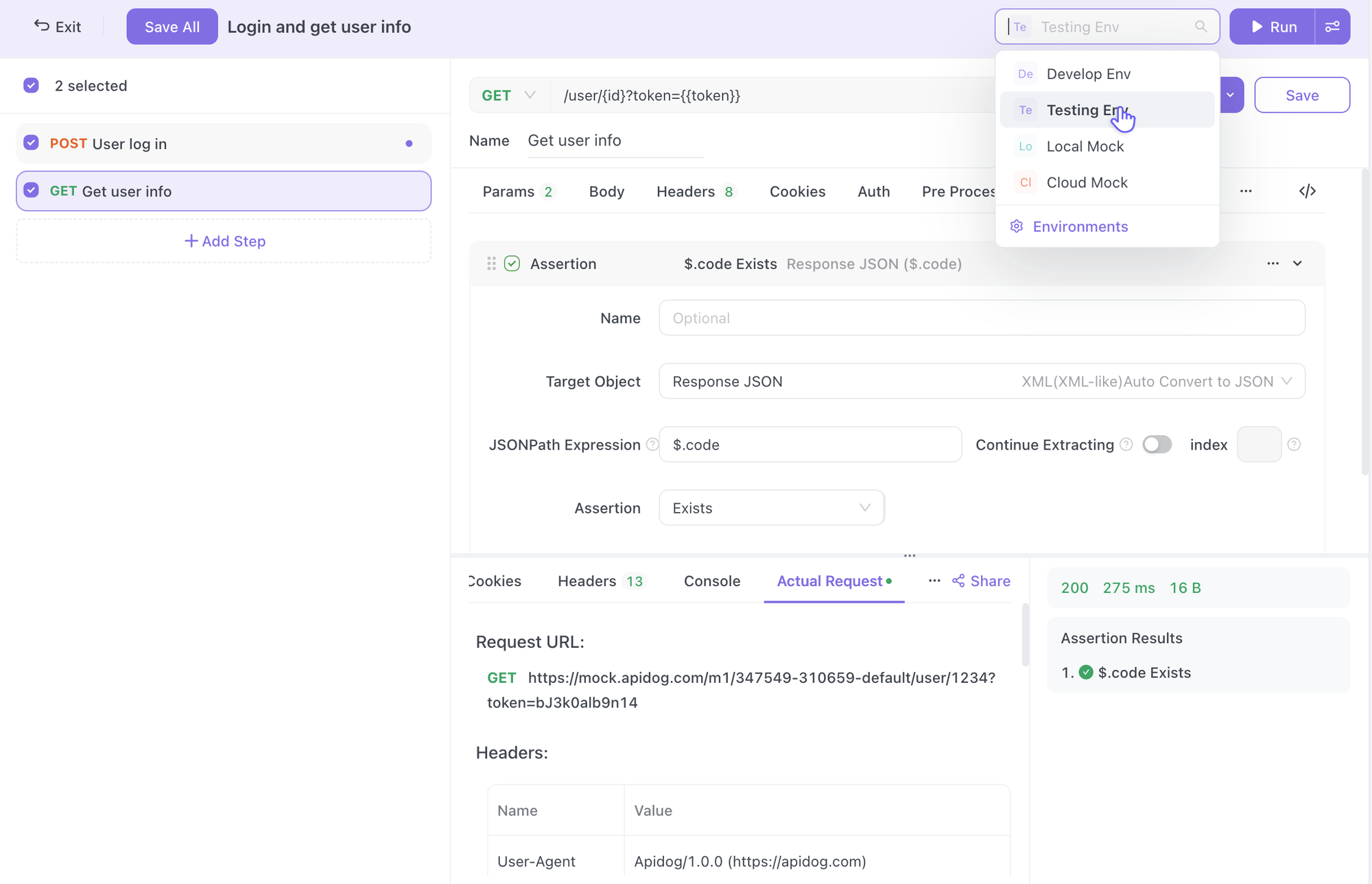
Platforms like Apidog focus on API workflow design, documentation, and testing, supporting both visual and code-driven orchestration as part of the broader API lifecycle.
Key Features to Look for in API Orchestration Tools
When evaluating API orchestration tools, consider the following features:
Workflow Management
- Visual Designer: Intuitive drag-and-drop or flowchart-based workflow modeling.
- Conditional Logic: Support for if/else branching, loops, and variables.
- Parallel Execution: Ability to run multiple steps concurrently where possible.
Data Handling
- Data Mapping: Easy transformation between different data schemas.
- Aggregation: Combine responses from multiple APIs into a single output.
Robustness
- Error Handling: Configurable retry, fallback, and error notification logic.
- Execution Logs: Detailed tracking for debugging and auditing.
Integration Capabilities
- API Import/Export: Support for Swagger, OpenAPI, Postman, and other formats (as in Apidog).
- Authentication Management: Secure handling of API keys, OAuth tokens, etc.
- Mocking: Simulate API responses for testing (a strength of Apidog).
Collaboration & Documentation
- Version Control: Track changes to workflows and APIs.
- Online Documentation: Generate and share live API docs, keeping teams in sync.
- Team Collaboration: Assign roles, share projects, and document decisions.
Real-World Applications of API Orchestration Tools
Let’s explore how API orchestration tools are used in practical scenarios:
E-commerce Order Processing
Scenario: When a customer places an order, the system must:
1. Check inventory (Inventory API)
2. Reserve items (Warehouse API)
3. Process payment (Payment Gateway API)
4. Create a shipping label (Shipping API)
5. Send confirmation email (Email API)
With API orchestration tools: The entire workflow is designed as a single process. If payment fails, the orchestration tool can release reserved inventory and notify the customer—handling all logic automatically.
Customer Onboarding in SaaS
Scenario: A new user signs up for a SaaS platform, requiring:
1. Creating a database record (User API)
2. Assigning a plan (Billing API)
3. Sending a welcome email (Email API)
4. Logging the event in CRM (CRM API)
API orchestration tools streamline this, ensuring all steps complete successfully or rolling back changes if any step fails.
Microservices Coordination
Modern applications often use microservices, each with its own API. Orchestration tools manage interactions between services, such as aggregating data for a dashboard or coordinating multi-step business processes.
Practical Example: Building an Orchestrated Workflow
Let’s see a hands-on example using a typical API orchestration tool workflow (pseudo-code):
Workflow: Order Fulfillment
Steps:
  - Name: Check Inventory
    API: inventory-service/check
    Method: GET
    Params: { product_id: {{order.product_id}} }
    OnFail: End with "Out of Stock"  - Name: Reserve Item
    API: warehouse-service/reserve
    Method: POST
    Params: { product_id: {{order.product_id}}, quantity: {{order.qty}} }
    OnFail: End with "Reservation Failed"  - Name: Process Payment
    API: payment-service/pay
    Method: POST
    Params: { user_id: {{order.user_id}}, amount: {{order.amount}} }
    OnFail: Call warehouse-service/release, End with "Payment Failed"  - Name: Send Confirmation
    API: email-service/send
    Method: POST
    Params: { email: {{order.email}}, template: "order-confirmation" }
    OnSuccess: End with "Order Complete"
With API orchestration tools, this workflow can be defined visually or via configuration, with built-in error handling, logging, and monitoring.
How Apidog Supports API Orchestration
Apidog is a spec-driven API development platform that stands out in the orchestration space by offering:
- API Design and Mocking: Quickly create and test APIs, simulate responses to speed up orchestration design.
- Import/Export Capabilities: Bring in existing APIs from Swagger, Postman, and more—streamlining the orchestration process.
- Visual Request Builder: Easily manage and chain API requests to model complex workflows.
- Online Documentation: Generate up-to-date, interactive API documentation for orchestrated workflows.
- Collaboration Tools: Keep teams aligned when building orchestrated API solutions.
By using Apidog as your API orchestration tool, you accelerate development, improve reliability, and ensure your API workflows remain well-documented and maintainable.
How to Choose the Right API Orchestration Tool
Selecting the best API orchestration tool depends on your requirements:
- Complexity: Do you need simple sequential workflows or advanced, multi-branch orchestration?
- Collaboration: How important are shared documentation and team features?
- Integration: Does the tool support your tech stack and authentication needs?
- Testing & Debugging: Are mocking and visual debugging important for your team?
- Scalability: Can the tool handle growing API ecosystems and more complex workflows?
For teams focused on seamless API development, testing, and orchestration, platforms like Apidog offer an all-in-one solution that grows with your needs.
Best Practices for Implementing API Orchestration Tools
1. Start with Clear Workflow Definitions: Map out processes before implementing in a tool.
2. Leverage Mocking and Testing: Use features like Apidog’s mock server to validate workflows before production.
3. Monitor & Optimize: Use orchestration tool logs to identify bottlenecks and failures.
4. Document Everything: Automatically generated docs help teams stay aligned as workflows evolve.
5. Automate Error Handling: Define fallback and retry logic at every step for maximum reliability.
Conclusion: Orchestrate Success with the Right Tools
API orchestration tools are the linchpin of modern, interconnected systems. By centralizing, automating, and optimizing multi-API workflows, these tools enable businesses to move faster, reduce errors, and deliver seamless experiences.
Whether you’re integrating microservices, automating business processes, or streamlining customer journeys, the right API orchestration tool—like Apidog—can make all the difference. Start by assessing your needs, mapping your workflows, and experimenting with leading platforms to unlock the full potential of your API ecosystem.