
Let’s cut to the chase: you’re probably here because you’re tired of waiting.
Maybe your backend team hasn’t finished the /api/users endpoint yet.
Maybe the payment gateway you depend on costs $50 per sandbox call.
Or maybe your frontend keeps breaking because someone changed the API response format again.
Whatever the reason, you need realistic, reliable REST endpoint mocks and you need them yesterday.
But here’s the problem: the internet is full of tools claiming to “mock APIs in seconds.” Some are CLI monsters that require Docker, Node.js, and a prayer. Others look slick but can’t simulate a 401 error without 20 clicks. And a few? They just return { "message": "hello world" } and call it a day.
So… what should you actually use to mock REST endpoints in 2025?
Good news: you’re not alone. And even better?
But Apidog isn’t the only option. So in this guide, we’ll walk through the best tools to mock REST endpoints, compare their strengths and weaknesses, and help you pick the right one for your role, team size, and project phase.
No jargon. No hype. Just practical advice from real-world experience.
Now, let's dive into the world of API mocking and find the perfect tool for your needs.
Why Mock REST Endpoints? The Superpowers You Gain
Before we look at tools, let's understand why mocking is such a game-changer.
- Parallel Development (The #1 Benefit): Frontend and backend teams can work simultaneously. Frontend developers can build and test UI components with realistic data immediately, without blocking on backend completion.
- Isolated Testing: Test your service or component in complete isolation. You can simulate specific scenarios like a
500 Internal Server Errorfrom a downstream service or a slow response without having to orchestrate failures in real systems. - Rapid Prototyping: Design your API contract first (a best practice!), create mocks, and get stakeholder feedback on real, interactive endpoints before writing a single line of backend logic.
- Cost and Resource Savings: Don't spin up expensive cloud resources or complex test environments for early development. Mocks are lightweight and free.
- Improved Reliability: Your tests won't fail because someone else's service is down. Mocks provide deterministic, consistent responses.
What Makes a Great REST Mocking Tool?
Not all mock tools are created equal. Here’s what to look for:
- Fast setup: Can you go from zero to working mock in under 2 minutes?
- Realistic responses: Does it generate smart fake data (names, emails, dates) or just static JSON?
- Support for multiple status codes: Can you easily return
401,429, or500? - Delay & network simulation: Crucial for testing UX under real-world conditions.
- OpenAPI/Swagger compatibility: If you already have a spec, why re-define everything?
- Team collaboration: Can you share mocks with colleagues without emailing config files?
- Offline capability: Does it work without internet or cloud accounts?
Keep these in mind as we review the top contenders.
Apidog: The Smart Mock Tool for Modern Teams
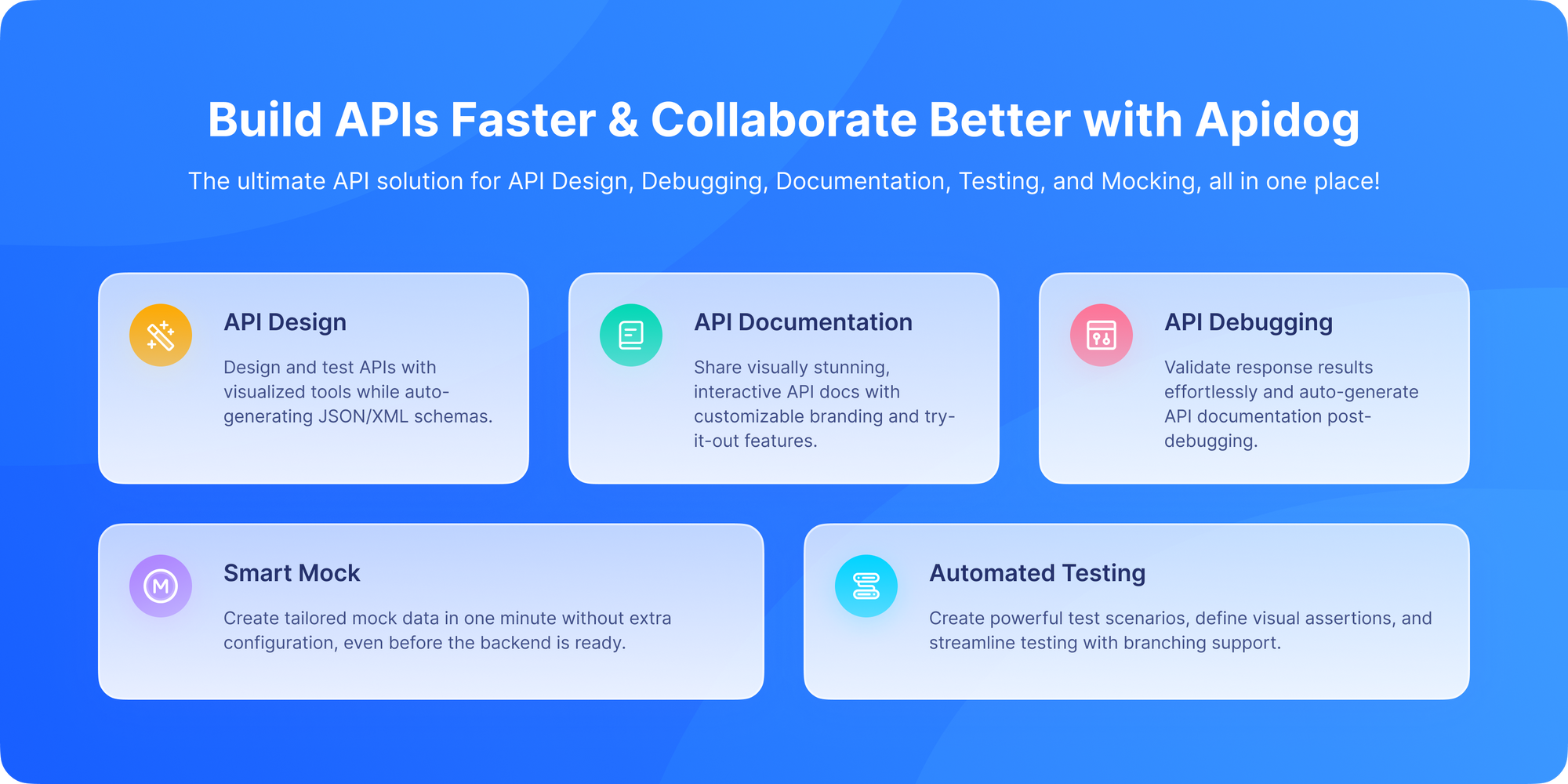
Apidog is an all-in-one API development platform built to help teams design, mock, test, debug and document APIs, and ship APIs with confidence. One of its most powerful features—and the one that consistently transforms development speed—is API mocking.
With Apidog, you can generate realistic mock APIs the moment you finish designing your schema or OpenAPI spec. No backend code, no waiting for a server, and no bottlenecks between teams. Front-end developers, mobile engineers, QA teams, and partners can start integrating immediately using stable, auto-generated mock endpoints that behave exactly like the real API will.
How Apidog Mocks REST Endpoints (Without the Headache)
1. Import or design your API:
- Paste an OpenAPI/Swagger URL
- Upload a YAML/JSON file
- Or build endpoints visually in the UI
2. Enable mocking with one click: Each endpoint gets a "Mock" tab. Toggle it on → Apidog auto-generates a mock URL.
3. Customize behavior instantly:
- Change response status (200 → 404)
- Add delays (e.g., 2000ms for “slow network”)
- Override JSON with custom logic or examples
- Use dynamic data:
{{name}},{{email}},{{uuid}}
4. Share with your team: Frontend devs, QA, and product folks all use the same mock URL no setup needed on their end.
Why This Feels Different
Most tools force you to choose between simplicity and power. Apidog gives you both:
- For solo devs: It’s faster than writing a Node.js server.
- For teams: It eliminates “works on my machine” hell.
- For API designers: Mocks stay in sync with your spec no drift.
Real example: Need to test a password reset flow?
- Mock
POST /auth/forgot-password→ return202 - Mock
POST /auth/resetwith invalid token → return400 - Mock same endpoint with expired token → return
410All in one project. All shareable. All versioned.
And yes, it’s free to start. No credit card. No watermarks.
Ready to try? Download Apidog for free and mock your first REST endpoint before your coffee gets cold.
Mockoon: The Lightweight Local Mock Tool
If you want nothing but a mock server, Mockoon is a beloved open-source desktop app.
How It Works
- Install the app (Windows/macOS/Linux)
- Define routes:
GET /products,POST /orders, etc. - Set status codes, headers, and response bodies
- Click “Start Server” → mocks run on
localhost
Strengths
✅ Zero dependencies: No Node.js, Python, or Docker needed
✅ Offline-first: Everything stays on your machine
✅ Simple UI: Great for quick prototyping
Weaknesses
❌ No OpenAPI import: You manually recreate every endpoint
❌ No team sharing: Colleagues must install Mockoon and import your config
❌ Limited dynamic data: You write static JSON or use basic templating ({{hostname}})
Best For:
- Solo developers
- Internal demos
- Learning REST concepts
But if you already have an OpenAPI spec (or work in a team), you’ll outgrow Mockoon fast.
Prism (by Stoplight)
If your REST API is defined in OpenAPI 3.0+, Prism is a CLI tool that turns your spec into a fully compliant mock server.
The Magic: Spec-Driven Mocking
Prism doesn’t just return hardcoded JSON. It:
- Reads your
schemas,examples, andresponses - Generates realistic mock data based on field types (
string,email,date-time) - Validates incoming requests against your spec
- Can simulate errors (
-errorsflag)
Quick Start
Boom mock server running on http://127.0.0.1:4010.
Pros & Cons
✅ Perfect OpenAPI fidelity
✅ Great for CI/CD (runs in Docker)
✅ Free and open-source
❌ No GUI – Terminal-only
❌ No collaboration – You host the server yourself
❌ Steeper learning curve for non-CLI folks
Ideal For:
- DevOps engineers
- QA teams writing contract tests
- Projects already using OpenAPI as source of truth
But if you hate the terminal or need to share mocks easily, Prism might frustrate you.
Postman
Yes, Postman can mock REST endpoints. But it’s… complicated.
How Postman Mocking Works
- Import your API into a Collection
- Go to “Mocks” → “Create a Mock Server”
- Postman gives you a URL like
https://xxxx.mock.pstmn.io
The Good
- Familiar interface if you already use Postman
- Basic mocking works out of the box
The Bad
- Static responses only: unless you manually add “Examples” for every endpoint/status
- No dynamic data generation (e.g., random names, dates)
- Collaboration requires paid plans: free tier limits mock servers
- Poor OpenAPI handling: often flattens or misinterprets complex schemas
Verdict:
Use Postman for mocking only if:
- You’re already deep in its ecosystem
- Your API is very simple
- You don’t mind manual response curation
For anything serious? There are better options.
WireMock
WireMock is the Swiss Army knife of mocking especially in Java ecosystems.
Strengths
- Extremely powerful: simulate timeouts, proxying, fault injection
- Stateful mocking: “After 3 failed logins, lock account”
- RESTful configuration: manage mocks via its own REST API
Weaknesses
- Requires Java (a dealbreaker for many)
- Steep learning curve
- Overkill for basic REST mocking
Use WireMock only if you need advanced behavior simulation not just standard CRUD endpoints.
Conclusion: Mocking is a Mindset, Not Just a Tool
Mocking REST endpoints isn't just a technical trick; it's a fundamental practice for modern, agile, and high-quality software development. It transforms API dependencies from blockers into enablers.
The best tool is the one that fits seamlessly into your workflow, empowers your team to collaborate, and grows with your project's complexity. For many teams, that's an integrated platform like Apidog that connects design, mocking, testing, and documentation. For others, it's a specialized library like MSW for bulletproof frontend tests.
Stop waiting. Start mocking. Download Apidog for free today and experience how a unified approach to API development can accelerate your projects, improve quality, and make parallel development not just possible, but effortless.