Let’s be honest: working with GraphQL can feel like riding a rocket ship. You get exactly the data you ask for, no over-fetching, no under-fetching, and real-time updates if you’re using subscriptions. But… how do you actually test it without losing your mind?
Maybe you just need to fire off a quick query to your dev endpoint. Or maybe you're part of a team building a complex API with dozens of types, mutations, and auth rules and you need more than just a playground.
This brings us to a classic dilemma: Should you use a lightweight GraphQL tester (like GraphiQL or Altair) or invest in a full API platform (like Postman, Insomnia, or Apidog)?
Good news: you don’t have to guess. And even better?
But before you decide, let’s break it all down because the right choice depends entirely on your role, your team size, and your project phase. Grab your favorite drink. We're diving deep.
Why Testing GraphQL Is Different (and Why Your Tool Matters)
Unlike REST, GraphQL isn’t about endpoints it’s about a single endpoint with infinite possible queries. That changes everything:
- You need schema awareness to autocomplete fields.
- You must handle variables, fragments, and directives.
- Mutations often require headers (like
Authorization: Bearer xyz). - Subscriptions need WebSocket support.
- And your queries evolve constantly so versioning and documentation matter.
A basic HTTP client won’t cut it. You need a tool that understands GraphQL. But do you need a whole platform?
Lightweight GraphQL Testers: The Specialized Specialists
These are tools built specifically for GraphQL. They're lean, fast, and laser-focused on helping you execute queries and mutations. Think of tools like GraphiQL, GraphQL Playground, or Altair. A lightweight GraphQL tester is a minimal, focused tool designed for one job: sending queries to a GraphQL endpoint and showing the response. Think of it as a “GraphQL playground.”
What they typically offer:
- A clean interface for writing and executing GraphQL queries
- Schema introspection and documentation explorer
- Query history and favorites
- Basic variable and header configuration
- Autocomplete and syntax highlighting
Why Developers Love Lightweight Testers
✅ Instant start: Paste your endpoint URL → go.
✅ Zero setup: No accounts, no projects, no onboarding.
✅ Offline-friendly: Many run locally or as browser extensions.
✅ Fast feedback loop: Ideal for debugging or quick validation.
They're like a high-performance sports car: incredibly good at what they're designed for, but not meant for hauling groceries or carrying multiple passengers. And that’s it. No project management. No team sharing. No test suites. Just query → response.
Full API Platforms: The Swiss Army Knives
These are comprehensive tools like Apidog, Postman, or Insomnia that support multiple API paradigms (REST, GraphQL, gRPC, SOAP) and offer extensive features beyond basic testing. A full API platform treats GraphQL not as an isolated experiment but as part of your entire API lifecycle design, mock, test, document, monitor, and collaborate.
What they typically offer:
- GraphQL testing alongside REST and other protocols
- Team collaboration and sharing
- Environment variables and data-driven testing
- Automated testing and CI/CD integration
- API design and mocking capabilities
- Documentation generation
- Performance testing
Why Teams Love Full Platforms
✅ Consistency: Everyone uses the same queries, variables, and auth.
✅ Repeatability: Save queries as test cases that run on every deploy.
✅ Visibility: New team members see documented, working examples not just code.
✅ Future-proofing: When your API grows, your tooling scales with it.
But big but they come with more complexity. More buttons. More concepts. More “where do I even start?”
They're like a fully-equipped workshop: you might not need every tool every day, but when you need them, they're right there. In short: They connect GraphQL to your real-world workflow.
When to Choose Which Tool?
Choose a Lightweight GraphQL Tester When:
- You're doing exploratory development and need quick feedback
- You're learning GraphQL and want minimal complexity
- You're working on a small, personal project
- You need to quickly debug a specific query
- Your team already has other tools for collaboration and automation
Choose a Full API Platform Like Apidog When:
- You're working on a team project that requires collaboration
- You need to test both GraphQL and REST APIs
- You want to automate your testing in CI/CD pipelines
- You're building complex workflows that require multiple requests
- You need to manage different environments (dev, staging, prod)
- You want comprehensive API documentation
- You're practicing API-first development
Apidog as a GraphQL Powerhouse (That Still Feels Light)
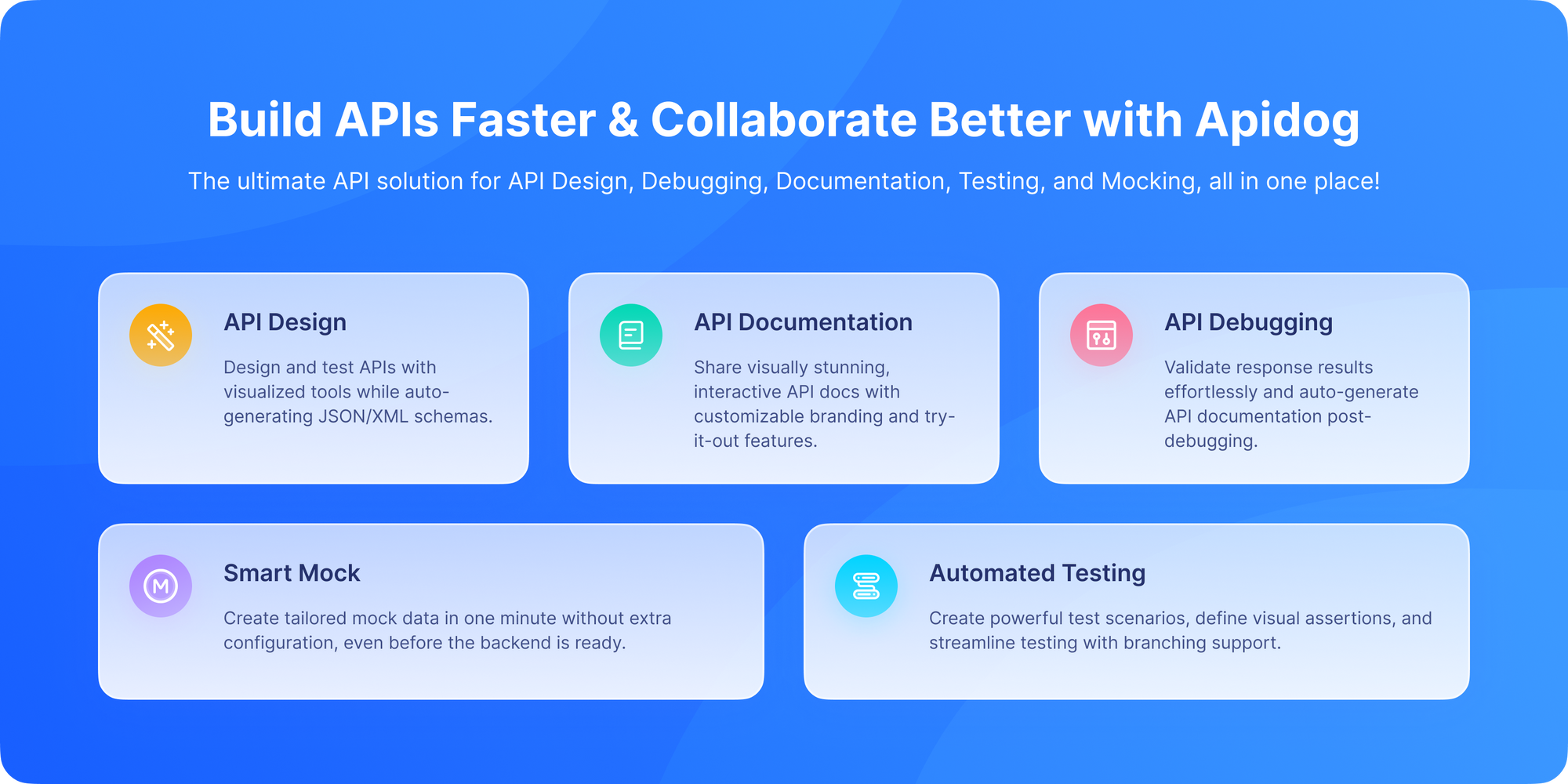
Here's the thing about Apidog: it looks like a full platform (because it is), but it also feels lightweight.
How Apidog Makes GraphQL Testing Effortless
- One-click schema introspection: Paste your GraphQL endpoint → Apidog fetches the schema → auto-enables autocomplete.
- Variables as first-class citizens: Define
userId: ID!in your query → Apidog gives you a JSON editor for variables below. - Headers managed per environment: Set
Authorization: Bearer {{auth_token}}once → reuse across all queries. - Test scripts with JavaScript: Validate response structure, status codes, even performance.
- Mock your GraphQL API: Yes, really. Apidog can generate a mock GraphQL server from your schema so frontend devs can work before your resolvers are done.
- Auto-generated docs: Every saved query becomes part of your living documentation.
Why Apidog Stands Out in the GraphQL Space
Many full platforms treat GraphQL as an afterthought—slapping a query editor on a REST-focused UI. Apidog was built for modern APIs from day one, including:
- Native GraphQL support (not a plugin).
- Schema diffing (see how your API changed between versions).
- Mock server that understands GraphQL types.
- Subscription testing (via WebSocket).
- Free for individuals and small teams.
Plus, unlike Postman (which requires a paid plan for team features), Apidog’s free tier includes collaboration, making it accessible from day one of team growth.
Try it yourself: Download Apidog for free. Import your GraphQL endpoint, run a query, and experience how a full platform can still feel fast, clean, and intuitive.
Conclusion: Right Tool for the Right Job
The choice between lightweight GraphQL testers and full API platforms isn't about which tool is "better" it's about which tool is better for your specific needs.
Lightweight testers are perfect for what they're designed for: quick, focused GraphQL query execution and exploration. They're the digital equivalent of a trusty pocket knife always handy for small tasks.
Full API platforms like Apidog are designed for the complex reality of modern API development. They understand that GraphQL APIs don't exist in isolation, they're part of larger ecosystems that include REST endpoints, authentication systems, multiple environments, and teams of developers.
As your project grows from a simple GraphQL endpoint to a comprehensive API strategy, you'll find yourself needing more than just query execution. You'll need collaboration, automation, documentation, and integration, the very features that full API platforms are built to provide.
Download Apidog for free today and discover how a comprehensive API platform can transform your GraphQL workflow from simple testing to full API lifecycle management.